There is perhaps no better display of modern architecture’s historical victory than Jacque Tati’s film Playtime. In it, a futuristic Paris has left-for-dead the grand boulevards of Haussmann, in favor of endless grids of International Style offices. The old city is reduced to longing reflections of Sacré-Cœur and the Eiffel Tower in the glass of these shiny new monoliths. But the irony central to the film is that this construction is created through mere surface treatments, and as the narrative unfolds, cheap mass-production withers in a world where the veneer has triumphed over craftsmanship and polish. In short, Modernism hasn’t always been all it's cracked up to be.
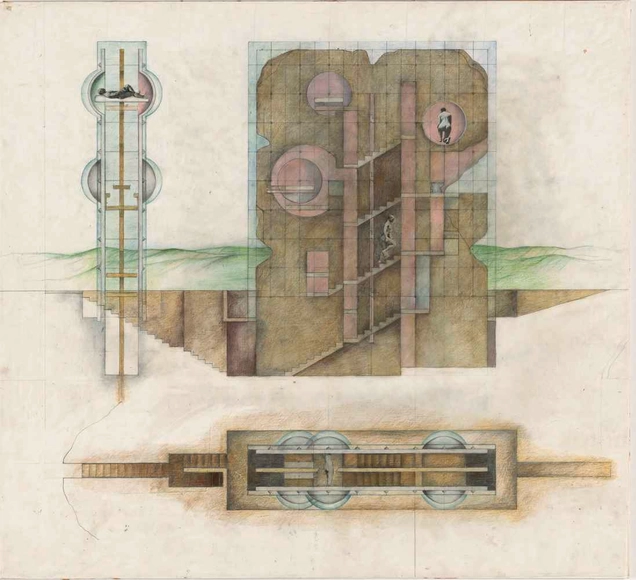
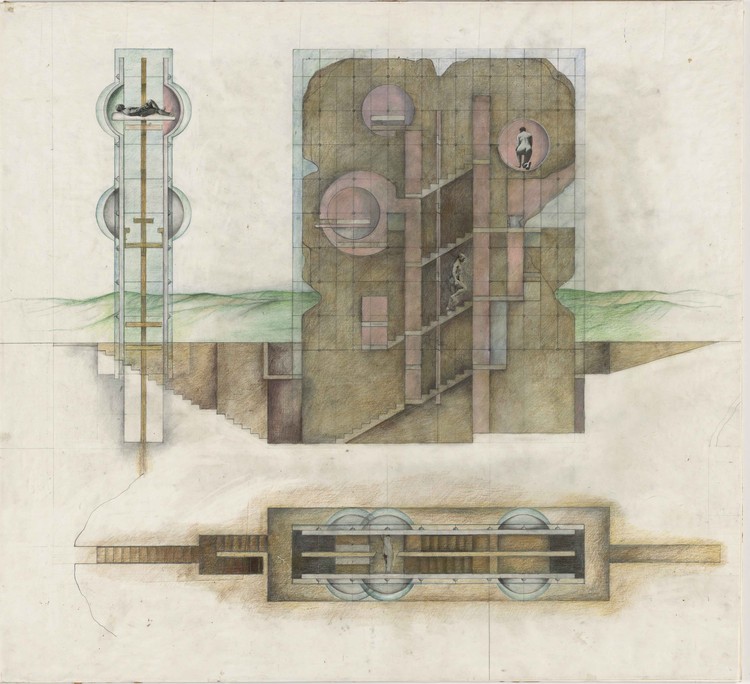
In the Museum of Modern Art’s new exhibition, "Endless House: Intersections of Art and Architecture," the simplicities of mass-market modern homes are abolished by artists and architects who, in examples from the 1940s to the present, have chosen to use the dwelling as a platform for universal messages and as an arena for architectural experimentation. In the same way that photography freed painting from the terrestrial concerns of realism, the simplicity of modernism liberated artists and architects to subvert extant conventions of buildings.
With a nuanced approach to site and purpose, the projects of Eduardo Cadaval & Clara Solà-Morales are geometric abstractions that are strong without being aggressive, and alluring without being indelicate. In a new documentary on their work, "Cadaval & Solà-Morales / Synthesis and Containment," the architects explain their history and process with commentary that is interspersed by tours of their most lauded projects, and validation of their work by peers. Juan Herreros, Founder and Director of Estudio Herreros, characterizes the architects as not heroic or epic, but as with ballerinas, practice makes the impossible look easy. Josep Luis Mateo, Founder & Director of Mateo Architectura, extols, “one can understand their work by itself, without having to recall their references.”
Focused on family housing, the highlight of contemporary Czech architecture, the exhibition presents 33 exceptional designs by 33 architectural studios offering an insight into contemporary Czech architecture and urbanism. Showing a wide range of approaches to individual housing needs including large and small houses; new projects and renovations; houses in the countryside, in dense urban centres and in suburbia; made of concrete, wood, bricks or steel; in modern, abstract, or traditional styles distinctive, subtle or introverted, the exhibition demonstrates the continuous increase in the quality of Czech architecture since the fall of Communism in 1989, capturing the developments in architecture within the context of significant political and social change.
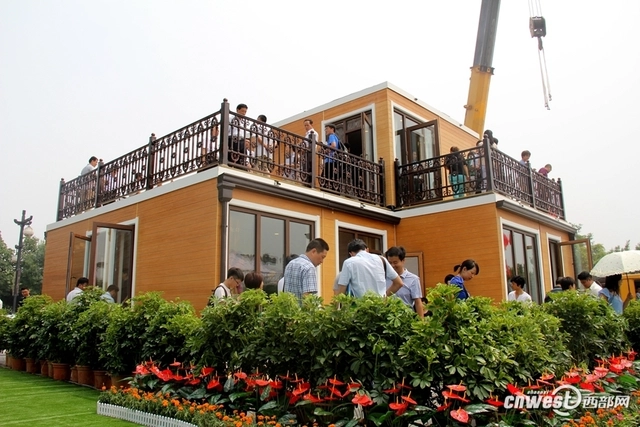
Chinese company ZhuoDa has assembled a two-story home in record speed; the modular house, comprised of six 3D printed modules, was assembled on-site in less than three hours. Likened to LEGO, the prefabricated home was 90 percent built off-site before its components were shipped to its permanent location. As Inhabitat reports, the home only took about 10 days to complete from start to finish.




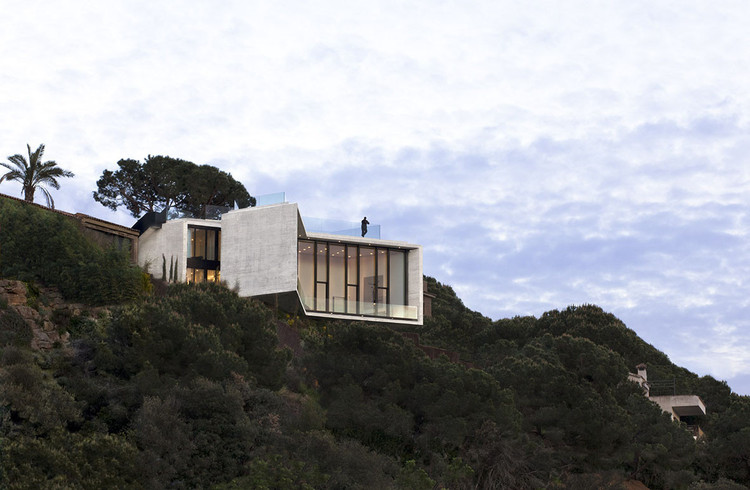
.jpg?1442198797 "Guinovart Florensa Residence. Image © Santiago Garcés")












.jpg?1435804316 "© Asaf pinchuk")