This article is the fifth in a series focusing on the Architecture of the Metaverse. ArchDaily has collaborated with John Marx, AIA, the founding design principal and Chief Artistic Officer of Form4 Architecture, to bring you monthly articles that seek to define the Metaverse, convey the potential of this new realm as well as understand its constraints.
Science fiction writers inspire us with bold and provocative visions of the future. Huxley, Orwell, Assimov, and Bradbury easily come to mind. They have imagined great advances in technology and oftentimes predicted shifts in social structure that were a result of the human need to open Pandora's Box. A large part of the charm and allure of science fiction is the bold audacity of some of these predictions. They seem to defy the laws of nature and science, and then, faster than you might have thought, the spectrum of human inventiveness makes it so.
Architecture as a profession is both deeply rooted in the past and driven by innovation. During the past few years, we have seen technology advancing at an unprecedented pace, developing tools and systems that change the way we understand the world. Digital spaces are becoming an accessible reality, as the metaverse is promising to enhance human interaction. Other digital tools such as robotic construction technologies, AI-generated images, and immersive virtual-reality equipment are likely to have a direct impact on the construction industry.
These topics are addressed by forward-looking architects, designers, and building industry professionals. Among others, contemporary artist Krista Kim talks about the economy of the metaverse, architect Alper Derinboğaz draws attention to the challenges facing the new generations of architects, and ICON founder Jason Ballard reveals the implications of technological innovations.
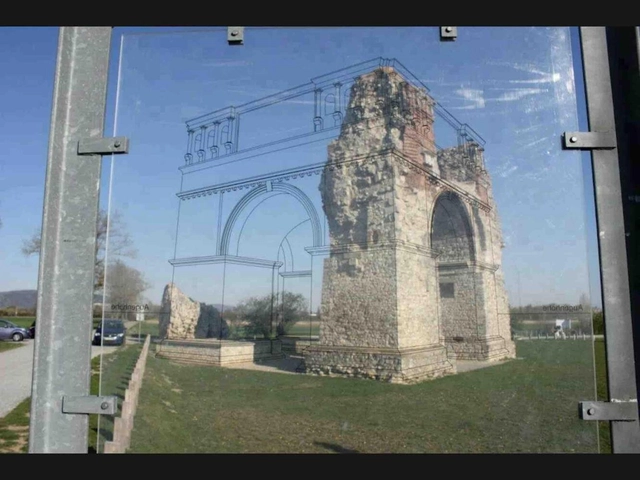
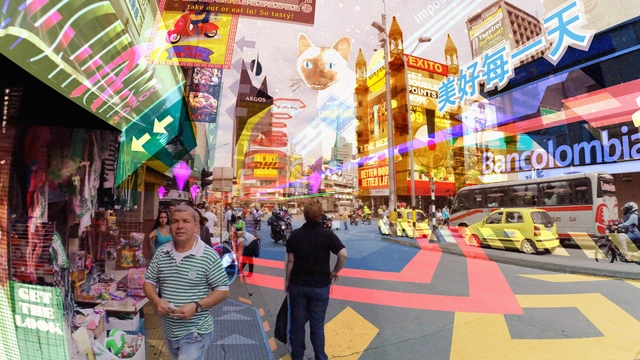
Lo-tech Augmented Reality. Image Courtesy of James Corbett
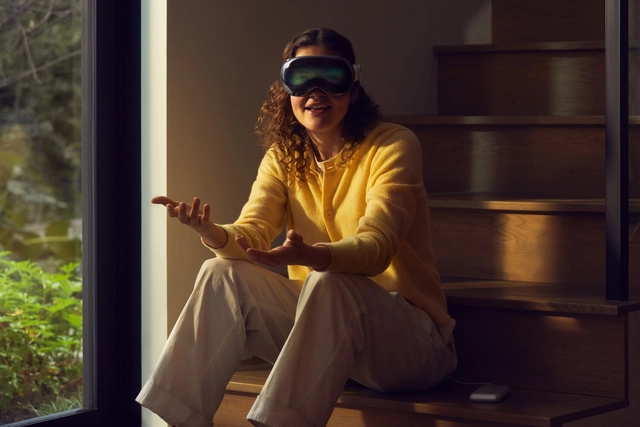
Augmented reality (AR) software has been a common feature in professional design toolkits for a while. But the recent release of Apple’s Vision Pro glasses shows the mixed-reality wearables sector is making serious inroads in consumer markets too, as one of the world’s biggest names in consumer design and technology enters the market.
A major reason for the immense hype surrounding Apple’s foray into AR/VR hardware, however, is the decision to position it as ‘spatial computing.’ By taking the complexity of augmented reality, and using it to heighten a familiar consumer sector – personal computing – the Cupertino-based brand has simplified the whole experience, widening its understanding and appeal.
On June 5, Apple launched Apple Vision Pro, a new type of spatial computer that uses augmented reality goggles to allow users to experience a blend between the digital and physical worlds. The device promises to offer its users an infinite canvas for apps, larger and more immersive than traditional displays, while allowing them to stay present and connected to others. It features visionOS, the first spatial operating system to create this new way of interacting with digital content. Previous concepts like the metaverse have promised to transform the way we experience digital worlds, with architects taking the opportunity to delve into the design of restriction-free virtual spaces. Could this new device bring new ways of experiencing three-dimensional spaces, to better integrate architecture with digital environments?
2022 has been the year of AI image generators. Over the past few years, these machine learning systems have been tweaked and refined, undergoing multiple iterations to find their present popularity with the everyday internet user. These image generators—DALL-E and Midjourney arguably the most prominent—generate imagery from a variety of text prompts, for instance allowing people to create conceptual renditions of architectures of the future, present, and past. But as we exist in a digital landscape filled with human biases—navigating these image generators requires careful reflection.
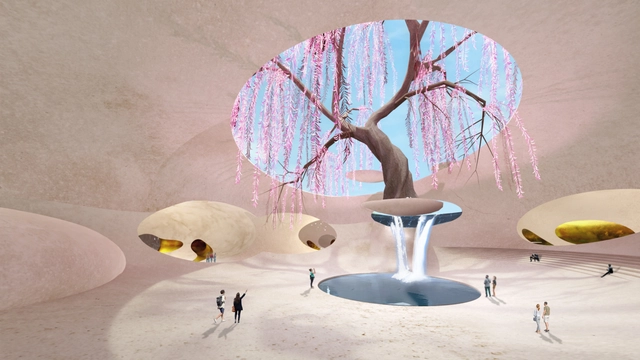
The new metaverse platform pax.world, set to launch in early 2023, has announced its collaboration with global architecture offices Grimshaw, HWKN, Farshid Moussavi, and WHY to create “Metaserai,” a vast social and cultural hub envisioned as the core of the new virtual community. The hubs are designed to host virtual cultural, social, and educational events such as concerts, theatre shows, digital art galleries, markets, lectures, parties, and festivals.
The pax.world platform aims to develop into a fully functioning society governed by a Decentralized Autonomous Organization, also known as a DAO. The virtual space will be divided into privately-owned plots of land punctuated by Metaserai communal hubs. These take inspiration from the Caravanserai of the ancient Silk Road, which became hubs for commerce and cultural exchange. Each of the architects is designing their own interpretation of Metaserai.
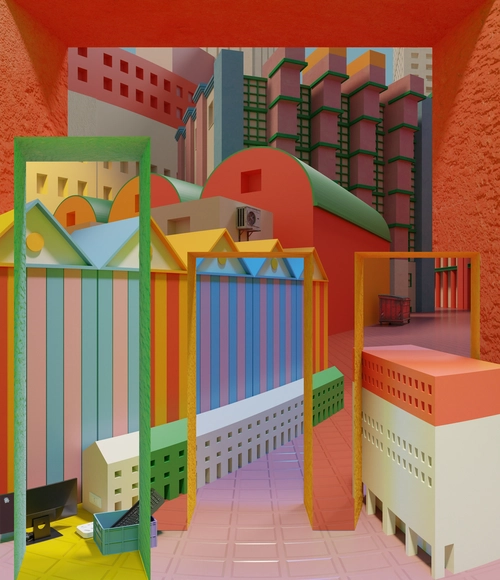
Through the “Search History” exhibition at MAXXI Museum in Rome, Lara Lesmes and Fredrik Hellberg, directors of the architecture and art studio Space Popular, set out to explore the work of Also Rossi and to translate his notions of “urban fact” and “analogous city” to the virtual realm. The installation is a reflection on the proliferation of metaverse platforms and the concept of virtual urbanism. The exhibition is part of the fifth edition of Studio Visit, a partnership between Alcantara and the MAXXI Museo nazionale delle arti del XXI secolo, which challenges designers to put forward a personal reinterpretation of the works of the masters in the MAXXI Architecture Collections.
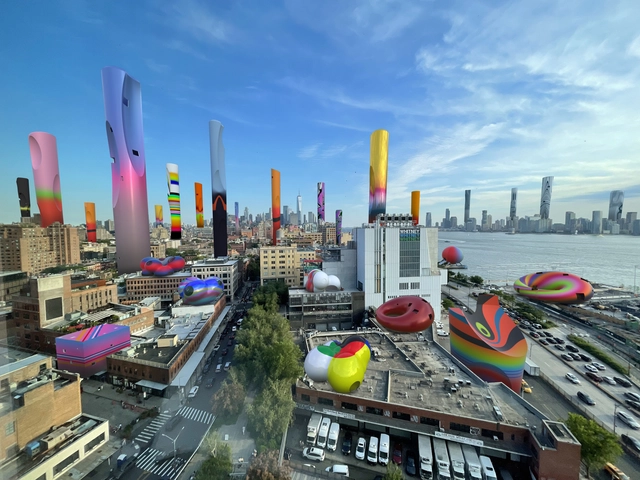
The promise of the metaverse, this new type of three-dimensional and immersive digital space, is proving to become more and more appealing to architects eager to explore the new realm of virtual creations. As it currently stands, the metaverse does not have a singular definition but is composed of many narratives and explorations. This unknown land is however fruitful ground for architects, who have to opportunity to shape not only the new environment but also the experiences of future users. The SOLIDS project represents one response to these conditions. Developed by FAR, an architect and engineer working with digital environments, SOLIDS uses a generative process to design unique, metaverse-compatible buildings.
Everyone’s experience of a city is unique. Whether one is visiting a place for the first time or has lived there all their life, their experiences are shaped by their personal interactions with the built environment. Buildings, landscapes, and streets come together to offer an opportunity for sensory stimulation, however, most of them are unable to provide inspiration. While a city’s infrastructure accounts for livability, equal importance isn’t given to enjoyability. Play and games embedded in the city’s fabric can help improve user engagement with urban spaces.
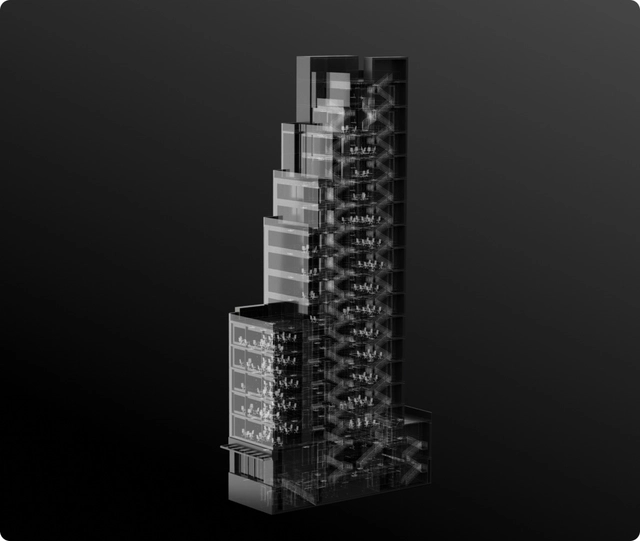
A developer in NYC purchased the first-ever non-fungible token (NFT) Office building in New York City. "Located" at 44 West 37th Street, the 4700 square meters NFT serves as an immutable digital asset that points to transforming how we design, build, operate, and monetize our spaces with only "one-click". The 16-story building was created by spatial intelligence company Integrated Projects and questions the function of architecture in Real Estate and the Metaverse.
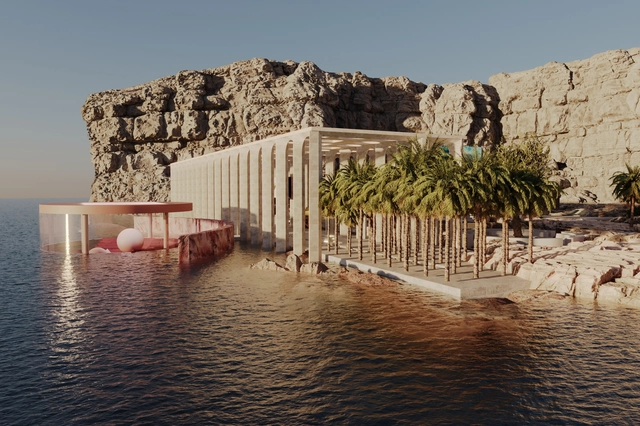
MetaMundo has launched its second three-dimensional NFT, an ocean-adjacent villa, complete with an NFT gallery, meditation pavilions, and entertaining areas. The structure was designed by American architect and hybrid-creative Luis Fernandez to become an immersive space for meeting, playing, and relaxing. Through this project, the architect aims to explore the changing paradigm of building in the metaverse. As laws of physics become irrelevant and materials are reduced to surface images, he asks the question what will architecture mean for the metaverse, how will we experience it and how will we use it?
As part of an initiative for Tequila José Cuervo, Rojkind Arquitectos presents its new and first project of the metaverse under the name "Metadestilería" (Metadistillery) which is based on a design exercise that responds to the function of objects with respect to human needs within specific contexts with the challenge of creating unique experiences through objects and architecture.
The Alexander Team and metaverse real estate development firm Everyrealm, have announced the launch of "The Row", a private, members-only metaverse real estate community featuring architecture designed by world-renowned artists. The Row will be launched on the metaverse world-building platform Mona, and will feature limited-edition series of 30 3D architectural landmarks, each sold as a 1-of-1 non-fungible token (NFT) designed by artists including Daniel Arsham, Misha Kahn, Andrés Reisinger, Alexis Christodoulou, Six N. Five, and Hard.
We are still at the dawn of the Metaverse, the next wave of the Internet. The current “mainstream” Metaverse platforms serve as experimental containers to host the wildest dreams of virtual worlds where we are supposed to unleash the imagination. However, from a spatial design perspective, they have so far been lame and ordinary. Without the constraints in the physical world, how do we draft the urban blueprints in the metaverse? I believe metaverse planners can find inspiration from Italo Calvino’s Invisible Cities, in which he revealed a poetic and mathematical approach to “urban planning” in the imaginary worlds.
The digitisation of architecture and design projects has been going on for some time now and has increased even more, largely due to the global pandemic. To hear talk of the metaverse, the NFT or the digital twins seems to be commonplace at this time, when the digital economy is booming and where architects and designers who seek to move from the physical world to the virtual world are beginning to proliferate. But will virtuality be the future of architectural visualisation?
Delft Hotel Interiors. Image via Frame Magazine used under terms of "fair use"
In recent years, there’s been a significant amount of clamor around the habits and impacts of the millennial generation. Headlines often read “Millennials Responsible for the Decline of Cereal”, “Millenials Are Why We No Longer Use Napkins”, and “Are Millennials Killing the Housing Market?” After being burdened with the blame of the death of almost anything, the millennial workforce has now moved away from the spotlight to make room for the next generation, “Gen Z”, which many believe are going to make significant societal disruptions- especially in the architectural and design workforce.
Over the past year, NFTs have entered the realm of architecture, prompting conversations over the role of the profession in the future digital economy. From the design of digital real-estate to exhibitions and architecture events exploring its value for the practice and established architecture firms embracing the new medium, NFTs have been embraced by the profession as the promise of a new form of creative production. Discover a round-up of architecture's experiments with NFTs so far, together with a series of Archdaily articles shedding light on the topic.