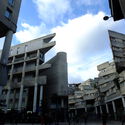
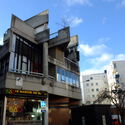
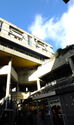
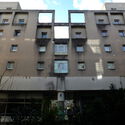
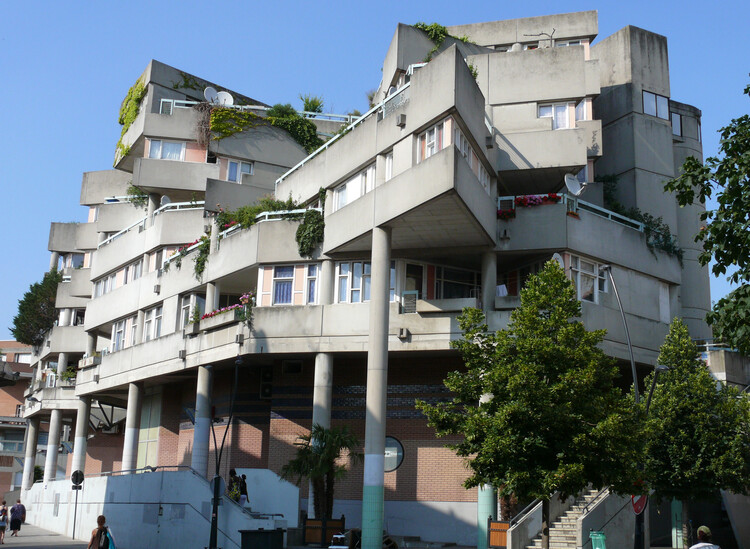
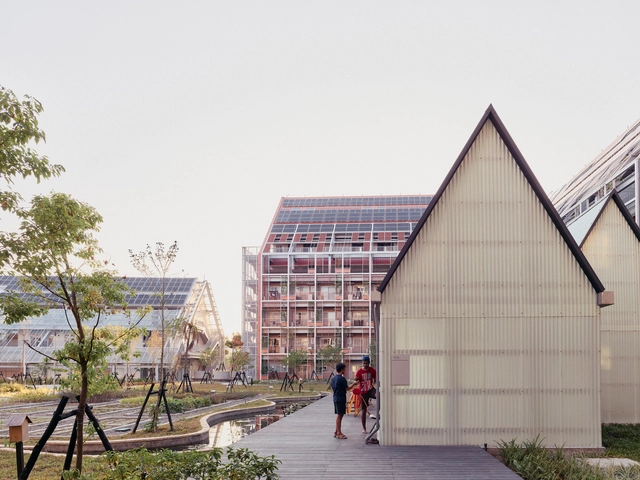
Saint-Denis is a commune in the northern suburbs of Paris, France, known for the Gothic Basilica of Saint-Denis and the Stade de France. At one corner of Place Jean-Jaurès in its historic center, adjacent to the Basilica, stands the Îlot 8 housing complex, a Brutalist landmark designed by architect Renée Gailhoustet. Built between 1975 and 1986 to provide workers' housing in the city center, countering the trend of relegating social housing to peripheral areas, the project is now at the center of a controversial redevelopment plan. Often referred to as "residentialization" and restructuring, the proposal involves the demolition of significant parts of its original design. This reconversion is part of the French Nouveau Programme National de Renouvellement Urbain (NPNRU) and is justified by concerns over structural deficiencies, safety, and maintenance.
The BIG SEE Festival returns on May 21-22, 2026, to Portorož, Slovenia, as the leading architecture and product design platform in South-East Europe, bringing together architects, designers, brands, and decision-makers from across the world. Formerly known as BIG Architecture and BIG Design, the unified BIG SEE Festival reflects an expanded ambition: to frame architecture and design as critical tools for navigating complexity, responsibility, and change.
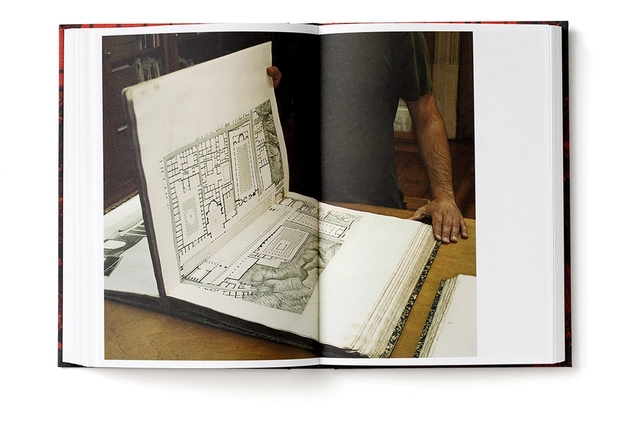
Architecture has always been more than bricks and mortar. It is equally constructed through words, ideas, and narratives. From ancient treatises to radical manifestos, from technical manuals to poetic essays, the written word has served as a spatial, pedagogical, and political tool within the field. Writing shapes how architecture is conceptualized, communicated, and critiqued — often long before, or even in the absence of, physical construction.
Historically, figures such as Vitruvius, Alberti, and Palladio employed writing to codify principles, project ideals, and legitimize architecture as a discipline. In the modern era, Le Corbusier, Adolf Loos, and Lina Bo Bardi wrote prolifically to expand the scope of architecture beyond form and function, often using publications as tools for persuasion and experimentation. The postwar period gave rise to new editorial strategies, as evident in the manifestos of Archizoom and Superstudio, and the polemical publications of Delirious New York and Oppositions, where writing served as both critique and project.
If the past few years were a perfect occasion for reflecting and debating on well-being, digitalization, and democratization in architectural design, this 2023 has been a tremendous opportunity to delve deeper and comment on other urgent topics: The climate crisis and the natural environment have unquestionably entered the global agenda of architecture and construction, alongside circularity, energy efficiency, and decarbonization. It's time to engage in dialogue about these matters to conscientiously build for the future.
Reviewing the future of wood, water, and lighting, in each of the related topics that ArchDaily developed month by month, we posed an open question for you - our dear readers - to actively contribute with your experiences and knowledge. After reading and compiling an immense amount of received messages, from construction professionals to students and architecture enthusiasts, it's time to present you with a summary of the main perspectives. Many thanks for your opinions, and we look forward to your comments for 2024!
Colors have played an essential role in the history of modern architecture - from Le Corbusier's theory of polychromy to the aesthetic conceptions of the Bauhaus. However, we find ourselves at the beginning of an era where the interpretation and implementation of colors in architecture are undergoing a transformation based on their impact on the built environment.
Throughout the month, we conducted an open call to listen and learn from our readers, exploring their predictions and thoughts related to the future of colors in architecture. After reviewing an immense number of comments and opinions, it was surprising to discover commonalities regarding the importance of considering energy efficiency in color choices. Check out the main viewpoints below.
In an effort to address the architecture industry’s environmental impact, Henning Larsen is presenting the “Changing Our Footprint” exhibition at Aedes Architecture Forum in Berlin. The event features the small but scalable steps that the office is taking to move towards a more desirable future through the projects they are designing and the research they are conducting. The exhibition aims to be an engaging event, inviting visitors to participate in the dialogue, to think critically about the proposed solutions and initiatives, and to ask difficult questions in the search for better outcomes. The exhibition is open until March 22, 2023. Henning Larsen will also host a series of panel debates at the Aedes Architecture Forum from February 22 to March 14.
Turncoats is a series of punchy debates that aims to turn the typical architectural discussion format on its head. Founded on the premise that mainstream architectural discourse is often so boringly well-mannered as to be “like watching dog owners compliment each other’s pooches,” Turncoats aims to ditch the platitudes and archi-jargon for a punchy, playful and provocative exchange of ideas that allows people to speak more freely and take more risks. Conceived in London and operating now in multiple cities, Turncoats New York launches with a bang on 13 June, addressing the topic Buildings Don’t Matter.
Join us at Midori House in London’s Marylebone for this live edition of Section D, Monocle 24’s weekly design radio show. Opinionated guests from the worlds of typography, graphic design, journalism and architecture join Section D host Josh Fehnert to reflect on their careers and London’s status as a design city and offer some resolution on that age-old question: "What is good design?"
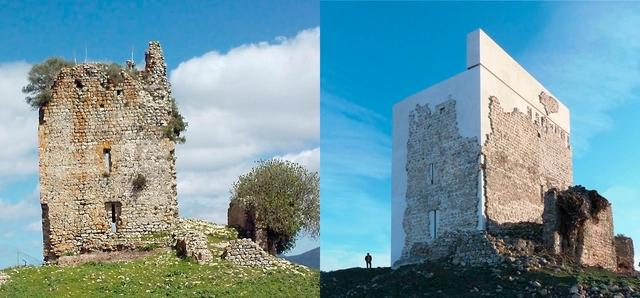
Before and After. Image via Leandro Cabello | Carquero Arquitectura
In 2011, after the partial collapse of the Matrera Castle in Cádiz, Spain (dating back to the 9th century) the city decided to restore the remaining tower, with the aim of preventing its collapse and protecting the few elements that were still standing.
The challenge fell into the hands of Spanish architect Carlos Quevedo Rojas, whose design received the approval of the Regional Government of Andalucía, in compliance with the Historical Heritage law 13/2007, which prohibits mimetic reconstructions and requires the use of materials that are distinct from the originals.
In the words of the architect: “This intervention sought to achieve three basic objectives: to structurally consolidate the elements that were at risk; to differentiate the additions from the original structure (avoiding the mimetic reconstructions that our law prohibits) and to recover the volume, texture and tonality that the tower originally had. The essence of the project is not intended to be, therefore, an image of the future, but rather a reflection of its own past, its own origin.”
Why has a restoration based on the anastylosis technique – which exists around the world – caused so much controversy? It is it really a “heritage massacre” as the media has said? Do you think it could have been carried out in a better way?
Join the debate and leave your comments after the break.
AAgora is a debate platform based at the Architectural Association, London, which aims to shed light on relevant architectural topics. These debates take the form of an open-table discussion which encourages the audience to participate at any time. AAgora's third debate will be "Pret A Habiter" - or, Ready to Inhabit - Towards Nomadic Homogeneity, in the city through the sharing economy and Airbnb.
AAgora is a newly-founded critical architecture debate platform at the Architectural Association in London, which aims to shed light on relevant architectural topics. These debates take the form of an open-table discussion which encourages the audience to participate at any time. AAgora's second debate will be "On the Chicago Biennial" - On Biennials, and how we define contemporary architecture.
“I’d like you to join me in hell” declared Catherine Slessor, the first female editor of The Architectural Review in her opening speech for the design debate series Turncoats in late November. What followed was a blistering, hilarious and poetic assault on the world of vanity publishing confided to an audience of 200 critics, architects and designers in SelgasCano’s Second Home. Normally a review such as this one might be accompanied with a film of the event itself, but in this case that is impossible due to Turncoats’ blanket ban on digital recording equipment (including phones) - one of numerous theatrical twists which have made this unassuming project one of the hottest tickets in town.
Turncoats is the creation of former AR Deputy Editor and current Deputy Director of the Architecture Foundation Phineas Harper, Studio Weave and Interrobang founder Maria Smith, and esteemed educator Professor Robert Mull, backed by the Cass architecture and art school. The series is like a hedonistic mash-up of an old school debating society and a ritualistic drinking game. Vodka shots, comedy warm up acts, sexy venues and mischievous polemical propositions make every Turncoats event a surreal and thought-provoking evening. The masterstroke is that not every invited panellist is speaking their mind – some are purely playing devil’s advocate. This reality-bending twist naturally invites a theatricality which blurs the line between argument and arguer, enabling a frankness of architectural debate rarely seen in our nervously polite industry.
The Crisis of Form André Tavares debates with Juan Coll-Barreu and Nicolás Maruri
Madrid is the first international city to receive a debate to launch the 4th edition of the Lisbon Architecture Triennale. Under the title The Form of Form, this edition is curated by André Tavares and Diogo Seixas Lopes.
Communicating forms André Tavares debates with Mark Tuff and Tim Abrahams
The Lisbon Architecture Triennale is very pleased to announce the kick-off debate - Communicating Forms – with André Tavares chief curator of 2016’s Lisbon Triennale, Mark Tuff and Tim Abrahams.
The Battle of Ideas is an annual, weekend-long series of panel discussions hosted at the Barbican in London, ranging across subjects from neuroscience to music and everything in between. With a strong thread of architecture and urbanism, this year offered a spectacular chance to probe the popular trends and fads in today's design culture.
Read on after the break for the highlights of the event.