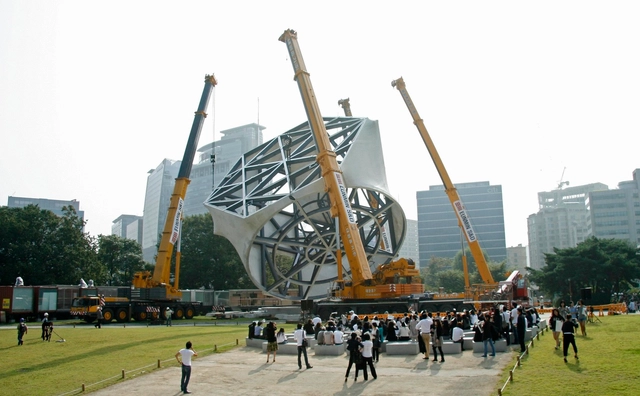
The Naomi Milgrom Foundation has selected Rem Koolhaas and David Gianotten of OMA for the design of Melbourne’s 2017 MPavilion. The announcement comes after this weekend’s closing of the 2016 MPavilion, designed by Bijoy Jain of Studio Mumbai, which welcomed more than 94,000 visitors to over 287 free events in its 139 day run. Now in its 4th year, the MPavilion program invites architects who have yet to completed a project in Australia to design and construct their first structure in the country.
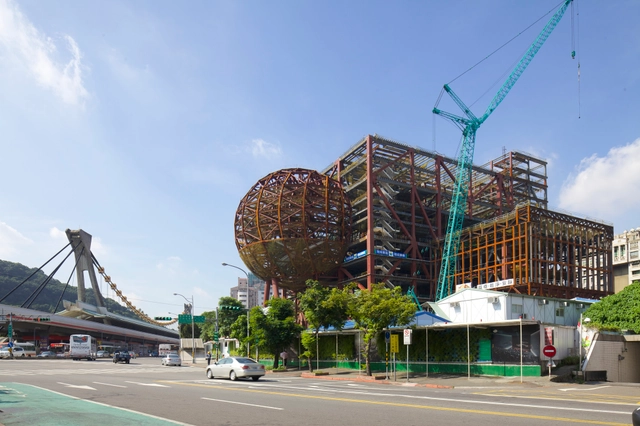
The scaffolding obscuring the facade of OMA’sTaipei Performing Arts Center has begun to come down, exposing the aluminum exteriors of the spherical Proscenium Playhouse and the Multiform Theatre for the first time. Upon completion, the experimental building will feature a looped public pathway, flexible auditoriums and unique stage environments. Construction on the building is now moving full speed ahead, with an expected opening date in June 2017.
Continue on for more images of the in-progress building.
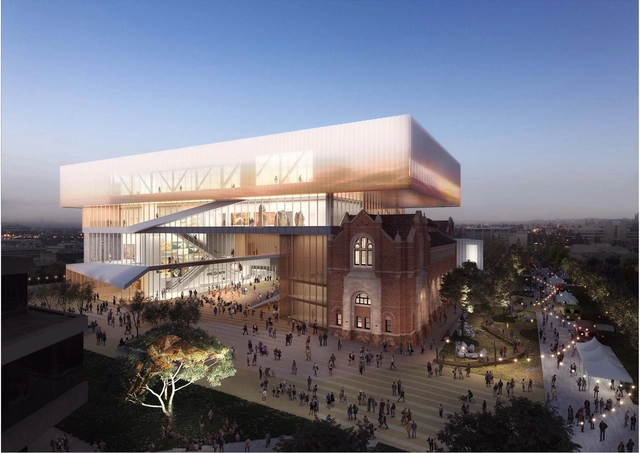
The New Museum for Western Australia. Image Courtesy of HASSEL + OMA
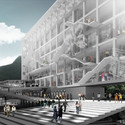
With the contract to design and build the museum in Perth officially awarded to contractor Brookfield Multiplex, HASSELL + OMA have revealed the design for the New Museum for Western Australia. The WA Government commissioned HASSEL + OMA to design the cultural institution in April of this year.
HASSELL Principal and Board Director Mark Loughnan, and OMA Managing Partner-Architect David Gianotten stated: “Our vision for the design was to create spaces that promote engagement and collaboration, responding to the needs of the Museum and the community. We want it to create a civic place for everyone, an interesting mix of heritage and contemporary architecture, that helps revitalize the Perth Cultural Centre while celebrating the culture of Western Australia on the world stage. The design is based on the intersection of a horizontal and vertical loop creating large possibilities of curatorial strategies for both temporary and fixed exhibitions.”
https://www.archdaily.com/792368/hassell-plus-oma-reveal-design-for-new-museum-for-western-australiaAD Editorial Team
Videos
Courtesy of OMA; Photography by Philippe Ruault
OMA's Taipei Performing Arts Center (TPAC) has topped out in a ceremony including Taipei’s mayor Hau Lung-pin, and OMA's Partners in charge of the project, Rem Koolhaas and David Gianotten. Even in its current skeletal state, the rigidly geometric form is clearly expressed with it's central cube supporting three protruding auditoriums, two cubic and one spherical. The design of the TPAC is in many ways experimental, incorporating a looped public path which shows off the building's backstage areas, and flexible auditoriums which can even be combined, offering extraordinary stage spaces that allow performances which would be impossible in any other theater.
Ahead of the topping out ceremony we spoke to partner in charge David Gianotten, who explained the building's design concepts and the challenges (or rather, surprising lack of challenges) in the construction, and told us "you will only understand it when you have seen it. It's super exciting, we encourage everybody that loves architecture to come and see it because it's spectacular."
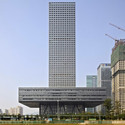
Standing outside of the recently completed Stock Exchange headquarters, he answered our questions about urbanization, innovation and the intricacies of running an office in an environment with such rapid urban growth. Shenzhen has proven an experiment of economic openness and is a vivid example of China’s recent growth. The city’s skyline is practically a physical graph of an upward-trending economy, with buildings designed by nearly every internationally renowned architecture firm. But OMA’s Shenzhen Stock Exchange building stands apart from the rest not only because of its impeccable construction (a rarity in the fast-paced building booms of Chinese cities), but also because it houses the institution that lists China’s biggest companies.
The 254 meter tower is an elegant structure that combines pure volumes with an exoskeleton grid clad in translucent glass. It represents a characteristic OMA-approach to innovative architectural solutions, made possible by extensive programmatic and technical research.
Read the full interview (which includes Gianotten’s insights on the study of architecture, the role of architects, and the importance of simplicity when communicating complex innovation) after the break.
David Gianotten, the director of OMA Asia, designs highly modern buildings across the continent but is still drawn to traditional temples for inspiration. Enjoy this great video he did with Crane.tv.