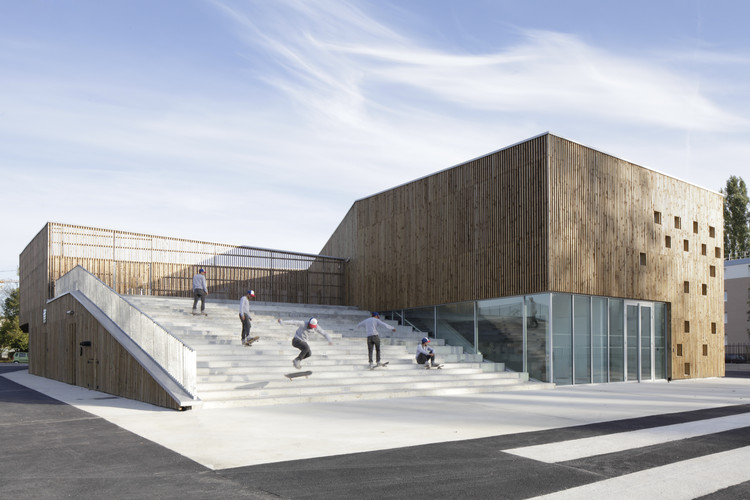
Just this past Monday, gmp Architekten was awarded the contract to design the new Kunsthalle Mannheim, a decision made by the Kunsthalle‘s jury. Their winning design portrays a symbolic identity, both on the outside and on the inside. The idea was to create a place that is easily remembered, and which appeals with its functional and urban quality. Analogous to the chess board type layout of Mannheim’s inner city, the design is a composition of several cubes, the regularity of which is however broken by an offset arrangement in terms of height and width, and also by the arrangement of squares within the development. More images and architects’ description after the break.
McAdam Architects recently unveiled their plans for a major Chinese trading and expo center in the city of Metz in Northern France. This feasibility study and outline concept will be an integrated trading complex with a total area(GBA) of over 6 million sqm. The EITC will include up to 3 million sqm of fixed frontage and flexible retail space,with additional hotel accommodation for up to 40,000 visitors and staff, 500,000 sqm logistical storage and customs clearance terminal facilities, to process up to 500 containers per day with warehouses for up to 64,000 pallets, and customer parking for over 80,000 cars. The development is divided into 4 potential construction phases, of approximately 1.5 million sqm per phase. More images and architects’ description after the break.
With locally grown and organic food becoming more popular in the Czech Republic, EDIT! was asked to design a market stall for a new concept of Green Markets. Through a reconfiguration of the typical retailing method, the architects create a unique response to the importance of enabling a personal interaction between the farmers and market visitors. From this, the farmer can relate to the visitors through their produce, and the relationships formed may contribute to the character of the market as a whole. More images and architects’ description after the break.
TomDavid Architects shared with us their first prize winning proposal for the Sustainable Market Square competition in Casablanca. In their proposal, they successfully combine indigenous techniques for shelter and heat control, the accountability of it’s residence, and innovative low-maintenance materials. In doing so, they create an efficient and pragmatic icon for the next generation market which serves as a catalyst for improvement. More images and architects’ description after the break.
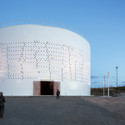
Designed by Mateo Arquitectura, the proposal for the Lascaux IV: International Cave Painting Center competition speaks to us of its history and woven of enigmas that humankind seeks to solve. It tells us that there are individuals who think, who prove, who suppose and interpret. Right beside, their virtual doubles welcome us in small theatres sunk into the ground, facing the hill. The gentle slope of the entryway leads you to a space of darkness, which awakens a unique experience. More images and architects’ description after the break.
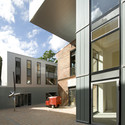
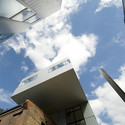
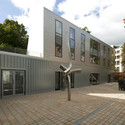
It’s been nearly twelve years since visitors first experienced the emotionally charged design of Daniel Libeskind’s Jewish Museum Berlin. Since then, the museum has become an world-renowned icon whose public and education programs have more than doubled in size. With an ever-expanding archive and library, it was decided the museum should be supplemented by an additional facility.
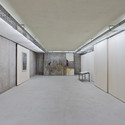
Today, alongside museum officials, Daniel Libeskind celebrates the opening of the Academy of the Jewish Museum Berlin. The facility was created from a former Berlin Flower Market (Blumengrossmarkt), whose shell undergirds the new structure. It’s 25,000 square foot, one story space now houses a library, archives and education center, along with additional office, storage and support space.
A sneak peak and the architects’ description after the break…
With the challenge of creating a new landmark on a floating platform, the ‘U-Topos’ proposal for the Faliro pier competition proposes a constructed “place”, a new “Land-” and a new “-mark”. Designed by Ksestudio, in an attempt to optimize climatic conditions, views and generate events, while developing an iconic identity, their project bends the given square platform to a “U” shape. The design is essentially a shell, an empty vessel, that frames the view towards the city and the sea, while signifying a gate, as small boats are allowed to park at the perimeter of the platform. More images and architects’ description after the break.



















.jpg?1353983365 "Render")
.jpg?1353983110 "Render")