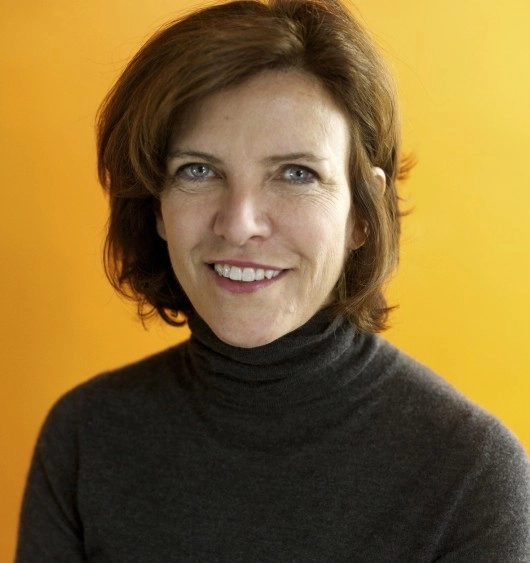
Jeanne Gang, founder of Studio Gang, will be hosting a public lecture at the Reva and David Logan Center for the Arts on Monday, April 28, 2014. The lecture, named 'What Mammals Want', will start at 5:15pm and seating is first-come, first-served.
Originally posted under the title "Well-Oiled Machine" on Metropolis Magazine, this fascinating article by Ian Volner profiles the international behemoth that is SOM, exploring how the practice has remained so prominent - and relevant - after 78 years, and what it is that stylistically unites a practice spread across five continents with more than 10,000 buildings to their name.
Frank Lloyd Wright called them the “Three Blind Mies.” Louis Skidmore, Nathaniel Owings, and John O. Merrill were the architectural troika whose namesake firm—founded in Chicago in the mid-1930s—became something like the Julia Child of postwar design, delivering European sophistication to middle America at midcentury. Through hundreds of buildings in cities all across the country (and, later, around the world) the office turned the stringent aesthetic of German master builder Ludwig Mies van der Rohe into an architectural metonym for big business. Whether you look at rows of sleek glass skyscrapers and see grace and economy, or only the “thousand blind windows” of Allen Ginsberg’s monstrous “Moloch,” it’s no stretch to say that you have Skidmore, Owings & Merrill (SOM) to thank for them.
The Chicago Architectural Club has named Christopher Marcinkoski and Andrew Moddrell of PORT Architecture + Urbanism and Grant Gibson of CAMES/gibson winners of this year’s Emerging Visions. Since its inauguration in 1998, the portfolio competition has sought to recognize significant endeavors by young architects, designers and new practices in Chicago. Works designed by the recipients will be on display at the 2014 AIA National Convention in Chicago. More information, here.
William McDonough + Partners has been selected to design Method’s first U.S. manufacturing facility on a brownfield site in Chicago’s historic Pullman community. The company, known for producing environmentally conscious cleaning products, commissioned McDonough to design an ultra clean, LEED Platinum facility constructed from Cradle to Cradle Certified materials and powered entirely by renewable energy.
The Chicago Architectural Club, with the support of AIA Chicago and the Graham Foundation, today announced the launch of the 2014 Emerging Visions portfolio competition. This competition seeks to provide a forum for young designers to be recognized and to share their visions, inventions and ideas. The award promotes significant architectural endeavors by young architects, designers and new practices yet to be acknowledged.
The College of Architecture at Illinois Institute of Technology (IIT) and its Dean Wiel Arets has announced the creation of the Mies Crown Hall Americas Prize (MCHAP) and the MCHAP for Emerging Architecture. With an objective to “reward the daring contemplation of the intersection of the new metropolis and human ecology,” these two biennial prizes will “recognize the most distinguished built constructs of the North and South American continents” while fostering research toward rethinking the metropolis.
MCHAP is an extension of the larger curricular and research initiatives of IIT, as established by Dean Wiel Arets, who states: “This new prize will not be bestowed to an individual or organization based solely off inventive form, however clever its design, or based solely off a submitted image, no matter how captivating. The prize's jury will instead be holistic in their approach to selecting exceptional works. Architecture, as a discipline, will continue its pursuit of technology, so that it can further advance. And architecture is for people; it is strengthened by their presence.”
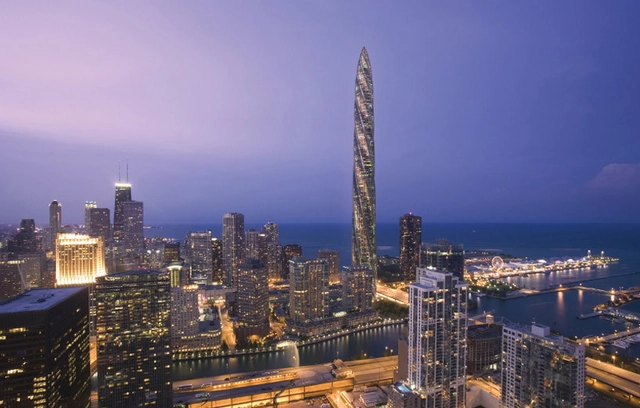
Cloaked in financial woes, what was intended to be the tallest skyscraper in the Western Hemisphere has remained a stagnate hole in the Chicago cityscape since the height of the crisis. However, the fate of the Santiago Calatrava-designed luxury condominium may be about to change, as developer Garrett Kelleher is actively seeking court approval to reinstate the project with a $135 million investment from Atlas Apartment Holdings LLC. More on Chicago's 2,000-foot “twisting" spire latest update here on the Chicago Tribune.
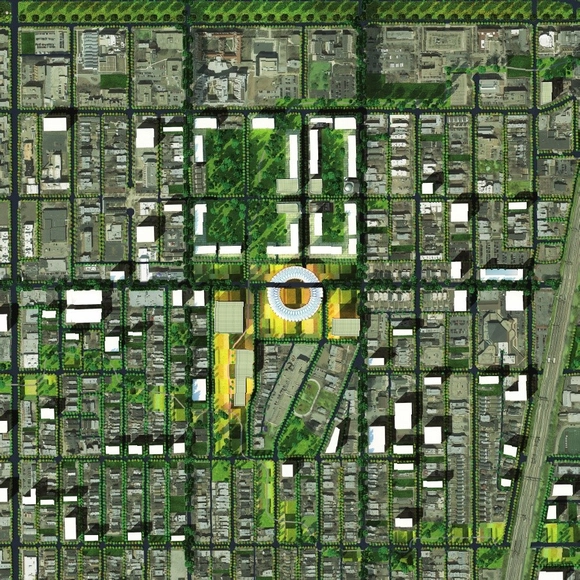
Plan View Depicting Future Library Bridging 63rd Street. Image Courtesy of Michael Sorkin Studio
Bidding for the future home of Barack Obama's Presidential Library is underway with three locations claiming the chief executive as their own. Obama's birthplace, Hawaii, has mounted a campaign in pursuit of their native son, followed by New York City's Columbia University, where he received his bachelor's degree in political science. Architect and urbanist Michael Sorkin believes it is the Windy City, however, his adopted hometown, that will ultimately win the presidential library bid.
https://www.archdaily.com/469003/michael-sorkin-sites-future-obama-presidential-library-in-chicago-s-south-sideJose Luis Gabriel Cruz
The American Institute of Architects (AIA) and MIT’s Center for Advanced Urbanism has produced a new report examining urban health in eight of the USA’s largest cities, which has been translated into a collection of meaningful findings for architects, designers, and urban planners. With more than half of the world’s population living in urban areas - a statistic which is projected to grow to 70% by 2050 - the report hinges around the theory that “massive urbanization can negatively affect human and environmental health in unique ways” and that, in many cases, these affects can be addressed by architects and designers by the way we create within and build upon our cities.
Northwestern University has selected Perkins+Will to design the new 600,000 square foot Biomedical Research Building for the Feinberg School of Medicine in Chicago. Planned for the site of Bertrand Goldberg’s recently demolished Prentice Woman’s Hospital, the new building will “anchor the University’s research facilities and be the hub of a world-class research and development enterprise that attracts innovation and entrepreneurship.”
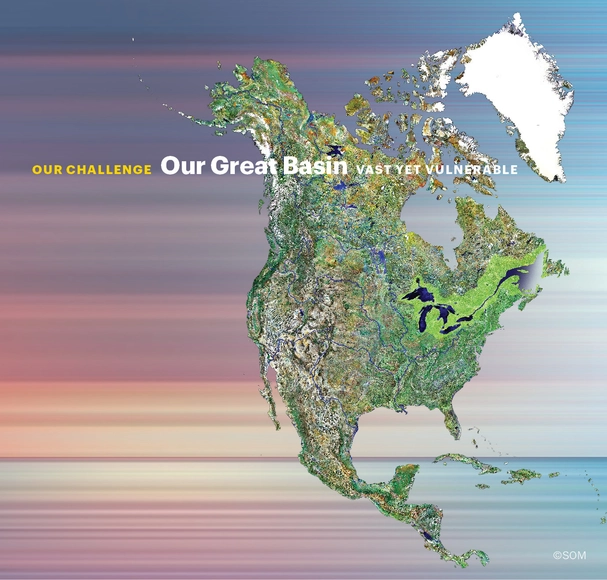
Great Cities, Great Lakes, Great Basin engages the public with the vastness and vulnerability of the earth’s largest surface freshwater resource, which spans from Duluth, Minnesota to the Atlantic Ocean. The exhibition depicts the Great Basin as one region defined by the watershed rather than political boundaries and illustrates a vision for the region as an international park that encompasses culturally-rich urban and rural areas. The exhibition also highlights initiatives around the region that Basin cities can learn from to enhance quality of life.


















_Hedrich_Blessing_015.jpg?1461898715&format=webp&width=640&height=580)
_Hedrich_Blessing_006.jpg?1461898524 "© Steve Hall/Hedrich Blessing")
_Hedrich_Blessing_026.jpg?1461898946 "© Steve Hall/Hedrich Blessing")
_Hedrich_Blessing_003.jpg?1461898474 "© Steve Hall/Hedrich Blessing")
_Hedrich_Blessing_010.jpg?1461898630 "© Steve Hall/Hedrich Blessing")
_Hedrich_Blessing_015.jpg?1461898715)