Yorgos Rimenidis and Michalis Softas, students of the University of Thessaly, in Volos, Greece shared their Craneloft proposal with us. The idea is a radical experiment to transform port cranes into lofts; and since the cranes can be found at basically any commercial port worldwide, the craneloft is a possible alternative with a global character. This revitalization stems from the students’ view that reusing objects, structures and engines left behind from the port will allow the free area to be incorporated in the urban tissue. This new form of habitation would be constantly changing and form a “condensed European city”.
More images and more about the craneloft idea after the break.
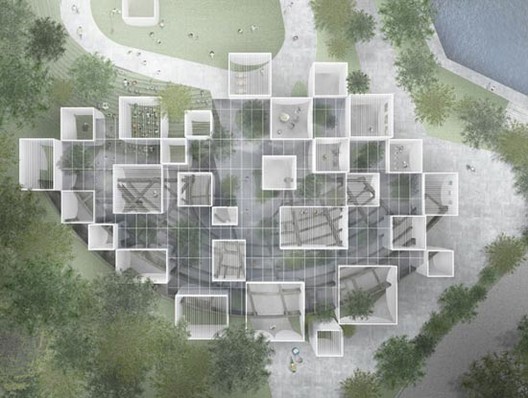
For Forrest Fulton Architecture‘s competition proposal, the Alabama-based firm designed a 900,000 sqf biomorphic spatial surface that connects the adjacent city and the landscape. The architecture focuses on creating an urbanistic landscape that morphs the common urban element of Yerevan, the superblock, to the site, a truncated hill along the natural amphitheater of the Yerevan. This new model of development supports a “holistic, ultra-green lifestyle” with overlapping natural and urban phenomenon.
More images and more about the project after the break.
It seems that this week everything is about Shanghai. The World Expo 2010 starts in three days and the pavilions are ready. Yesterday, we featured some amazing photos that Chaz Hutton took at the Expo. Today, David Goss shared with us many more, and even a video inside the UK’s Pavilion. Check them out after the break!
Suppose Design Officedesigned a renovation proposal for the Hill of Water and Sculpture in Japan. The project is situated in an industrial area along the Tokyo Bay. In the proposal, existing structures are converted into individual tower like sculptures. The sculptures meet the ground in an interesting manner, as each rests upon a curved base. The structures are connected to the existing beams located in the industrial area and the building’s varying heights create a balanced composition. The interior spaces are formed around the existing infrastructure and create a new type of space for people to experience the existing components of the site, in addition to the new sculptures.
Anne Holtrop’s Trail House follows a series of trails in the ground that were created by the daily circulation of pedestrians. The house becomes the path and transforms the inside into a “walking home.” As the house branches along the series of paths, it becomes narrower and then wider to provide ever-changing views of the site. In this way, Holtrop makes a specific link with the environment by showing the house as a product of the site.
More images and more about the project after the break.
What began in a rented townhouse on Manhattan’s Upper East Side has grown to become an internationally recognized preeminent source for exhibitions and publications related to historical and contemporary African art. The Museum for African Art will finally find a permanent home along Manhattan’s “Museum Mile” and will be open to the public next April. Designed by Robert A.M. Stern Architects, LLP, the museum will bring the prestigious row of museums of Manhattan to Harlem, one of the country’s most important centers of historic and contemporary African-American culture.
More about the museum and more images after the break.
ULHT (Universidade Lusófona de Humanidades e Tecnologias) organized an international workshop on the theme of waterfront design (European Workshop Waterfront Urban Design) EWWUD. The workshop was coordinated by Pedro Ressano Garcia.
This event took place between 14 and 28 March 2010 and has several international specialists in nine foreign universities.
The 47 foreign students with 14 student from Portugal were mixed and distributed into eight different groups, where eight final projects were presented. You can see all the boards after the break.
With more than 80 comments, it became one of the most controversial and discussed pavilions. At Fernando Brandão they followed the discussion and now they wanted to show you the complete project. More images, drawings and the architect’s description after the break.
A ceremony on April 16th marked the official groundbreaking of “Sonnenhof”, a landmark development designed by J. MAYER H. Architects consisting of four new office and apartment buildings extending over several allotments in the historic center of Jena, Germany.
GLR Arquitectos‘ residence in Nuevo Leon, Mexico sits on higher topography than its neighboring houses. This “privileged situation” provides the home with greater height, and as a result, better vistas toward the National Park of Chipinque. The home is comprised of simple, pure geometric volumes that intend to evoke an image of lightness within a language of heavy and massive volumes.
Yury Permyakov designed a simple house that adheres to the client’s main concern: to maximize the seperation from the neighboring houses. The 300 sqm house is seen as some “kind of pearl” that wrapped by a protective layer, and only a slight sliver of the inner surface of the facade is left open. The exterior protective surface is a coarse dark-colored metal sheets with small holes.
AMO is a design and research studio inside OMA, a think tank operating on the boundaries of architecture: media, politics, sociology, sustainability, technology, fashion, curating, publishing and graphic design. Some of their works include the barcode flag for the EU and a study for Wired magazine.
And while OMA covers sustainable strategies on a building or master plan scale, AMO is approaching it on en European scale as one of the five consultants conducting technical, economic and policy analyses for Roadmap 2050, an initiative by the European Climate Foundation which looks to chart a policy roadmap for the next 5-10 years based on the European leaders’ commitment to an 80-95% reduction in CO2 emissions by 2050. You can download a brief of Roadmap 2050 in PDF.
The goal is to achieve a 2% energy efficiency saving per year in order to meet this goal, with power and vehicle transportation being the most important areas.
Through the complete integration and synchronization of the EU’s energy infrastructure, Europe can take maximum advantage of its geographical diversity. The report’s findings show that by 2050, the simultaneous presence of various renewable energy sources within the EU can create a complementary system of energy provision ensuring energy security for future generations.
AMO’s work focuses on the production of a graphic narrative which conceptualizes and visualizes the geographic, political, and cultural implications of the integrated, decarbonized European power sector.
On their study you can find an interesting approach to a diverse european energy grid, including energy trade and the use of new non-traditional sources.
The image of “Eneropa” appears as a new continent based on its energy production: Biomassburg, Geothermalia, Solaria, the Tidal States… are part of this new territory. Other branding concepts are introduced on the study, creating a tangible image of this ambitious plan, which reminds the powerful (yet simple) idea behind the barcode flag.
Daniel Bonilla Arquitectos‘s latest project is an open chapel in La Calera, Colombia that is gently nestled into the surroundings. The simplicity of the geometry adds a touch of elegance to the pious space, as the natural features of the environment, wind and light, create “an essential harmony.”
MONU magazine on urbanism is continuously looking for interesting contributions. The current open call for submissions for MONU “Most Valuable Urbanism” and closes by the end of May 2010.
O + A have conceived a conceptual pool scheme for a river in Amsterdam. Entitled Urban Beach, the pool appears as a continuous band that is folded and lifted to create a mobius strip-like effect. The folding allows the object to become more flexible, and the architects see it as a framework for various programmatic activities, such as an open-air movie theater in the summer, or a wellness center in the winter.
More images and more about the pool after the break, via Dezeen.
Cheungvogl, a young international architectural practice based in Hong Kong (see previous projects by Cheungvogl featured on AD here), designed two residences in Tokyo on a private development. House 2a is to be occupied by the client, a Japanese-German couple, based in Tokyo while House 2b is for sale. The client’s required that the design be, “Calm, but not sterile. Humble, and yet unexpected. Economical, nothing extravagant. Open space with flexible floor plans and a space to contemplate.” Working with these ideas in mind, Cheungvogl created related residences that also become separate enities.
More about the residences and more images after the break.
Based in Germany, Studio Aisslinger‘s new housing prototype is modular, sustainable and transportable. The low energy house, named ‘Fincube’, is comprised of thin horizontal “ledges” of locally grown wood that wrap the slightly bulging form. This second facade layer provides privacy for the inhabitants and fuses the man-made structure with its natural surroundings. The home provides 47 sqm of living space with a minimal CO2 footprint, and can also be easily dismantled and rebuilt on a different site. The supporting structure is made of local larch and the interior is a combination of larch and stone-pine. Organized in a helical structure, the entrance area blends into a generous open kitchen with an adjacent living space, and around the corner rests the bedroom.