Standing at 78 meters tall, the Museum of the Future (MOTF) is far from reaching Dubai’s famous skyline, which features skyscrapers like the unparalleled Burj Khalifa – the world’s tallest tower. However, with its bold shape and striking façade illuminated by more than 14,000 meters of Arabic calligraphy, it certainly succeeds in taking its place among the city’s most iconic buildings. The award-winning project by Killa Design and Buro Happold, described by many as ‘the most beautiful building in the world’, opened in February of 2022 in Dubai’s Financial District. In a total built up area of 30,000 sqm, it accommodates exhibition spaces for innovative ideologies, services, and products, as well as theater spaces, a laboratory, and a research center.
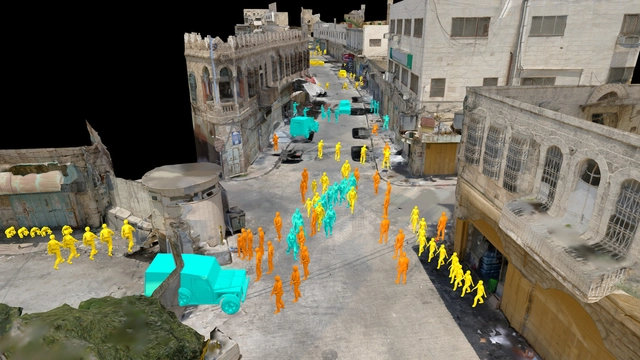
“Since I remember myself, I have wanted to be an architect… I could see the way that neighborhoods were organized. I could see the separation. I could see the frontier areas between the Palestinian community and the Jewish majority,” expresses Eyal Weizmanin conversation with Louisiana Channel, in regards to understanding the ‘political significance’ of architecture and the potential of the occupation as a critical tool for understanding the world.
Eyal Weizman was interviewed by Marc-Christoph Wagner at Forensic Architecture’s studio in London, in April 2022. As the head of Forensic Architecture, he is renowned for his part within the multidisciplinary research group, using a combination of architectural technologies and techniques to investigate instances of state violence and violations of human rights across the globe. Growing up in Haifa, Israel he developed an understanding of the political connotations within architecture from an early stage.
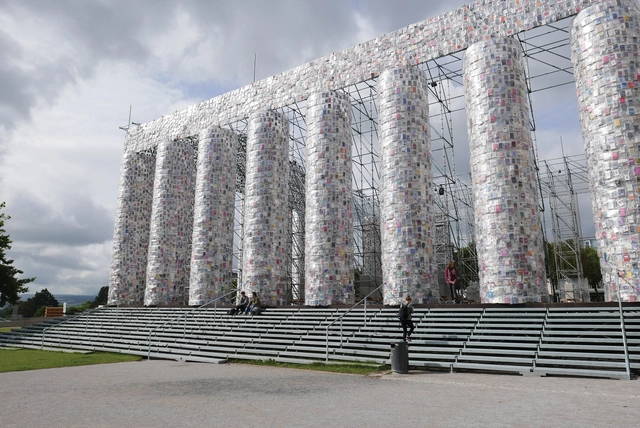
Marta Minujín, Parthenon of Books, Dokumenta 14, Kassel, Germany, 2017. Image by Anne-Catrin Schultz.. Image Courtesy of Real and Fake in Architecture–Close to the Original, Far from Authenticity?
The term “fake” has been in the media frequently in the early 21st century, referring to headlines and fictional statements that are perceived as real and are influencing public opinion and action. Replacing the historically more common term “propaganda,” fake news aims at misinformation and strives to “damage an agency, entity, or person, and/or gain financially or politically, often using sensationalist, dishonest, or outright fabricated headlines.” Tracing fake news and differentiating “real” information from personal opinions and identifying intentional (or unintentional) deceit can be complicated. It is similarly complex to trace the duality of fake and real in the built world. To explore the larger context of fake statements in architecture and environmental design, a look at the definition of fake and related terms might be necessary.
Videos
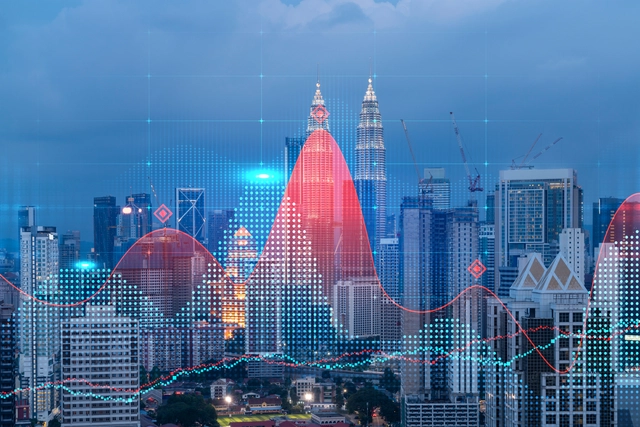
The Digital Twin . Image via Shutterstock/Videoflow
The emergence of the Digital Twin phenomenon has heralded a great change in terms of urban planning. It essentially presents the city as dynamic, in virtual form. Ensuring every element from the historic fabric, new construction, and public transit is accounted for in one three-dimensional model. Not only does it present key elements in terms of the landscape, but it also encompasses often overlooked conditions such as the presence of light throughout the day, shadows, and the presence of vegetation and trees. All of which contribute to a better preliminary process of site analysis.
Videos
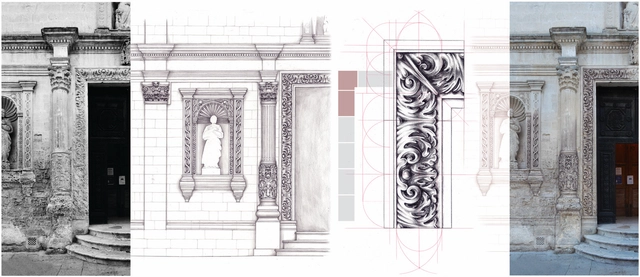
Mariapia di Lecce (commended, Hybrid category): Reconstruct with drawing. Hand drawing for graphic analysis.. Image Courtesy of Sir John Soane's Museum
If there is any word that describes what architectural renders look like nowadays, it would be: impressive. The immense world of rendering has allowed people to engage in virtually-built environments, exploring each space and experiencing what they might hear or feel as they walk by one room to another without being physically present in the project.
The main purpose of a render is to help viewers visualize what the final result of the project will look like. Whether it is for presentation or construction purposes, architects need to translate their visions in a way that helps people who were not involved in the ideation process understand the space and the experiences that come with it. However, not all architects have the proper skills or the time to create such hyper-realistic environments, but with the exceptional quality of visuals being produced nowadays and the rising demand, it has become somewhat mandatory for every project to be presented as a realistic 3D render. So if you are one of those architects who don't have the skills nor time, here are ways you can present your project as an immersive visual experience that translates its identity without resorting to 3D software.
























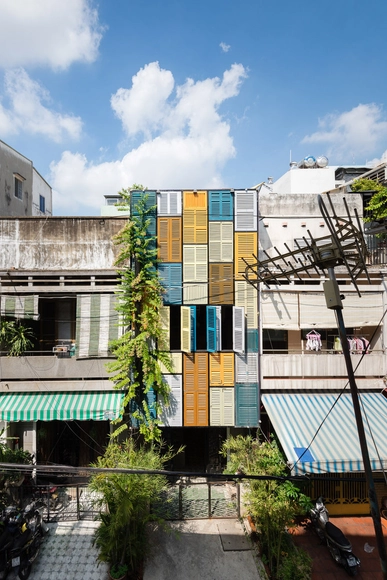












![Town House in Antwerp / Sculp[IT] - Extension, Facade, Door](https://snoopy.archdaily.com/images/archdaily/media/images/5584/2768/e58e/ce09/c200/0117/slideshow/sculp(IT)-Lalo-002web.jpg?1434724194&format=webp&width=640&height=580)
![Town House in Antwerp / Sculp[IT] - Extension, Kitchen, Facade, Beam, Table, Chair](https://images.adsttc.com/media/images/5584/280c/e58e/ce09/c200/011d/thumb_jpg/sculp(IT)-Lalo-036web.jpg?1434724357 "© Luc Roymans")
![Town House in Antwerp / Sculp[IT] - Extension, Door, Table](https://images.adsttc.com/media/images/5584/27e0/e58e/ce17/3700/0119/thumb_jpg/sculp(IT)-Lalo-025web.jpg?1434724313 "© Luc Roymans")
![Town House in Antwerp / Sculp[IT] - Extension, Facade, Handrail, Beam, Stairs](https://images.adsttc.com/media/images/5584/27e9/e58e/ce09/c200/011c/thumb_jpg/sculp(IT)-Lalo-027web.jpg?1434724323 "© Luc Roymans")
![Town House in Antwerp / Sculp[IT] - Extension, Garden, Door, Facade, Stairs, Handrail, Chair](https://images.adsttc.com/media/images/5584/2796/e58e/ce09/c200/0119/thumb_jpg/sculp(IT)-Lalo-012web.jpg?1434724240 "© Luc Roymans")
![Town House in Antwerp / Sculp[IT] - More Images](https://images.adsttc.com/media/images/5584/2768/e58e/ce09/c200/0117/medium_jpg/sculp(IT)-Lalo-002web.jpg?1434724194)