The New York Economic Development Corporation and Mayor Bloomberg of NYC announced the completion of the final plan for Willets Point - a peninsula on the Flushing River in Northern Queens, New York. The development of Willets Point is part of the urban renewal project associated with Citi Field – the Mets’ new stadium. Nicknamed the Iron Triangle, the project will include housing for mixed incomes, retail and entertainment amenities, a hotel, a convention center, office space, parks and open space, and a new public school, all of which falls under the umbrella of LEED-certified buildings and infrastructure. As with every redevelopment plan, there are positives and negatives to restructuring the community.
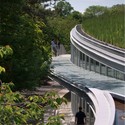
The Green Carceri, designed by TARQUITECTOS, arises as a natural extension of the High Line Park, connecting himself with the High Line and flying over the river, thus enabling a continuation of the public space underneath with the neighborhood to the height of the street and the docks. Winding around a series of vertical communication cores, the building allows both internal transit users and visitors to descend to the level of the street without having to enter the building. More images and architects’ description after the break.
Cameron Michael captures the energy of the city with this time-lapse production. From the highline to the city skyline, this video makes you feel like you’ve just spent your entire Sunday walking through the streets of Manhattan. Although Michael admittedly “bent” a few laws while filming The Manhattan Project, this adventure seems to have been well worth the effort. Enjoy!
Taking place June 15th from 7-9pm at McNally Jackson in New York, CLOG is inviting the public in their celebration of the launch of their third issue, Data Space.
In the past decade New York City’s government, along with numerous organizations and design teams, have taken the initiative to revive the city’s public spaces and reclaim underutilized areas that have long been associated with the city’s manufacturing past. We’re all familiar with the High Line, a project that takes over the elevated rail lines of Chelsea and Meat Packing District that until several years ago stood as a desolate and eroding piece of infrastructure, which was beautiful in its own way but largely underutilized. Then there is the Brooklyn Navy Yard, which has become a mecca for designers, fabricators and research companies and has recently acquired a museum to celebrate its history. And of course, there are the city’s waterways, which, since New York City’s early history, have served its manufacturing and trade economy, have become parks along the waterfront as part of the Hudson River Greenway and the FDR Drive. Manufacturing has long been replaced by Wall Street, but there are parts of the city that still retain the industrial past along the historic waterfront and continue to operate some of the most important facilities that allow the city to function. Now it is time to reintroduce a public use among these industrial zones.
Heroic. Contemplative. Grieving. Victorious. The rebirth of the former World Trade Center site in lower Manhattan has engendered significant public reaction and reflection. With implications as complex as they are profound, it is not surprising that it has taken more than a decade to heal the urban scars of September 11, 2001.
I had the rare opportunity to sit down with three architects working on the site, Santiago Calatrava, David Childs, and Daniel Libeskind, at the recent American Institute of Architects convention in Washington, D.C., where they were honored along with four others, as “Architects of Healing.” We discussed their experience of reshaping one of the most culturally significant sites in the history of the United States.
Remember the “Cosmic Quilt” kickstarter campaign we published a few weeks ago? Well, it was a success! With the help 20 students from the Art Institute of New York, The Principals were able to construct a reactive architectural environment just in time for the New York Design Week that took place May 19-21.
We stumbled across this fantastic video, by Mindrelic on Vimeo, capturing the endless movement of Manhattan. The maker behind Mindrelic spent a little over a month hotel hopping around Manhattan to shoot this time lapse. I was particularly mesmerized by the constant play of light and shadow throughout the entire city. Enjoy!
Approach, a two-day parametric design workshop June 23-24, put on by Studio Mode / modeLab, will introduce participants to advanced topics in Grasshopper for Rhinoceros. In a fast-paced and hands-on learning environment, participants will iteratively engage a diverse set of parametric approaches to case-study design scenarios, each requiring advanced creation and manipulation of Data Structures and/or the extension of Grasshopper’s Parametric Workflow. The collection of case-studies will furthermore provide a mechanism to critically assess the value in each approach relative to workflow, best practices, linear versus non-linear design processes, and opportunities for modular re-use in other design contexts. For more information, please visit here.
HOK was recently selected to design the new University at Buffalo (UB) School of Medicine and Biomedical Sciences on its downtown campus upon winning a global design ideas competition. Located at the center of the region’s emerging bio-sciences corridor, this new transit-oriented medical school development will anchor a lively, urban mixed-use district on campus and bring 1,200 students, faculty and staff downtown. With the goal of fostering collaboration and interdisciplinary care, the new academic medical center will create connections that allow students, faculty, biomedical researchers and clinicians to move easily from classroom to bedside to lab. More images and archtiects’ description after the break.
In honor of One World Trade Center becoming the tallest building in New York, EarthCam has released an exciting time-lapse movie showcasing the construction progress from 2004-2012. In just a couple minutes, you can witness years of construction. Not only is the process a moving one on an emotional level, but also sheds hope on a site that holds such strong meaning in the U.S. for a time in history that will never be forgotten.