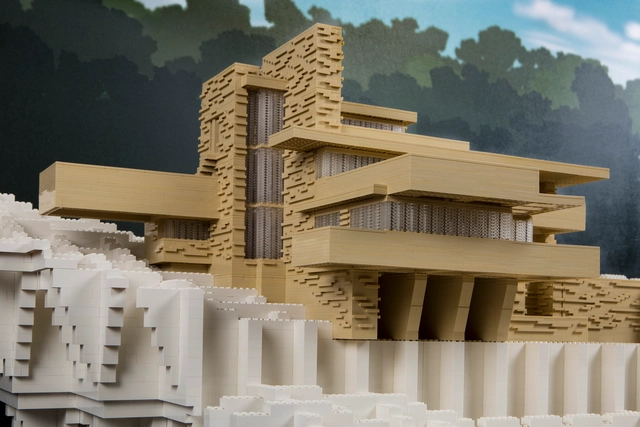
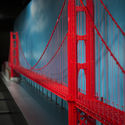
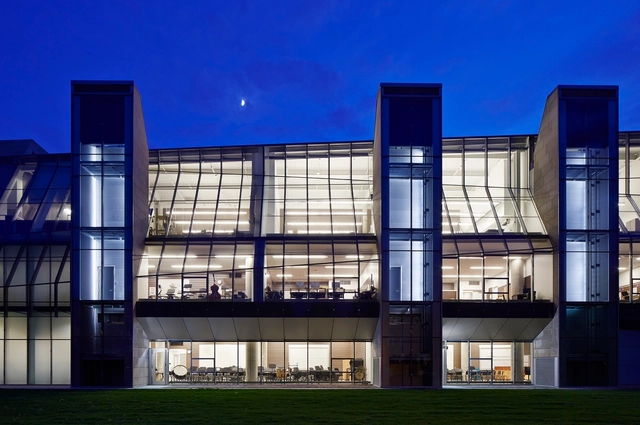
Brick by Brick features a spectacular collection of more than a dozen LEGO-built structures of engineering marvels, constructed by LEGO Certified Professional and Chicago native, Adam Reed Tucker. These model structures include:
• A 60-foot-long Golden Gate Bridge
• The Hoover Dam, made with 42,000 bricks
• The American Eagle roller coaster from Six Flags Great America, and it even operates!
• The Roman Colosseum, whose oval structure was designed more than a dozen times to get it right
In his book We Have Never Been Modern, philosopher Bruno Latour concludes that an inability to make humanity and nature inherently separate is one of Modernism’s most misguided tropes. Thus, contemporary designers that hope to riff on or have continuity with modernism must understand that architecture, even at its most aestheticized, is not hermetically sealed off from the outside world - and that therefore modernism is not a plateau of design, but another base camp on the road to further refinement.
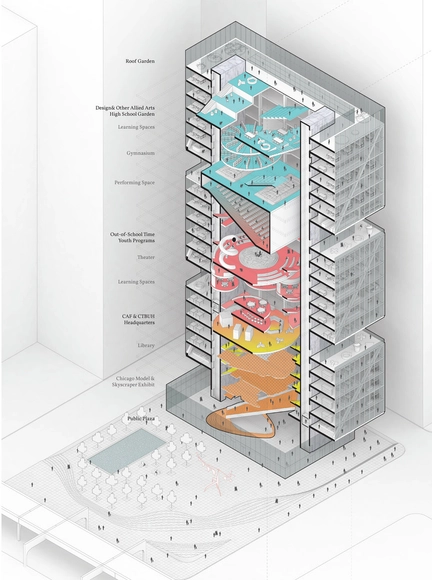
In Chicago, the city where Modernism reached both its metaphoric and physical peak, Atelier 2B, a team of Yewon Ji, Nicolas Lee, Ryan Otterson, recently shared the top-five prize of the Chicago Architecture Foundation's ChiDesign Competition (part of the Chicago Architecture Biennial) for their project Soft in the Middle: The Collaborative Core. Indebted to the legacy of Mies and the International Style, Atelier 2B proposed a Modernist-tower-redux that (externally at least) is composed of three stacked rectangular volumes bisected with terraces, set back from the street by a large public plaza. The project brief called for “a new center for architecture, design and education,” in a competition judged by critics including Stanley Tigerman, David Adjaye, Ned Cramer, Monica Ponce de Leon, and Billie Tsien.
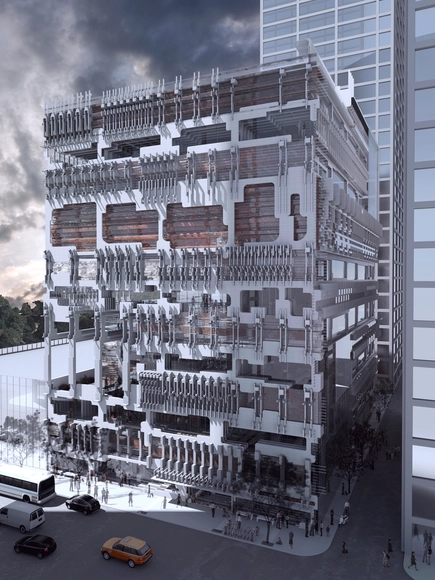
Exterior Rendered View. Image Courtesy of mcdowellespinosa
The Chicago Architecture Foundation (CAF) has announced the three winners of its ChiDesign ideas competition to design the Chicago Centre for Architecture, Design and Education (CADE). The competition was in conjunction with the first ever Chicago Architecture Biennial, following the spirit of Robert McCormick’s international competition for the Chicago Tribune Tower in 1922 which opened discourse on the importance of design to the public. Similar to McCormick’s competition, but tackling a more modern, mixed-use typology, the Chicago CADE is envisioned as a facility to house the Chicago Architecture Foundation; the Council on Tall Buildings and Urban Habitat; a design and allied arts high school; and learning spaces for an extra-curricular youth program. Read about one of the winners, "Layered Intelligence" after the break, and see another winner, "Unveiled" here.
Stanley Tigerman will discuss his 2015 New Titanic along with the opening of a special exhibit that includes a selection of past and recent work featuring the 1978 “Titanic” photomontage.
Monuments are deliberate gestures—objects or structures created to commemorate an event, person or era. Their meaning is usually imposed, and they often serve as focal points for aspirational civic and political attributes like valor and sacrifice, or to underscore a foundational political narrative. But their meaning can transform, changing over time as the relevance of their symbolism ebbs and flows due to social and political shifts. Like monuments, architecture and photography are also inflected with a grace of intention, and both have the ability to commemorate or represent a nation, event, time or place. The act of photographing monuments and buildings transforms them, sometimes revealing some of the original qualities and more closely evoking the response that they were originally intended to have. And photographs have an inherent memorial quality. This group exhibition examines the work of international artists, some of whose work addresses actual monuments, some whom look at architecture and its relationship to memory and how its importance and symbolism can shift over time, and others approach the idea of the future monument.
Building on these precedents, Hawthorne predicted that after years of baroque parametricism, in 2015 architects would use last year’s meditations on history as a practical foundation for new projects and proposals. An example of this can be found in the work of Michael Ryan Charters and Ranjit John Korah, a duo who recently shared the top-five prize for the CAF led ChiDesign Competition (part of the Chicago Architecture Biennial) for their project Unveiled. In a brief that called for “a new center for architecture, design and education,” and with lauded jurors including Stanley Tigerman, David Adjaye, Ned Cramer, Monica Ponce de Leon, and Billie Tsien, Charters and Korah proposed what could casually be summarized as a terracotta framework over a multi-story crystalline form of wooden vaults, but is actually something much more complex.