Olivia Poston

Olivia Poston is a designer, researcher, writer, and educator based in Boston, Massachusetts. Her design practice studies environmental narratives of resource security and landscape urbanism by employing data visualizations and cartographies to reveal the spatial relationships between urbanism, labor, landscape, and minerals. Her research on the energy transition, climate infrastructure, and resource extraction has received generous support from the Norman Foster Foundation, the Penny White Project Grant, the Climate Solutions Living Lab, and the London Centre for Interdisciplinary Research. Olivia holds a Masters of Design Studies at Harvard’s Graduate School of Design within the Ecologies domain and a Bachelors of Architecture from the University of Tennessee in Knoxville.

BROWSE ALL FROM THIS AUTHOR HERE

Environmental Politics: Lydia Kallipoliti’s Approach to Transforming Architecture through Ecological Pedagogies

Lydia Kallipoliti is a recognized architect, author, and educator whose pioneering research has transformed the way architecture engages with the pressing challenges of sustainability, technology, and environmental politics. As an Associate Professor at Columbia University's Graduate School of Architecture, Planning, and Preservation (GSAPP), Kallipoliti's approach to architectural education encourages students to confront critical issues such as waste, reuse, and closed-loop systems. Her pedagogical philosophy empowers students to see design not only as an aesthetic or functional pursuit but as a powerful tool for addressing global ecological crises, urging them to think systemically and creatively about the future of the built environment.

In addition to her role in academia, Kallipoliti has authored influential works such as The Architecture of Closed Worlds and Histories of Ecological Design: an Unfinished Cyclopedia, which delve deeply into the relationship between architecture and environmental politics. Her research and writings have sparked discourse on methods for architects to reconsider traditional design paradigms and embrace sustainability as a core tenet of architectural practice.

Environmental Politics: Lydia Kallipoliti’s Approach to Transforming Architecture through Ecological Pedagogies - Image 1 of 4Environmental Politics: Lydia Kallipoliti’s Approach to Transforming Architecture through Ecological Pedagogies - Image 2 of 4Environmental Politics: Lydia Kallipoliti’s Approach to Transforming Architecture through Ecological Pedagogies - Image 3 of 4Environmental Politics: Lydia Kallipoliti’s Approach to Transforming Architecture through Ecological Pedagogies - Image 4 of 4Environmental Politics: Lydia Kallipoliti’s Approach to Transforming Architecture through Ecological Pedagogies - More Images+ 4

Vibrancy and Utility: Embracing Color in Urban Apartment Kitchens

Subscriber Access | 

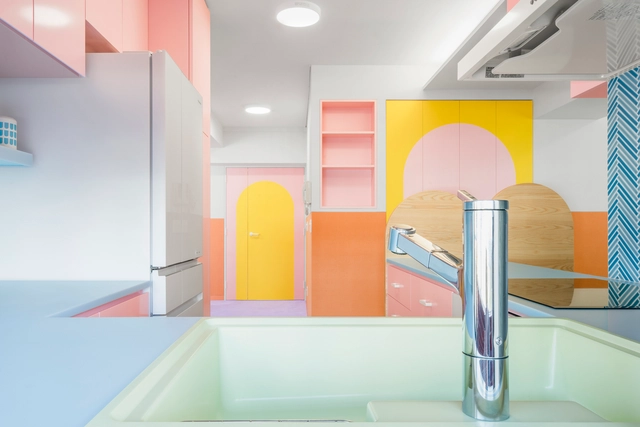
Urban apartments are frequently praised for their clever use of space, but what of their approach to color? Thoughtfully incorporating color is more than an aesthetic decision; it has the potential to shape emotional responses, influence mood, and create spatial illusions. Research in color psychology shows that colors affect our social, cultural, and psychological reactions, making them powerful design tools. Variations of blue, for instance, have been shown to slow melatonin production, keeping people more awake and alert, while shades of green relieve strain on our nervous systems, helping us feel calmer and more grounded. Color in architectural spaces can even alter our perception, creating illusions of depth, movement, and texture that influence how we experience space. Warmer hues like oranges and reds tend to make a room feel more intimate and cozy, while cool whites and blues lend a sense of openness, making spaces appear taller and more expansive.

Vibrancy and Utility: Embracing Color in Urban Apartment Kitchens - Image 2 of 4Vibrancy and Utility: Embracing Color in Urban Apartment Kitchens - Image 1 of 4Vibrancy and Utility: Embracing Color in Urban Apartment Kitchens - Image 8 of 4Vibrancy and Utility: Embracing Color in Urban Apartment Kitchens - Image 3 of 4Vibrancy and Utility: Embracing Color in Urban Apartment Kitchens - More Images+ 29

The Beaten Path: Connecting Towns and Identity through Appalachian Trail Networks

Subscriber Access | 

Every year, over a thousand people complete the 2,192-mile (3528-kilometer) Appalachian Trail between Springer Mountain in Georgia and Mount Katahdin in Maine. Millions more follow the trail for a shorter stretch by spending time at the countless overlooks, walking along the wooded ridges, or meandering through the small town centers, making this network one of the world's most visited and widely recognized trail corridors. However, the proposal for this expansive trail corridor, originally entered in a 1921 Journal of the American Institute of Architects article by Benton MacKaye, was far from a mere recreational outdoor amenity. This "project in regional planning" was a radical critique of the industrializing modernity that sharpened the divide between expanding cities of the Eastern coast and waning towns of the Appalachian mountains.

The Beaten Path: Connecting Towns and Identity through Appalachian Trail Networks - Image 1 of 4The Beaten Path: Connecting Towns and Identity through Appalachian Trail Networks - Image 2 of 4The Beaten Path: Connecting Towns and Identity through Appalachian Trail Networks - Image 3 of 4The Beaten Path: Connecting Towns and Identity through Appalachian Trail Networks - Image 4 of 4The Beaten Path: Connecting Towns and Identity through Appalachian Trail Networks - More Images+ 26

Designing Shared Rural Environments: Defining Public Spaces beyond Urban Metrics

Rural environments are often difficult to define in administrative and professional contexts and carry notable biases and complexities. Population and density thresholds are the most common determinants for drawing administrative boundaries, yet other factors, such as infrastructure, employment, and services, contribute to the characterization of rural environments. In the United States, the Census Bureau defines rurality, not by its characteristics or resources, but by absences, as "any population, housing, or territory not in an urban area." For the design and planning community, it is important to define the future of rural environments, not through the metrics of urban resources or infrastructure, but to design a new framework for flexibility, adaptation, and health.

Designing Shared Rural Environments: Defining Public Spaces beyond Urban Metrics - Image 1 of 4Designing Shared Rural Environments: Defining Public Spaces beyond Urban Metrics - Image 2 of 4Designing Shared Rural Environments: Defining Public Spaces beyond Urban Metrics - Image 3 of 4Designing Shared Rural Environments: Defining Public Spaces beyond Urban Metrics - Image 4 of 4Designing Shared Rural Environments: Defining Public Spaces beyond Urban Metrics - More Images+ 6

The Tourism Effect: Reshaping Cities, Landscapes, and Infrastructure

Subscriber Access | 

This summer, over one million visitors, spectators, and athletes are expected to gather in the streets of Paris for the 2024 Summer Olympic Games. The preparation for the event included massive investments into upgrading infrastructure, venues, and public spaces throughout the city and country. In addition to the restoration of Grande New de I'Île-des-Vannes venue, the Georges-Callerey Swimming Pool, and the Poissonniers Sports Center, the city has revealed new typologies of public services and a master plan for the Olympic Athletes Village by Dominique Perrault Architecture.

The Tourism Effect: Reshaping Cities, Landscapes, and Infrastructure - Image 1 of 4The Tourism Effect: Reshaping Cities, Landscapes, and Infrastructure - Image 2 of 4The Tourism Effect: Reshaping Cities, Landscapes, and Infrastructure - Image 3 of 4The Tourism Effect: Reshaping Cities, Landscapes, and Infrastructure - Image 4 of 4The Tourism Effect: Reshaping Cities, Landscapes, and Infrastructure - More Images+ 6

Architecture Beyond Humanity: Designing for Non-Human Species

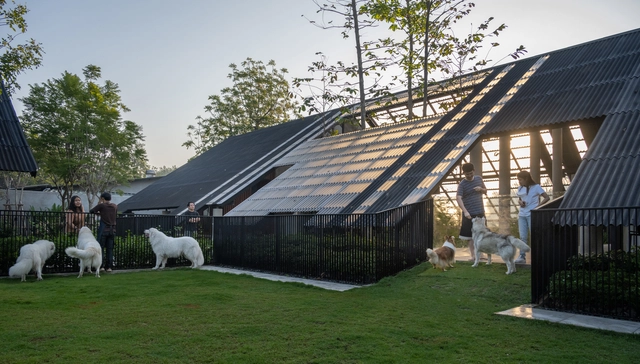
Are humans the only stewards of the built environment? For many architects and planners, spaces are designed with a focus on the needs, comfort, and health of humans. A spatial ordering, in constructed spaces and the urban fabric, designates humans as the default, singular user in this scenario. However, as much as humans have influenced the trajectory of the world, other species play a crucial role in designing, forming, and maintaining the urban landscapes of the twenty-first century.

Architecture Beyond Humanity: Designing for Non-Human Species - Image 1 of 4Architecture Beyond Humanity: Designing for Non-Human Species - Image 2 of 4Architecture Beyond Humanity: Designing for Non-Human Species - Image 3 of 4Architecture Beyond Humanity: Designing for Non-Human Species - Image 4 of 4Architecture Beyond Humanity: Designing for Non-Human Species - More Images+ 30

Progress and Reparations: Unpacking the Loss and Damage Fund from COP27

Subscriber Access | 

In November of 2022, the coastal city of Sharm El Sheikh, Egypt, hosted the 27th convention of the United Nations Conference of the Parties, known as COP27. Since signing the Paris Agreement in 2015, the nearly annual conference has gained momentum as a global leader in sharing knowledge and developing frameworks to mitigate climate change worldwide. While the more recent COP28, held in Dubai in 2023, focused on conversations of energy production, this previous conference focused on urban contexts, as they deal with the urgent need for incorporating loss, damage, and climate reparations into climate action plans. As two years have now passed since COP27, it is important to revisit these discussions and hold governing bodies accountable for the promises made and the benchmarks set for climate change mitigation. One of the most ambitious plans from COP27 highlights an urgent debate in our urban environments: how will we define loss, damage, and climate reparations in the twenty-first century?

Progress and Reparations: Unpacking the Loss and Damage Fund from COP27 - Image 3 of 4Progress and Reparations: Unpacking the Loss and Damage Fund from COP27 - Image 5 of 4Progress and Reparations: Unpacking the Loss and Damage Fund from COP27 - Image 2 of 4Progress and Reparations: Unpacking the Loss and Damage Fund from COP27 - Image 4 of 4Progress and Reparations: Unpacking the Loss and Damage Fund from COP27 - More Images+ 7