New Finnish Architecture – The New Generation, taking place April 20-21 in New York, will include two events on young architects & architecture practices by Newly Dawn – Emerging Finnish Architects. The events introduce the most interesting young, up-and-coming Finnish architects and their latest projects, visions and ways of working. Social interaction, pleasant user experience and transparency have appeared as key elements in emerging Finnish architectural offices. The architects Janne Teräsvirta (ALA Architects), Anu Puustinen (Avanto Architects), Mikko Summanen (K2S Architects) and Tuomas Toivonen (NOW for Architecture and Urbanism) will offer a fresh look into some of their upcoming projects and the latest developments in Finnish architecture. More information on the events after the break.
theCharrette, an architecture and design publication written and produced by students at the Tulane School of Architecture, focuses on the power of journalism to expose and investigate themes, trends, and subtleties in an interdisciplinary context both within the city of New Orleans and at a larger international scale. You can check out their publication here, and look forward to a larger complimentary issue coming in May as well.
The Skanska: Bridging Prague International Design Competition, announced by reSITE Festival, ARCHIP (Architectural Institute in Prague) and Skanska, seeks to find new conceptions and proposals for the River Vltava, in Prague, Czech Republic. The scope of the competition is the Vltava riverbank and its immediate context from Libensky Most (Bridge) to the north to Zeleznicni most (Railway Bridge) to the south. This section of the river has really various character and quality on both riverbanks, which gives competitors a chance to select and work on a wide scope of places and areas. The proposals should use existing potential of the Vltava river, define its connection with the city – and lead to creation of attractive public spaces of adequate scale, living by a variety of activities. More information on the competition after the break.
gmp Architekten was recently awarded the first prize in the international competition to build the Culture Center in the newly created Changzhou city center. With a total floor area of 365,000 square meters, the building in this city of three million, between Wuxi and Nanjing, is six times the size of the Louvre in Paris. Reflecting elements of Changzhou’s southern Chinese culture and the city’s prominent water features, their design includes a number of museums such as an arts museum, a science and technology museum and a library, together with service facilities supporting the center for culture in the Xinbei district of the city. More images and architects’ description after the break.
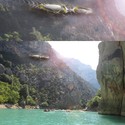
Dr. Margot Krasojevic is known for using digital parameters to explore the psychological effects of architecture – materials and spatiality – on its inhabitants. The Hanging Hotel / Suspended Campsite is one such project that was completed in October 2011 for Holden Manz Wine Estate Cape Town in Massif de L’ Esterel, (Gorges Du Vedron) South of France. The project is an investigation in the choreography of perceptions of the environment around us. In this particular project, catering to rock climbers, Dr. Krasojevic uses compound glass and a prism louver system to alter how the climbers see their environment and stimulates different psychological experiences based on these subtle shifts in vision.
After remaining on hold since 2005, the General Services Administration (GSA) has reinstated plans to construct a new U.S. Courthouse in downtown LA. The 3.7 acre dirt lot at 107 South Broadway, down the street from Morphosis’ Caltrans building, LA’s City Hall, and the Walt Disney Concert Hall, has remained dormant since 2007; shortly after the GSA abandoned Perkins + Will’s estimated $1.1 billion conceptual design due to rising costs. Now, plans for the courthouse have been scaled back and the GSA has just released the shortlisted teams competing of the project. Continue reading after the break to see who made the cut.
Created by Reiser + Umemoto for the Hong Kong & Shenzhen Bi-City Biennale, “Manhattan Memorious” explores what Manhattan could have been. The film visualizes several unrealized projects from Manhattan, including Buckminster Fuller’s dome over Midtown, Rem Koolhaas’ City of the Captive Globe, RUR’s East River Corridor, Paul Rudolph’s Eastside Redevelopment Corridor, Morphosis’ West Side Yard and others.
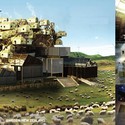
The Devoid Tower, designed by Daniel Caven at the Illinois Institute of Technology, Chicago, and featured in eVolo magazine, explores the passive systems that can be incorporated into high-rise design. Composed of a central volume that is pierced by a void, the tower’s design is influenced by a set of design rules, and tested using parametric and environmental analysis. More images and project description after the break.
In 2007 I visited one of the most talked about autism buildings at the time, the Netley Primary School Autistic Unit in London, England. To my surprise, the building did not look or function in the way the publication material had depicted it. The teachers I interviewed said the views from the nearly wall-to-wall, floor-to-ceiling windows were too distracting for the students. Their solution was to cover ¾ of the windows with paper. On top of making the building look somewhat rundown, this solution appeared to hinder the lighting design that originally depended on more daylight. The lesson for future projects seemed obvious; limit views and adjust the lighting accordingly. That is the conclusion I drew, and apparently so did Haverstock Associates, the firm that designed Netley.
After Netley, Haverstock Associates adjusted their approach for the recently finished Kentish Town School Autistic Resource Base. At Kentish Town, Haverstock scaled back the amount of exterior views by employing opaque walls that allow light in but limit views out. There are still a few large views to the outside, and the opaque walls are punctuated every so often with small clear glass windows, mostly above eye-level, but the approach is noticeably different from the one used at Netley (for Kentish Town project images see here). But is the conclusion about limiting views correct? Perhaps, but it might be something else. Maybe what is viewed matters more than how much is viewed.
https://www.archdaily.com/223076/architecture-for-autism-exterior-viewsChristopher N. Henry
“White”, a gallery installation produced by the 20 students of Studio 400, a fifth-year architectural design studio at California Polytechnic State University, San Luis Obispo, served to present each of the student’s research books. The installation was designed, developed, fabricated, and installed by the studio in a collaborative effort. The students developed the design over a period of about a month, with fabrication and installation occurring over a five day period. 80,000 square feet of plastic sheeting was sliced, loomed, woven, stapled, taped and tied to provide a climbable and malleable surface in the 4,500 square foot gallery. “White” supported a variety of interactive experiences above and below this dynamic surface, opening and exploring the relationships between book, user, material, space, and collective group. More images and the studio’s description after the break.
The winners of the Global Holcim Awards 2012 were recently announced which asked participants to design a project for a school in Gando, Burkina Faso, a community center in Sao Paulo, Brazil, and a plan for urban renewal in Berlin, Germany. These outstanding sustainable construction projects were selected from 15 finalists by a panel of independent experts led by Enrique Norten. More images and information on the winning designs after the break.
The semiannual journal SOILED, published by CARTOGRAM Architecture + Urban Design, has released its third issue, entitled Platescrapers, which probes edible encounters at the intersection of inhabited spaces and the processes of cultivating, peddling, and devouring. It posits that foodstuffs can become extensions of physical places. Platescrapers is at once a narrative and a rallying cry, commingling food culture with established power structures and political agendas. Along this trajectory, Platescrapers navigates itinerant fare, comestible politics, and gastro-ritual to purvey stories about social issues and exaggerated realities; each story illustrates food as a monument to galvanize the public. More images and information on the issue after the break.
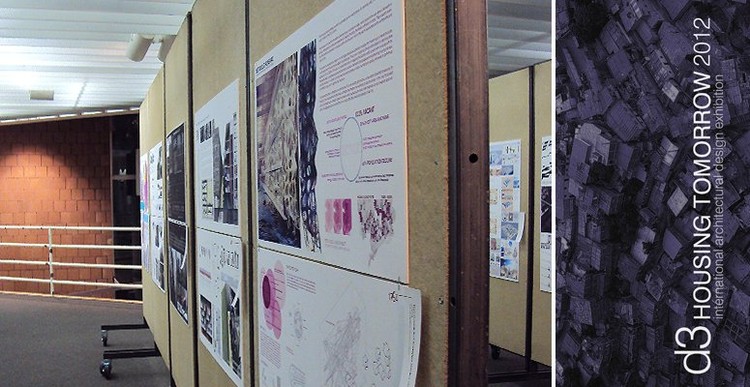
d3 is pleased to announce the winners of the 2012 Housing Tomorrow competition. The annual competition promotes the exploration of contextual, cultural, and life cycle flows that offer new housing strategies for living in the future. Sponsored by New York-based d3, the competition invites architects, designers, engineers, and students to collectively explore innovative approaches to residential urbanism, architecture, interiors, and designed objects.
d3 recognizes innovative strategies that challenge conventional housing typologies with emerging planning strategies, advanced technologies and alternative materials. Competition submissions for 2012 reflect forces of globalization and adaptation, as well as the changing nature of visualization in academia and professional design practice. As an annual competition, d3 Housing Tomorrow seeks to identify and celebrate emerging voices and visionary proposals that connect housing with people, context and ecologies.
Continue after the break to view the three winners and twelve honorable mentions selected by the jury.
Receiving second-place in the Classic Siftung Weimar international competition for the New Bauhaus Museum, the proposal by Architekten HRK (Klaus Krauss and Rolf Kursawe, Cologne) enhances the public access into Weimarhallenpark. The distinctive form of the museum creates a strong impression in the urban setting and is characterised by the cleverly staggered arrangement of the elongated structures. The proposal is also impressive in terms of its interior design qualities. The central interior space creates a unique, independent and attractive flair for the New Bauhaus Museum. Continue after the break for more images.
If you could construct your house out of materials made, recycled, or found within 100-miles of your lot, would you? And if you did, would you feel proud that you never once stepped into The Home Depot? Would you tout the fact that you took an environmental stand, that you did your bit to help the world?
Would you have?
As we mentioned in February, The Architecture Foundation of British Colombia has launched a competition to construct the 100-mile House. Inspired by the 100-mile Diet of locavore fame, in which you only eat what is grown or harvested within 100 miles of your home, the 100-mile house challenges you to construct historically, “using only materials and systems made/ manufactured / recycled” within a 100 mile radius.
But is this method truly better for the environment? Or just another example of pretentious pseudo-greenery?
Janine Benyus, president of the Biomimicry 3.8 Institute in Missoula, MT, will be giving a lecture at MIT on the theme of ‘Evolved to Fit: Biomimicry in the Built Word’. Janine Benyus is a natural sciences writer, innovation consultant, and author of six books, including her latest − Biomimicry: Innovation Inspired by Nature. In Biomimicry, she names an emerging discipline that seeks sustainable solutions by emulating nature’s designs and processes (e.g., solar cells that mimic leaves, agriculture that models a prairie, businesses that run like redwood forests). The event, which is free and open to the public, takes place Thursday, April 5th at 6:30pm at MIT Building 10, room 250. For more information, please visit here.
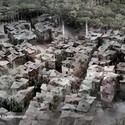
The center of Tirana is marked by a clear urban layout, but its recent growth filled up a large area around it without any order, structure, adequate services or meaningful public spaces. In this proposal by Cino Zucchi Architetti, in collaboration with One Works, Gustafson Porter, Buro Happold London, and Antonello Stella Architects, the voids rather than the buildings become the catalysts of new urban regeneration. In doing so, their design attracts public and private functions around a sequence of green spaces of high environmental quality. The extension of the boulevard into a lively green promenade progressively opens up to the beautiful landscape of the hills across the Tirana river. More images and architects’ description after the break.
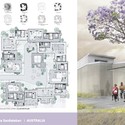
Armin Valter and Joel Kopli shared with us their competition winning proposal for the Memorial of Victims of Communism in Estonia. Situated on/in northern coastal limestone cliff near town Paldiski, which was a closed military nuclear submarine base in soviet times, their design attempts to revitalize the place and bring more awareness to people of the region. More images and architects’ description after the break.
The 12th International Alvar Aalto Symposium will be held in JyväskyläFinland from August 10-12, 2012. With the theme of ‘Crafted’ – The Ingredients of Architecture’, the question arises: How does architecture rise above the ordinary? Organised by the Alvar Aalto Academy, the international Alvar Aalto Symposium aims to address the complex relationship between material, craft and culture, not simply as a matter of professional practice but also as a sociological and pedagogical imperative. More information on the event after the break.
We at ArchDaily are used to picking the best buildings for you, dear readers, but we felt it was time to turn the tables a bit. The following is the best of you. You didn’t always agree with us, but you opined intelligently, and for that we salute you.
”Imagine if we designed all public space as if we lived in a democracy. Imagine if we treated participation as a right. Imagine if this was part of the core curriculum in architecture schools.”
– Graeme Bristol
Our Number 1 Comment, after the break…
https://www.archdaily.com/222335/the-best-of-you-our-top-3-comments-of-the-monthAmber P