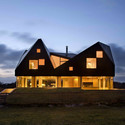
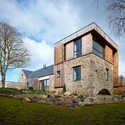
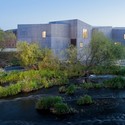
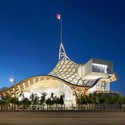
The 2012 RIBA Award winners have been announced! Since 1966, RIBA has set the standard for architectural excellence across the UK with the RIBAAwards. As bdonline points out, this year RIBA has halved the number of projects who have received awards in an attempt to harden the competition. Shortlisted from 739 entries, the 59 winners chosen from the UK and EU will now be considered for the 2012 RIBA Stirling Prize – the UK’s most prestigious architecture prize whose 2011 winner was the Evelyn Grace Academy by Zaha Hadid Architects.
RIBA president Angela Brady said: “The judges were delighted to see so many well considered, crafted and innovative projects, and the use of beautiful materials; these projects are truly exciting and inspiring.”
In April, Black Spectacles filmed a discussion with Stanley Tigerman and the AIA Chicago Education Knowledge Committee revealing an intimate look at Tigerman’s 60+ years in the profession in his own words. The discussion is guided by a series of questions from the audience that send Tigerman into stories from his experiences, his attitude towards the profession today, technology and ethics.
Read on for key points from the interview after the break.
The Globe/Hedron Rooftop Farm is a bamboo greenhouse designed to organically grow fish and vegetables on top of generic flat roofs. Designed by Conceptual Devices, the structure is optimized for aquaponic farming techniques: the fish’s water nourishes the plants and plants clean the water for the fish. Using this farming technique, the design is optimized to feed four families of four all year round. More images and designers’ description after the break.
Every June 21st since 2003, Go Skateboarding Day has rallied skateboarders around the globe – in skateparks and public plazas, downtown nooks and parking lots – to grind, ollie, and kickflip it with the best of them.
If I didn’t lose you at “ollie,” you’re probably wondering: what the heck does this have to do with architecture?
Well, I could talk about the architectural challenge that a skate park, as an interactive public space with specific topological requisites and social implications, offers architects. I could show you some cool testaments to the fact, such as the Architecture for Humanity-sponsored projects in Afghanistan and Manhattan, opening today.
But, rather selfishly, I’m more interested in what skateboarding has to offer us beyond skateparks. A skater, unlike your typical pedestrian, experiences space just as intensely and consciously as an architect himself, albeit in a different way. He/she is alive to the possibility of space, not in its totality, as an architect would be, but as a collection of tactile surfaces to be jumped on, grinded, and conquered.
The skater offers a revolutionary perspective for the architect: one that allows you to see buildings beyond what they were intended to be, to see (and design) buildings as “building blocks for the open minded.”
We continue our coverage of the Architecture Billings Index with a not-so optimistic report for May. The economic indicator showed a substantial drop in the Index (which had previously been inching upward over the past five months). In fact, all regions reported a decline in demand for design services and all regions fell below 50 (any score above 50 indicates an increase in billings). The official report for May was 45.8, with the regional breakdown as follows: Northeast (48.6), West (47.6), Midwest (46.8), South (46.1). “For the second year in a row, we’re seeing declines in springtime design activity after a healthy first quarter. Given the ongoing uncertainly in the economic outlook, particularly the weak job growth numbers in recent months, this should be an alarm bell going off for the design and construction industry,” said AIA Chief Economist, Kermit Baker, PhD, Hon. AIA. “The commercial/industrial sector is the only one recording gains in design activity at present, and even this sector has slowed significantly. Construction forecasters will have to reassess what conditions will look like moving forward.”
From next Friday 22nd will take place the AA Projects Review Exhibition. The place of the event is located in the Architectural Association’s main building at 36 Bedford Square, London WC1B3ES.
Projects Review offers an overview of the AA’s 2011/12 acadamic year. On display are hundreds of drawings, models, installations, phogographs and other materials documenting the diversity and experimental nature of the AA School.
‘At the AA architecture is pursued as a form of cultural knowledge, across year-long design projects and portfolios. We believe that truly great schools don’t just nurture and support architectural talent: they build audiences for experimentation, out of which new architectural ideas, visions and projects emerge. Please join us as part of this audience, which the AA remains committed to promoting at the cutting edge of architectural cuture, practice and learning.’
The access to this Friday event required invitation but will be free the rest of the days until 14th July.
Safdie Architects was recently selected to design a new mixed-use development in Colombo, Sri Lanka. The 69-storey mixed-use project will be the first for Moshe Safdie in Sri Lanka, and is expected to be the tallest residential building in Colombo when it is completed. The design includes expansive family and community space amenities such as community gardens, shared outdoor spaces within the upper levels of the building, and individual roof gardens or terraces for every residence, a hallmark of Safdie’s design philosophy to provide access to outdoor spaces in high density urban housing. More images and architects’ description after the break.
The proposal for the Ajoodaniyeh Tower by Kamvari Architects seeks to use traditional design within Iran as a means of addressing performance criteria within a high-rise. With the intention of analyzing unique aspects of traditional architecture specific to the region, they combine these with advanced design methods to produce a novel proposal for the site and our client. More images and architects’ description after the break.
Despite all of the preconceived notions about New York City being overpopulated, noisy and constantly bustling, there are numerous pockets within the five boroughs that offer respite from the city. This design strives to be one such pocket – or island. Governors Island has a long military history that dates back to 1776. It was controlled by the U.S. Government first for the U.S. Army and later for the Coast Guard. In 2002 the island was “sold” to the people of New York and declared a national monument. In 2010, Mayor Bloomberg and Governor Paterson agreed on the future operations, planning and redevelopment of the island through the Trust for Governors Island. Since then, the island has been open during the summer months for visitors to enjoy the unique seclusion offered by the the old military grounds. But the Trust had bigger plans. Choosing a team of architects, urban planners, designers and landscape architects that include Rogers Marvel Architects, Diller Scofidio + Renfro, Mathews Nielsen and led by West 8, plans began to unfold that would reimagine the island as a getaway for New Yorkers. Playing up to its isolation, its abundance of lawns and trees, and the views that it offers, the first phase of the plans have officially broken ground and are scheduled for completion in Fall 2013.
If you love architecture, this is one auction you won’t want to miss! Architecture for Humanity has launched their highly anticipated I Love Architecture Charity Auction, featuring over 70 sketches from 50 of the world’s top architects and designers. The time to start bidding is now, as the auction will close on June 29th. All proceeds will support Architecture for Humanity.
UPDATE: In an e-mail to ArchDaily, a Sr. PR Manager at OMA told us that while Victor van der Chijs expressed his hopes that Turkey will host the Olympics in an interview with an Anatolia news agency earlier this month, OMA is not planning on opening an office in Turkey any time soon.
The Metropolitan Transportation Authority has selected L.A.’s Gruen Associates and London’s Grimshaw Architects to design the new master plan for Union Station in Los Angeles. The pair was awarded with the commission over some of the biggest names in the profession, such as Norman Foster and Renzo Piano (view the other five fantastical proposals here). They will transform the historic 1939 station and its surrounding 40 acres into a world-class, 21st century transportation hub that will host the future high-speed rail system that plans to connect L.A. and San Francisco.
The master planning process could take as little as 24 months. No surprise, considering both Gruen and Grimshaw have a great amount of experience with transit related projects. Gruen recently worked with Metro on the first phase of the Expo Line, while Grimshaw has extensive resume in Europe and is involved with the forthcoming Fulton Street Transit Center in Lower Manhattan, which is planned for completion in 2014.
China is well known for its mind-bogglingly fast-paced construction, but its latest claim is truly one for the record books.
Sky City, an 838-meter (2,750-ft) building to be built by Chinese construction company Broad Sustainable Building (BSB), of Broad Group, will not just be the tallest skyscraper on the planet, won’t just be “earthquake-proof,” won’t just implement a sustainable design approach – it will go up in only 90 days.
Skeptical? BSB isn’t. They’ve used their building technique (which involves pre-fabricating and assembling up to 95% of the materials in modular form before construction even begins) to assemble a 15-story building in 6 days and a 30-story hotel in 360 hours,CNN reports. As for safety concerns, BSB has built a 30-story prototype that withstood a simulated magnitude 9 earthquake — whether the 220-story Sky City will be as secure remains to be seen, but BSB certainly seems confident.
The 244th annual Summer Exhibition at the Royal Academy of Arts, which is held until August 12, features a site specific architectural installation designed by architect and artist Chris Wilkinson, Director at Wilkinson Eyre Architects. Positioned in the center of the RA’s Annenberg Courtyard, From Landscape to Portrait is a 12 meter-long sculpture based on a series of 11 wooden artist’s frames, supported upon a timber structure clad in polished stainless steel. More images and information on the installation after the break.
Architect: CEBRA Location: Tuborg Havnevej 7, Hellerup, DK Client: Experimentarium Area: Approximately 30.000 m2 modernization and extension Program: Center for Natural Science and Technology Competition Year: 2011 Completion Year: 2015
After placing first in the design competition to transform an old mineral water bottling plant into a Science Center, CEBRA will move forward with the adapted proposal upon receipt of a substantial donation from the The A.P. Møller and Chastine Mc-Kinney Møller Foundation. The original building will be restored to serve as an interactive national center for science, technology and culture and house the Experimentarium’s diverse exhibition and education activities for the neighboring communities. CEBRA’s solution of layering a new expression on the historic entity brings science to the forefront while acknowledging contextual cues that create links back to its surroundings.
Located on an urban corner lot in the city of Vancouver, the Zero Mile House establishes a relationship between the size of the lot and the size of the construction it supports. Designed by Yianna Bouyioukou, the architectural strategy is focused on most of the house’s construction materials being produced literally on the specific lot. This way, land is not only the physical support for the human habitat, but also the provider. More images and architects’ description after the break.
Located on top of a plateau, which is abruptly ended by a sloped edge, the strong topographical element of the Riethüsli Primary School leads to a severe breaking point between the site and its surrounding context. Designed by MPP Architekten, the aim of the concept is to let the school act as an urban communicator. More images and architects’ description after the break.
The main objective of the project for the Ödemis New City Center by Onat Öktem is to integrate urban functions to ensure the continuity of the pedestrian and green axis while creating a new structure. In this context, defined and undefined urban spaces have been reorganized to increase the physical, social and cultural wealth of the citizens. Green axis, squares and spaces in the city have been evaluated as an advantage for the social, cultural and physical development. More images and architects’ description after the break.
Five international consortia of architecture and landscape firms have been shortlisted in a competition to design the future research centre of the European Spallation Source (ESS)- a Partnership of 17 European Nations committed to the goal of collectively building and operating the world’s leading facility for research using neutrons by the second quarter of the 21st Century. The 21st century, large-scale science centre will focus on sustainability, creating an attractive working environment and integrating well into its surroundings. It will be built in southern Sweden and is planned to open in 2019.
Continue after the break to view the complete shortlist.