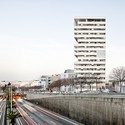
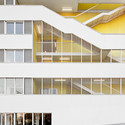
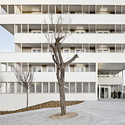
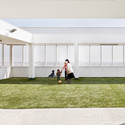
The program is intended to engage students and recent graduates, working individually or in teams to imagine the repurposing of our existing cities with buildings that are made from renewable resources, offer expedient affordable construction, innovate with new and old wooden materials, and provide healthy living / working environments.
The story of the Zachary House, designed byStephen Atkinson Architecture, is one of idealism of the profession and faith to the design. In three iterations, the house that was originally designed for Atkinson’s own parents went from being the incarnation of the architect’s own ideal image, revered by both modernists and traditionalists, to a highly protected “manuscript” of an architectural vision. The house was originally built in the 90′s in Zachary, Louisiana, where it gained a substantial amount of attention from other residents and the media for its blend of the “dog trot” and “shotgun” style homes. The house, now in its third life, was built under specific conditions that maintained every element of its distinctive design.
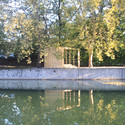
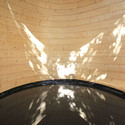
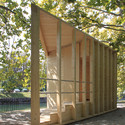
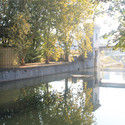
Architects: twelveplus Location: Ljubljana, Slovenia Architect In Charge: Kieran Donnellan Project Year: 2012 Photographs: Courtesy of Water Temple Workshop
In their second prize winning design in the international competition, ZA Architects aimed at developing a few new principles of hotel organization. Instead of separating visitors from the environment, the architects intends to embed peoples’ lives in local city life. For this reason, there is no hotel building itself, instead they propose hotel rooms placed in existing buildings (offices, residential) connected with web of hung pathways. More images and architects’ description after the break.
Taking place now until January 13 at the Carnegie Museum of Art, the ‘White Cube, Green Maze: New Art Landscapes’ exhibition consists of a worldwide survey of art sites that break open the “white cube” gallery space. These sites typically mix old and new, featuring collaborative plans by several designers and encouraging exploration outdoors as a new type of museum is emerging — one that fuses inventive architecture and landscape design with radical conceptual and installation art. More images and information on the exhibition after the break.
Kengo Kuma & Associates, together with Holzer Kobler Architekturen, won the architectural design competition launched in 2012 to develop Cosandey Square at École Polytechnique Fédérale de Lausanne (EPFL). Their project, “Under One Roof,” will unite an experimental Art & Sciences space and a demonstration pavilion under a single, long stone roof at the Montreux Jazz Lab. To connect science and culture at EPFL, the university’s campus will boast a novel “backbone” that stretches the length of Cosandey Square. More images and architects’ description after the break.
This latest architectural publication for CLOG seeks to highlight a defining architectural style of the postwar era — characterized by severe, abstract geometries and the use of cast concrete, block and brick — Brutalism arguably produced some of the world’s least popular public buildings.The style’s international propagation brought modern architecture to ever-larger constituencies, and some argue that the perceived shortcomings of these Brutalist structures led to the demise of the Modernist project. While today often admired (and even loved) by architects, many Brutalist projects are now threatened with demolition. Judging by the work of many contemporary practitioners, however, the influence of Brutalism only seems to grow. Before the wrecking balls swing, it is time to look back on, debate, understand, and learn from Brutalism. Submissions are due November 5. For more information, please visit here.
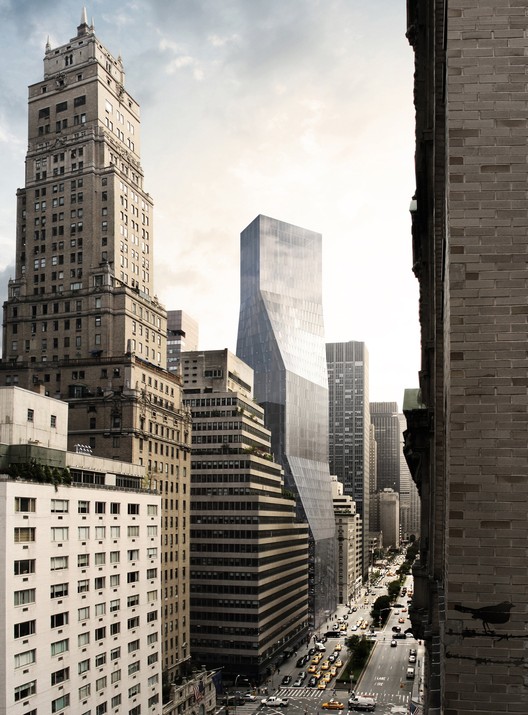
Only weeks after revealing their designs for 425 Park Ave., soon to be New York’s latest “Iconic” Building, Foster + Partners have now taken a stab at one of New York’s oldest iconic buildings: Grand Central Station.
Yesterday, at the MAS 2012 Summit, Norman Foster was one of three architects to present his re-imaginings of the station, which turns 100 this February. Unfortunately, it hasn’t borne its age well. Designed to support 75,000 people a day, Grand Central, one of the world’s busiest transport hubs, routinely handles about ten times that much (and even a million on peak days). With the upcoming LIRR East Side Access and plans to re-zone the area, now is the time to re think this building’s future.
Foster + Partners has developed tremendous expertise in transit programs, having designed some of the world’s largest airports, viaducts, subway stations – even a spaceport (perhaps there’s no better example of their facility for tackling enormous infrastructure challenges than their proposal for the Thames Hub). That expertise shows in their vision for Grand Central, which eases accessibility and mobility by widening concourses, improving entrances, enlarging public spaces, and reconfiguring streets in favor of pedestrian traffic – bringing, in their words, “clarity back to Grand Central Terminal.”
More about this project from Foster + Partners after the break:
Our friends from JAJAshared their latest proposal, which was awarded third prize, for a new public library in Daegu, South Korea. Pushing the boundary of the notion that a library must be a contained, quiet and nearly isolated space, JAJA’s proposal treats the library as massive public zone for the fostering of communal creativity, and dissolves the separation between inside and nature. JAJA, typically noted for their form making abilities, have opted for a minimialistic formal language of the architecture, so that the streamlined library can capture the textures of the existing trees and the books within to create a cohesive experience that celebrates both.
More, including images, drawings and model photos, after the break.
The competition winning proposal for the three metro stations of the second metro line at Wola district in Warsaw focuses on showing a clear connection between designed stations and the context of the surroundings. Designed by a collaboration between KiR Biuro Projektowe and a group of independent architects, one can interpret the stations as a specific indication and an invitation to interesting, though perhaps a bit forgotten places “on the surface” corresponding to the stations. The context of the place gave a separate, unique character to each of the stations. More images and architects’ description after the break.
Designed by TAAT (Theatre as Architecture, Architecture as Theatre) and exhibited at the World Horticultural Expo 2012, Khor I is a specific challenge to perform a play without any guidance or introduction. The dramatic situation is simply available and can be ‘filled-in’ and approached freely. The theatre installation represents a common ground between theatre, architecture and the visual arts with its monumental quality. More images and architects’ description after the break.
L&L Holding just unveiled an exhibit of conceptual designs created by the four finalists in its recently-concluded international architecture competition to design a new 425 Park Avenue tower in Manhattan’s prestigious Plaza District. The exhibit is running as part of the Municipal Art Society’s 2012 MAS Summit for New York City being held at Jazz at Lincoln Center on until today, October 19.
The two-day exhibit includes brief narratives and a host of visuals that were included as part of each finalist’s submissions, which were first presented to L&L Holding in July. The submissions on display are from the following international firms, each led by a Pritzker Prize-winning architect: competition winner Foster + Partners (Lord Norman Foster), Rogers, Stirk, Harbour + Partners (Lord Richard Rogers), OMA (Rem Koolhaas) and Zaha Hadid Architects. More images and information on the finalists’ proposals after the break.
The Daegu Gosan Public Library Competition Entry by Eduardo Lopez arises from two considerations; in the first place, understanding the importance of the facade as a foreground and background to the library site and secondly, taking up the radical change to the direct link between the ‘green belt’ and the surrounding area. To resolve this, the architects attempt to merge the library volume with the buildings next to it and create a movement in the facade, where the trees of the ‘green belt’ carve the facade vertically, creating a sense of dynamism. More images and architects’ description after the break.
Named in tribute to Ken Roberts, a Dallas-based architect, the annual Ken Roberts Memorial Delineation Competition has grown from an event that recognized hand-drawn renderings of local area architects to a competition that encompasses architectural delineation made in a variety of media by students and professionals the world over. Organized by AIA Dallas, “KRob” is the longest-running architectural drawing competition anywhere. New to this year’s competition is a category dedicated to travel sketches, open to all students and professionals. Prize winners in all categories will receive a generous assortment of hardware from Doghouse and Wacom as well as software provided by Corel.
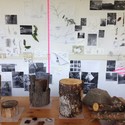
A small group of diverse students participating in the inaugural AA Visiting School Eugene were given the responsibility to design and build something that would enhance and reflect the forest, within a ten-day timeframe.
MAS Context, a quarterly journal created by MAS Studio, recently released their fifteenth issue: VISIBILITY. Making visible the invisible. That was the title of their interview with interactive designer George Legrady. Conceived for the Seattle Public Library, it visualizes the circulation of books going in and out of the library’s collection. This issue continues to make visible the invisible conditions present around us that inform the way we engage with the city. At the same time, they are bringing forgotten landscapes, hidden away systems and lost environments back to the forefront of the discussion, all of them significant in our history and waiting to be reexamined. To download the journal, please visit here. More information after the break.
The competition also included Atelier Christian de Portzamparc, Ateliers Jean Nouvel, Herzog & de Meuron, KPF, Maki and Associates, Renzo Piano Building Workshop, Richard Meier, Rogers Stirk Harbour + Partners and Zaha Hadid Architects; and all the projects will be presented today at the MAS NY Summit.