
-
Architects: Foster + Partners
- Year: 2008
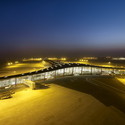
Text description provided by the architects. After 4 years the Beijing Airport -currently the biggest one in the world- is finished, just in time for the 2008 Olympics. The airport, designed by Foster + Partners, turned out to be a very efficient building in terms of in terms of operational efficiency, passenger comfort, sustainability and access to natural light.

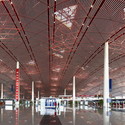
As an interpretation of traditional chinese culture the roof of the airport has a dragon-like form. According to Norman Foster this is a building borne of its context. It communicates a uniquely Chinese sense of place and will be a true gateway to the nation. This is expressed in its dragon-like form and the drama of the soaring roof that is a blaze of ‘traditional’ Chinese colours – imperial reds merge into golden yellows. As you proceed along the central axis, view of the red columns stretching ahead into the far distance evokes images of a Chinese temple.

Project description
Located between the existing eastern runway and the future third runway, Terminal 3 and the Ground Transportation Centre (GTC) together enclose a floor area of approximately 1.3 million m2, mostly under one roof. The first building to break the one million square meter barrier, it will accommodate an estimated 50 million passengers per annum by 2020.

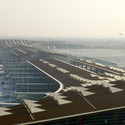
Although conceived on an unprecedented scale, the building’s design aims to resolve the complexities of modern air travel, combining spatial clarity with high service standards. It will be friendly and uplifting for the passenger as well as easy to navigate. Comprising three connected, light-filled volumes – T3A, B and C – the simple, symmetrical diagram fans out at either end to accommodate the arrivals and departure halls for T3A (processing terminal and domestic gates) and T3B (international gates). The satellite T3C (domestic gates) occupies the centre of the diagram. This arrangement is an efficient means of maximising the perimeter, so increasing the capacity for aircraft stands, while maintaining a highly compact and sustainable footprint.

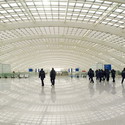
Although the length from north to south is three and a quarter kilometres, the visual links between the three elements are maintained by strong sight lines as well as visual connections between the lower level and an open mezzanine level above. All spaces are naturally lit and the generous glazing and skylights maintain a link with the outside and its changing sky. Views along the central axis are marked by the distinctive red columns, which continue along the external edges of the building into the distance, evocative of traditional Chinese temples.

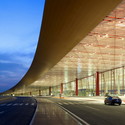
The embracing curved cantilever of the terminal greets passengers arriving by road or from the GTC in a single welcoming gesture. Departures and arrivals are on separate levels. The traditional airport diagram has been inverted at T3B, with arrivals on the upper level, to allow visitors to Beijing to experience the thrill of this dramatic space from the best vantage point.

The single unifying roof canopy is perforated with skylights to aid orientation and bring daylight deep into the building. The colour palette moves through 16 tones from red at the entrance at T3A through to orange and finally yellow at the far end of T3B. This establishes a subtle zoning system that breaks down the scale of the building and enables easy wayfinding. This palette is also applied north to south in the ceiling above the arrivals and departures halls, heightening the sense of curvature in the roof plane.
Connections between T3A and T3B take place on a high speed automated people mover (APM) which travels at up to 80kph, with a journey time of just two minutes. The APM is easily accessed from the main departure level and set within a landscaped ‘green’ cutting, exposed to daylight and views up and through the building, all of which helps to maintain a sense of orientation.

The roof is a steel space frame with triangular roof lights and coloured metal decking. It curves, rising at the midpoint to create a dramatic central cathedral-like space, and tapering towards the edges of the building to provide more intimate areas as passengers travel towards the gates and the aircraft piers. The trusses that support the glazing echo the changing colour system in the roof – shifting from red to orange to yellow. The high transparency of the curtain walling is made possible by extra large mullions, which are generously spaced to allow larger spans of suspended glazing.
The terminal building is one of the world’s most sustainable, incorporating a range of passive environmental design concepts, such as the south-east orientated skylights, which maximise heat gain from the early morning sun, and an integrated environment-control system that minimises energy consumption. Rather than the sprawl of many separate buildings, it uses less land by bringing everything closer together for ease of communication in one efficient structure, yet it is still 17% bigger than the combined floorspace of all of Heathrow’s terminals 1, 2, 3, 4 and the new Terminal 5. In construction terms, its design optimised the performance of materials selected on the basis of local availability, functionality, application of local skills, and low cost procurement.
ALL IMAGES © NIGEL YOUNG / FOSTER + PARTNERS