Indeed, entering the Main Concourse of Grand Central Terminal is a pleasure that rivals few others. For me, it took me by surprise: walking, as New Yorkers do, in a determined beeline through an undistinguished tunnel, I was suddenly struck by light. I stopped, as New Yorkers never do, to observe a vaulted, starry ceiling, the changing light, and multitudes of people whipping by.
Grand Central is one of New York’s most beloved icons, one of the few which tourists and natives share alike. Which is not to say, of course, that it isn’t in need of a face-lift.
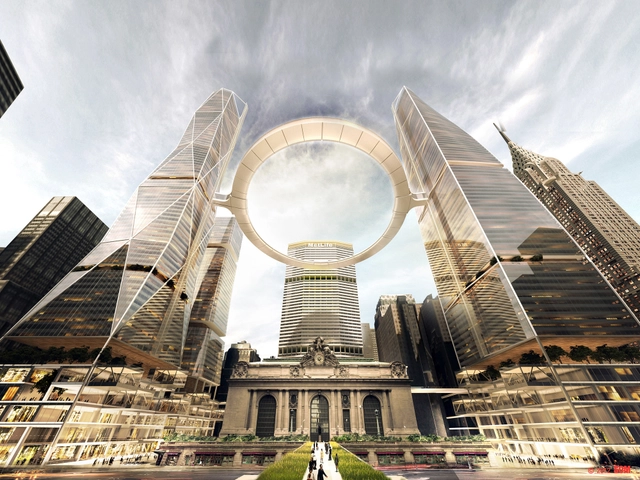
The Terminal’s upcoming centennial, which corresponds with proposed re-zoning laws that would completely change the face of Midtown, makes now the perfect moment to consider how Grand Central’s grandeur can be preserved and its neighborhood reinvigorated. Last week, the Metropolitan Art Society (MAS) invited three firms to share their visions - and while SOM’s gravity-defying “halo” may have stolen the show, only one truly captured the spirit of Grand Central, and explored the full potential of what it could - and should - one day be.
Last week, Donaire Arquitectos was selected as the winner of the international competition, organized by ArchiFolio, to build the new A.M. Qattan Building, which is a charity that has worked towards the development of culture and education, with a particular focus on children, teachers and young artists. Located in Ramallah, Palestine, the winning proposal for the Quattan Foundation is perceived as a lighthouse bringing enlightenment to the Palestinian people. This role as flagship of Palestinian culture is in need for a recognizable image worthy to represent its social leadership with a physical landmark. More images and architects’ description after the break.
At about the same time as Kenzo Tange’s two huge Olympic arenas for the Olympic Games in the summer of 1964 in Tokyo, there was built in the southern part of Japan a much more modest sports arena of Takamatsu in Kagawa Prefecture between 1962 and 1964. More after the break.
Sou Fujimoto Architects have shared with us their first place proposal for the Beton Hala Waterfront Centre in Belgrade, Serbia. Contrasting the medieval fabric of the capital city, Sou Fujimoto’s “floating cloud” intertwines an array of social and transportation programs into an organized tangle of suspended ramps that emerge from the static platform of the Beton Hala. It was lauded by the jury to be a “brave proposal” that holds the “highest emblematic potential among all of Beton Hala entries”.
SOM recently shared with us their new tower located in Manila’s Makati Central Business District that has been shortlisted for a 2012 MIPIM Asia award. Rising 33 stories to height of 160 meters, the Zuellig Building is the first premium office tower in the Philippines to be erected since 2000. It is also the first building in Makati that has been pre-certified by the U.S. Green Building Council (USGBC) at the LEED Gold level, and is expected to achieve LEED Platinum certification by September 2013. More details after the break.
The Brazilian Institute of Architects and Rio de Janeiro department (IAB-RJ) have announced architects Pedro Évora and Pedro Rivera of RUA Arquitetos as winners of a competition to design the 2016 Olympic golf course clubhouse. The competition, open to professionals who graduated within the last 15 years, attracted entries from 82 teams of architects and landscape architects from across Brazil.
RUA Arquitetos’ winning scheme captures the atmosphere of Rio by showcasing the lush tropical landscape of Barra da Tijuca with a large veranda whose lightweight roof collects rainwater to irrigate the course.
Continue reading for the architects’ project description.
Grant Associates shared with us their just released short film of a walk round Gardens by the Bay in Singapore, which recently received the World Building of the Year Award at the World Architecture Festival. One of the largest garden projects of its kind in the world, Andrew Grant, director of UK landscape architects Grant Associates, walks around Gardens by the Bay in Singapore, reflecting on the ideas and inspirations behind the the design of the spectacular Supertrees, Cooled Conservatories and Themed Gardens. The project is an integral part of Singapore’s “City in a Garden” vision, designed to raise the profile of the city globally whilst showcasing the best of horticulture and garden artistry.
Most people would imagine libraries being made up of large platforms fully equipped with rows of desks and bookshelves stacked on one another with strict division of programs in the building. However, the second prize winning proposal by Seung Hyun, Yuh and Se Hyeon, Kim from studio SH for the new library typology for Gosan starts by examining and breaking apart this hierarchical inclination. By blurring this strict boundary and providing flexibility in its library program, the ‘White Diamond’ becomes not only a place for exploring knowledge but also a space for meditation with diverse private and public experiences. More images and architects’ description after the break.
Lattice Lab is a two-day workshop put on my modeLab, which takes place November 10-11. The lab will focus on the topic of topological/subdivision modeling with paneling tools and weaverbird. In a fast-paced and hands-on learning environment, they will cover fundamental concepts related to working with mesh geometry, high-order topological smoothing, and grid-based modeling. Drawing inspiration from the patterns found in 3-dimensional lattice structures, they will create geometrical units capable of responding to a range of dynamic contexts. Additionally, they will explore the limits and opportunities of 3D printing while testing the visual and structural effects of their lattices. For more information, please visit here.
Architecture school ideally combines practical, intellectual, and theoretical skills which center on the production of physical projects. The key is to find programs that are able to provide a judicious cross-section of disciplines to develop one’s critical and practical abilities. That is done either within the design program itself, or by providing access to other colleges and school campuses.
Hosted by the faculties of Architecture and of Inter-Media at the China Academy of Arts in Hangzhou, the ‘Made With Bamboo: Architecture, Arts & Crafts’ event will take place Monday, October 29th at 6:30pm. The aim of this presentation is to grow the appreciation of this wonder grass and the most outstanding architects, designers and craftsmen working with bamboo by celebrating their works. The architecture section concentrates first on structural solutions mainly as developed in Colombia and than on aesthetic solutions. The main emphasis of the arts & crafts section is the exceptional Japanese basketry. More information after the break.
Michael Van Valkenburg Associates (MVVA) and Thomas Phifer & Partners have been announced as winners of an international competition set to transform 15 blocks of the neglected Waller Creek in downtown Austin, Texas, into a vibrant local attraction. Co-sponsored by the nonprofit Waller Creek Conservancy and the City of Austin, the ambitious project intends to spearhead redevelopment within the city’s central business district with the 1.5 mile urban scheme that represents approximately 11 percent of Austin’s downtown.
“Today, we glimpse a transformation of Austin through a new community gathering place. This design team selection illustrates our City’s desire for great civic space, unique culture and opportunity for interaction with nature,” Austin Mayor Pro Tem Sheryl Cole said during the City Hall announcement. “We look forward to each new milestone of this development.”
The preservation battle continues over the fate of Bertrand Goldberg’s 1970’s Prentice Woman’s Hospital. As we reported in July, an ever-growing community of prominent architects – such as Frank Gehry, Jeanne Gang, Tod Williams and Billie Tsien – have joined preservationists in the fight to save the late modernist structure that is at risk of being replaced by a new biomedical research facility for Northwestern University.
The seven-story concrete cloverleaf, cantilevered 45 feet from the supporting core and floating atop a glass and steel box, is an engineering feat ahead of it’s time as well as an important icon within the Chicago skyline. As architecture critic Michael Kimmelman argues, “Great late-Modernist buildings, innovative and ruggedly beautiful, deserve respect and, increasingly, careful custody. Prentice is a good example.” However, it is not suited for 21st-century research labs and many Chicagoans hate it. Currently, Northwestern University is leading the debate by arguing that a new building would “bring to the city millions of investment dollars, create jobs and save lives”.
Could there be a compromise? Solutions are rarely black-and-white. Kimmelman has consulted Chicago architect Jeanne Gang to envision a proposal that would satisfy both opposing sides. Continue reading to learn more.
Construction has commenced on the US Air Force Academy’s Center for Character and Leadership Development (CCLD), designed by SOM. This new building will be the most recent addition to the Air Force Academy’s Campus in Colorado Springs, Colorado, which was also designed by SOM in 1954. The design and construction of the new facility gives SOM the opportunity to revisit the significant project of the 20th century and incorporate the values of the initial design to the addition.
Oyler Wu Collaborative was once again asked to design the architecture for SCI-Arc‘s graduation ceremony along with other faculty members. The challenge included rethinking the event of the ceremony while keeping the existing pavilion they had previously designed. Essentially, the challenge called for making the existing pavilion new again. Their stage operates as a hybrid of different elements, incorporating into it a large stage with a central podium, seating that is configured much like a bleacher, and a cantilevered shade canopy. While the center of the actual stage is in alignment with the center of the existing pavilion, the overall structure is positioned asymmetrically, with the bleacher and canopy located off axis. More images and architects’ description after the break.
Located in Rome’s ‘Olympic Village’, the ‘Cube House’ is laid out as a single unit in which a central element, in the form of a cube, divides and distributes its various functional areas without any interruptions: living, sleeping, cooking and bathing. Designed by Studio Schiattarella, their renovation in the original 49 m2 apartment is designed in a way that all the internal partitions could be eliminated, resulting in the formation of a single open space measuring 7m x 7m. More images and architects’ description after the break.
If you are considering turning your designs and business practices into a more eco-friendly, deeper shade of green, then we strongly encourage you to attend the ‘Implementing Green Practices in Your Designs’ free event as part of the How to Make it series. Hosted by UncommonGoods, a brooklyn-based online retailer of unique gifts and creative designs, the event includes a panel of design professionals sharing their advice on how to source more eco-friendly materials and how to set up a studio or workspace with little environmental impact. Taking place October 29th from 6:30pm-9:00pm, attendees will also have the opportunity to discuss their product ideas and designs with the buyers and panelists. For more information on the event, please visit here.
Just this Monday, Kongsberg City Council announced that Mecanoo Architecten, together with Code Arkitektur and Buro Happold, won the design competition for a Knowledge and Cultural Square in the center of Kongsberg, a former mining town about 75 kilometers southwest of Oslo, Norway. The project comprises of a design for a cultural and teaching building totaling approximately 24,000 m², and includes future expansion of other functions, such as student housing, sports facilities and businesses. More images and architects’ description after the break.
October 24 marks the long-awaited grand opening of the Franklin D. Roosevelt (FDR) Four Freedoms Park in New York City. Located on a triangular site formed by the southern tip of Roosevelt Island, the four-acre FDR memorial park stands for the “freedom of speech and expression, freedom of worship, freedom from want, and freedom from fear”. It was conceived nearly four decades ago by the legendary architect Louis Kahn, shortly before his death in 1974.
Read our previous coverage for all the design details and get a sneak peak after the break with images from the dedication ceremony.
British-American architect and historian Kenneth Frampton has been confirmed as this year’s winner of the Theory Prize of the Schelling Architecture Foundation. The jury is honoring Frampton for his “fundamental studies on tectonics and the architectonic large-scale form as predominant elements of urban landscapes. His theoretical range encompasses a vastness that no other prominent thinker in architecture has yet achieved. In addition, he will be honored for his accurate studies in which he has been analyzing current construction processes as well as the history of modern architecture since the early 19th century”.
As the winner of the 2012 Theory Prize, Frampton will now participate as a jury member in the selection of the Schelling Architecture Prize winner. Given that of the ten winners of the Schelling architecture prize four of them have already won the Pritzker Prize – most recently Wang Shu and Lu Wenyu – the nomination for the Schelling Architecture Prize is in itself a distinction.
The three nominated practices for the €20,000 Schelling Architecture Prize are:
The outcome of the 2012 United States presidential election will have global economic implications. In the midst of one of the most severe global recessions in history, policymakers around the world are waiting to see which way the United States will go this coming November. Will it stay the course of potential recovery—as yet incomplete—set by President Barack Obama? Or will it veer to the right into the still vague and undefined policies of challenger Mitt Romney?
For architecture specifically there is much at stake in this, the most expensive presidential race in history, where two contrasting visions of government’s role in the economy are boiling over. The Democrats advocate a course of continued federal investment and regulation to steer the country through rough economic waters they say were created by eight years of Republican policies. The Republicans point the finger and say Obama’s policies have not succeeded. They prioritize bringing down the deficit, reducing the size of the federal government and less regulation. Both sets of policies claim to be the answer to get the economy growing again.
Regardless of who wins the chances that economic growth will magically spring back to pre-recession levels are slim to non-existent. But whose policies would be more likely to at least make the long climb out of the well more tolerable?
Vote in our Presidential Poll after the break
https://www.archdaily.com/285321/archdaily-u-s-election-poll-where-do-architects-standAD Editorial Team