Today we had the chance of attending the opening of this impressive exhibition. As we mentioned previously some weeks ago, the Victoria & Albert Museum in London prepared this event focused on the work of the British firm Heatherwick Studio, responsable for the last Shanghai 2010 British Pavilion, as well as the Rolling Bridge, or the New Bus for London that was just released in the 38 route. The exhibition comprises a large range of different scales of design, going from specific objects or furniture, to large infrastructural and urban projects. It will be open for the public from next Thursday 31st.
Over the past five years, the Make it Right Foundation in New Orleans has been realizing its commitment to build 150 affordable, green storm resistant homes for families living in the Lower 9th Ward. The foundation, established by Brad Pitt, has completed seventy-five homes with the time and efforts donated by local and international architects such as Gehry Partners,Morphosis,Kieran Timberlake, Pugh+Scarpa, and McDonough+Partners.
Following with the list of films we propose every week, as The Belly of the Architect, Blade Runner, and Gattaca.This week we are going back to the times when technologies didn’t allow yet the sound or even color to be part of films. Metropolis, one of the classics by the German director Fritz Lang, is a film that shows a future where the city is structured in vertical layers according to the different social strata. Something that could be recognized in the current situation of several cities today… Do you know about any example? Do you think this will be the actual future pattern of our cities?
“The typical Urban Dweller today has no understanding of where or how food is produced/distributed. We have become dependent on huge, powerful, profit-minded corporations to bring huge quantities of food from industrial farms into our supermarkets – but the entire process is hidden, massively complex, and, ultimately, unsustainable.”
In Part I of this Series, I made the case that Urban Agriculture has incredible potential; unfortunately, however, in America, it has a long way to go. Our economy, our government, our technology, even our perception of what “food” is relies upon the Food System we currently have in place. Urban Agriculture could very well be the answer, but, frankly, not yet.
So where does that leave us today?
All over the world, citizens are taking the Food Revolution into their own hands, becoming urban bee-keepers, guerilla planters, rooftop gardeners, foodie activists. While community engagement and political lobbying are vital to these grassroots movements, so too could be design.
By designing our cities – our public and civic spaces, our hospitals and schools – with food in mind, we can facilitate this Revolution by making food a visible part of urban life, thus allowing us to take that crucial first step: eliminating the physical/conceptual distance between us and our food.
What does it look like to design with food in mind? More after the break…
While the excitement builds for the Olympic Games this summer, London is also preparing for their Design Festival of mid-September. In a joint effort between Arup and Sound and Music, the installation at Trafalgar Square will focus on the idea of design you cannot see by creating a black rubberized portal that will transport visitors to inaccessible places and remote environments through a series of three-dimensional soundscapes created by leading musicians and sound designers. By isolating the sense of sound, visitors will be submerged in a completely new environment as they stand in one of the busiest squares in the world.
With a seating capacity of 300 at its core, the Fulldome Experience Center, designed by FORMA, gives visitors a dynamic interactive space carrying both scientific and educational functions. It includes installations, exhibitions and game zones as well as a cafeteria, gift shop and conference room for the visitors’ comfort and versatility of the building. More images and architects’ description after the break.
The aim of Bohuon Bertic Architectes for their gymnasium in Plabennec, France is to create an efficient tool in regard to the building’s use as well as for the surrounding area, making the project friendly, enjoyable, serene and identifiable. Characterized by horizontality, the site is a vast, dominant plateau that immerses the user in the scenery. The project interprets and synthesizes the characteristics of the place and programmatic datum resulting in two fundamental elements: the base and the volume-signal. More images and architects’ description after the break.
Co-Chaired by Xavier Costa from Northeastern University and Martha Thorne from IE University, the ACSA International Conference, ‘CHANGE, Architecture, Education, Practices’ will be held in Barcelona from June 20-22. The event will focus on schools and intellectual leadership as we transition to new economic scenarios and professional cultures in architecture worldwide. The relationship between schools and the profession can be very permeable and often imprecise. Each informs the other, at times leading to greater relevance, at other times leaving disconcerting gaps. The conference will focus on CHANGE, and will explore these issues in relation to seven themes, Civic Engagement, Academia, Practice, Technology, Cities, Globalization, Sustainability and one flexible open category. For more information, please visit here.
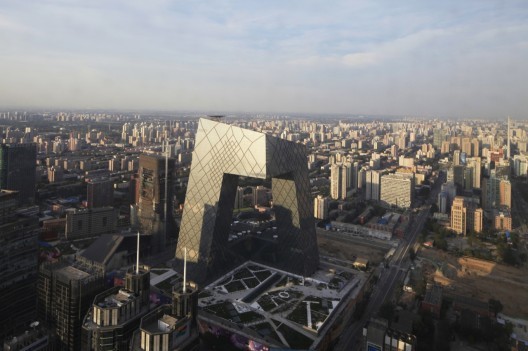
Enjoy this interesting footage captured by Tomas Koolhaas – son of Rem Koolhaas – in February 2012 of the recently completed China Central Television (CCTV) Headquarters in Beijing. The monumental structure took eight years to complete and is OMA‘s first major building in China, as well as their largest project to date. The building is planned for occupancy later this year to broadcast the London 2012 Olympics. Check out our previous coverage for more building information.
Continue after the break to view a short clip inside the CCTV building during construction!
São Paulo-based architect Anthony Ling has shared with us his perspective on Andrew Maynard’s recent article “Work/life/work balance”. Maynard’s article was extremely popular as it discussed some of the industries most controversial issues surrounding exploitative and exclusionary working practices. Although Ling agrees with many of Maynard’s points, he disagrees with the logic of Maynard’s two options for attaining a good work/life balance – (1) taking the risk of going broke and start your own practice or (2) leave the profession. Greatly inspired by Joshua Prince-Ramus, Ling proposes a solution that focuses on the creation of more business-minded, medium-sized practices.
By reading Andrew Maynard’s critique on today’s architectural workplace I could share his feelings and his rage towards the top-down management system run by many corporate architecture firms and the poor environment most architects work in. I couldn’t agree more that architecture is not as romantic as one sees it, and people who decide to embrace the field should know that. He is also right on by saying that a small percentage of time is spent on creative work and that architecture isn’t the highest paying profession, but I think most people who decide to enter the business already know about this last one. Although his ideas are inspiring and even agreeing with part of his solution to the problem, I think his logic is wrong.
Located in Naples, the Piazza Garibaldi, designed by Dominique Perrault Architecture, is one of the most important and complex transportation hubs in the Neapolitan transportation system. This infrastructure project, which includes a metro station, offers the opportunity to upgrade this lively urban space bustling with activity. More images and architects’ description after the break.
Last Friday we attended the 2012 Pritzker Prize ceremony in Beijing, where Chinese architect Wang Shu from Amateur Studio received the “Nobel of Architecture”.
Last year the ceremony was held in Washington DC with the presence of President Obama, and this year the event was also held in an important political context, at the People’s Hall of Beijing, with the presence of important Chinese government officials related to the urban process of China, including the Mayor of Beijing and the Minister of Housing and Urban-Rural Development.
In my opinion Wang Shu’s architecture presents a contemporary and progressive approach that acknowledges the rich tradition of Chinese architecture, considering not only projects in dense urban contexts but also in the rural areas of China. As the next generations of Chinese architects are influenced by his architecture, a generation that will be an active part of China’s growth, he will indirectly influence how millions will live in the next years.
I think that for the first time the Pritzker Prize became something beyond a mere recognition to the great work of a living architect, turning into a statement on how architecture should face the rapid growth of our cities in the Urban Age to improve the quality of life of the next 3 billion that will move into cities in the next 40 years.
Located in the Tongzhou district of Beijing, Urban Creek is an attempt at having architecture merge within various spheres of public space. Designed by ATOL Architects, the project is focuses around the idea that architecture should be conceived as a cultural connective tissue that creates opportunities to link spaces and neighborhoods together. In redefining the very notion of mixed-use from a free standing commercial box/podium/tower typology, this design aims at creating an ever evolving city center to reconnect with its secret past. More images and architects’ description after the break.
Stefan Tuchila, an architecture photographer based in Bucarest/Paris shared with us a set of images of the latest Monumenta exhibition in Paris. After the amazing installation by Anish Kapoor last year, it was Daniel Buren‘s time to take this challenge and create a concept for the 2012 edition.
YIBD ‘Project R6’, designed by REX, is an urban boutique residence for short-term business people, young urban professionals, and foreign residents in Seoul, South Korea. To meet the trends of its users and compensate for its small unit size, R6 must engender a strong sense of community and its residences must be highly attractive, providing generous views, daylight, and cross-ventilation. Maximizing daylight and cross-ventilation are also paramount to providing a highly sustainable residence. More images and architects’ description after the break.