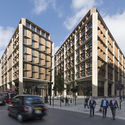
According to a statement by the US Embassador in the UK, KieranTimberlake´s design “meets the goal of creating a modern, welcoming, timeless, safe and energy efficient embassy for the 21st century.”
Regarding the “safety” issues, KT’s design shows an interesting solution away from embassies from the early 90s surrounded by large walls with no urban considerations, using a park with a pond instead. The Embassy is no only an icon, but an urban piece “honoring the English tradition of urban parks and gardens as the context for many civic buildings”, connecting the Thames embankment to the new pedestrian way to the south.
view from Embassy park (rendering by Studio amd)
“Viewed from the north at the proposed plaza, the embassy grounds will provide the prospect of an open park, a landscape of grasses rising gracefully to the new embassy colonnade, with the required secure boundaries incised into the hillside and out of view. Instead of a perimeter-walled precinct, the site to the north and south is a welcoming urban amenity, a park for the city that fuses the new embassy to the city of London. Alternatives to perimeter walls and fences are achieved through landscape design.”
The pure geometry of the cube is fragmented by a highly specialized ETFE (ethylene-tetrafluroethylene, used in several recent buildings) facade optimized to shade interiors from east, west and south sun while admitting daylight and framing large open view portals to the outside. If you take a closer look to the renderings from the inside you will notice that the ETFE foils include thin photovoltaic film that intercepts unwanted solar gain in certain angles. The scrim also renders the largely transparent façades visible to migratory birds to discourage bird-strikes.
Interview conducted, condensed + edited by Sarah Wesseler
What do research and development mean in today’s design field? To learn more about architectural R&D, I turned to KieranTimberlake, a Philadelphia-based firm that has earned wide acclaim for its innovative work in arenas such as prefabrication and sustainable design. Partner Stephen Kieran and research director Billie Faircloth spoke with me about the history and practice of the firm’s in-house research team.
LivingHomes®, a developer of modern, sustainably designed, prefabricated homes, has partnered with Kohler Co., to present the Kohler LivingHome, designed by architects Kieran Timberlake. Designed to achieve LEED-Platinum certification, the two-story Kohler Living features furnishings, materials, products and technologies that showcase the best in high design and technology with a low ecological footprint.
Designed to achieve USGBC’s LEED for Homes Platinum certification, the Kohler LivingHome reflects LivingHomes’ Z6 Sustainable Building Goals which include six key objectives for all LivingHomes’ construction and operation: Zero Water, Zero Energy, Zero Waste, Zero Emissions, Zero Carbon, and Zero Ignorance.
This house was premiered at the TED Conference in Long Beach, CA a few weeks ago. Here´s a time-lapse video of the house being assembled:
From the recycled steel and timber-efficient engineered lumber that make up the modules, central vacuum system, and mini-duct air distribution and ventilation systems that help improve indoor air quality; to the bio-composite wood siding, recycled glass tiles, blown-in insulation, high-performance windows with recycled frames, water-saving features and the home resource monitoring system that displays water, energy, and gas usage in real-time, the Kohler LivingHome is built to achieve a minimal environmental footprint.
The Kohler LivingHome is being offered for sale at $499,950.
For more information, click here. Images of the house interiors, after the break. read more »
Made to Measure is a monograph showcasing the work of Leers Weinzapfel Associates, an architecture firm based out of Boston, Massachusetts. Leers Weinzapfel Associates first gained prominence by taking on infrastructure projects that are often left to engineers. Where…
Sited on the coastal edge of the Bay of Bengal, Golconde, a dormitory for the Sri Aurobindo Ashram in Pondicherry, India, was designed by architects Antonin Raymond and George Nakashima. Golconde is a remarkable architectural edifice, seemlessly negotiating between…
We were excited to receive Mackintosh School of Architecture’s 36th addition of MacMag – a student publication that catalogues the work of the student body in a way that is as much about the graphical expression as it is…