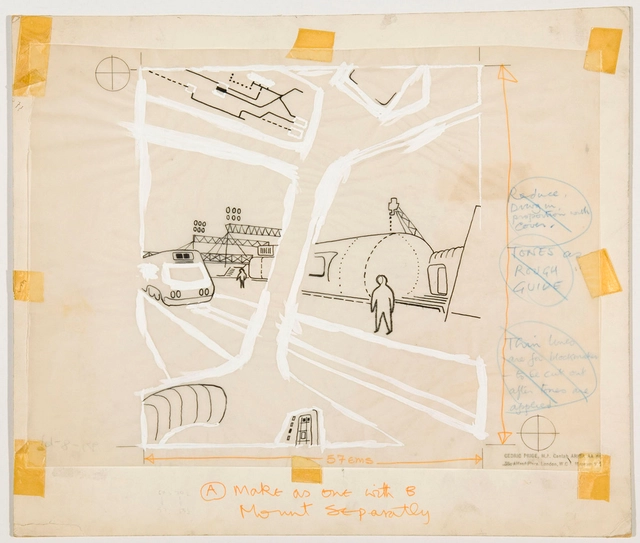
Cedric Price's "Potteries Thinkbelt" project. Image Courtesy of Canadian Centre for Architecture
Samantha Hardingham's recently-published work, A Forward-Minded Retrospective: Cedric Price Works—1953-2003, traces the architect's career through a comprehensive collection of his drawings and renders. The exhaustive two-volume work acknowledges Cedric Price not just as the entertaining novelty he is often regarded as, but as a great mind who was ahead of his time. While the vast majority of work produced during his lifetime was never built, Hardingham draws out the radical genius behind such projects as the hybrid office complex-highway "Officebar," a zoo restaurant whose column-less interior paved the way for its later conversion to a giraffe habitat, and many others—built and unbuilt.
In addition to the uncanny future forecasting expressed in many of Price's works, they are also known for serving as inspiration for the functionalist designs of Renzo Piano and Richard Rogers, making them necessary to a complete understanding of the modern architectural canon. In an article on Metropolis Magazine, Samuel Medina takes a whistle-stop tour of some of the most intriguing works presented in Hardingham's new book.
As the impacts of global climate change escalate, forward-thinking architecture firms have committed to being part of the solution. Increasingly, these firms are signing on to the 2030 Challenge and American Institute of Architects’ supporting initiative, AIA 2030 Commitment, which provide a framework to reduce fossil-fuel dependence and make all buildings, developments, and major renovations carbon neutral by 2030.
The 2030 Challenge has been adopted by 80 percent of the top 10 and 65 percent of the top 20 architecture, engineering, and planning firms in the United States, as well as many state and local government agencies. Among these are Eskew+Dumez+Ripple (EDR), a New Orleans–based architecture and planning firm; HOK, a global design, architecture, engineering, and planning firm; and CTA Architects Engineers, an integrated design, engineering, and architecture firm with offices throughout the Western United States and Canada. Here, five professionals from EDR, HOK, and CTA share seven key tactics they’ve employed to move toward the 2030 target—and a sustainable future for the planet.
https://www.archdaily.com/869056/7-ways-architects-can-work-toward-carbon-neutral-buildings-by-2030Heather Head
Massachusetts is destroying its toll plazas. By the end of this year, every single one on the Massachusetts Turnpike will have been demolished. Drivers will still pay to use the road—they will zoom through the metal arches of electronic tolling infrastructure—but the routine of slowing down, stopping to grab a ticket, and waiting for the barrier to rise will be gone.
Massachusetts is being more aggressive than most places about sweeping away its old tolling infrastructure, but all across the country, from New York to Florida, Texas to California, road authorities are switching to all-electronic tolling. While it’s too soon to declare the tollbooth dead, it’s easy to imagine a future in which roads are unencumbered by boxy plazas and simple gates.
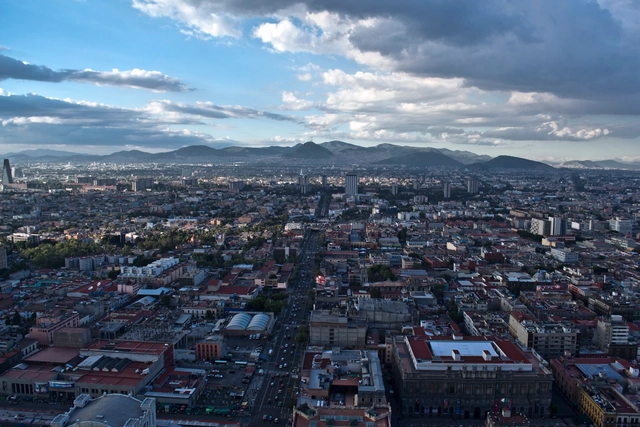
Though the idea of a vacation in Mexico usually brings to mind images of margaritas on white-sand beaches, it seems the country is slowly but surely gaining recognition in other aspects as well. Among the most populated urban cities in Latin America and the world – not to mention The New York Times' number one "Place to Go in 2016" – Mexico City offers a particular cultural diversity evident both in its traditions and in its architecture. Considering it's the main tourist, educational, cultural, economic and political center of Mexico, it makes sense that it's the perfect scenario for the social encounters of its multicultural inhabitants and tourists.
The sites of architectural interest alone are worth the visit, with prehispanic, classic, modern and contemporary examples ranging from Juan O'Gorman and Luis Barragán to Felix Candela and David Chipperfield. Add to that the fact that its gastronomic scene has garnered much praise and attention in recent years, and you've got a perfect combo. Below is a carefully curated list of 30 sites that every architect should know and visit.
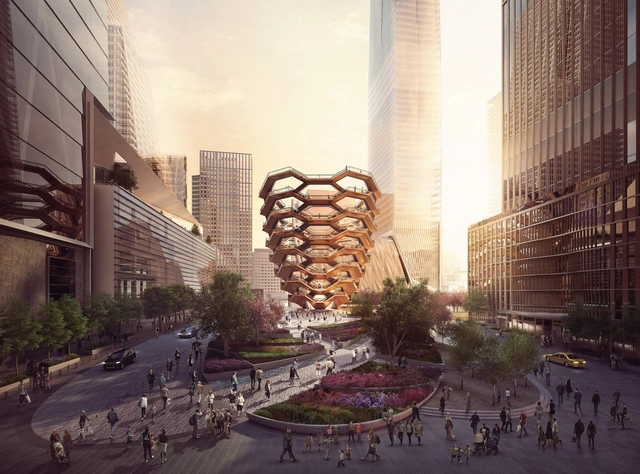
The 150-foot-tall steel structure has been compared to a bedbug, a beehive, and a döner kebab. Its base is 50 feet wide and its upper span measures 150 feet. Image Courtesy of Forbes Massie-Heatherwick Studio
When Thomas Heatherwick—the nimble London-based designer known for work that defies easy categorization—unveiled his design for a new public landmark called Vessel at Hudson Yards to a crowd of reporters and New York City power players in September, questions abounded. What is it? What will it do to the neighborhood? And what does it say that Stephen Ross, the president and CEO of Related Companies, the primary developer of Hudson Yards, is financing the entire $250 million piece by himself?
It’s natural that Ross chose Heatherwick Studio to design his centerpiece, because the office’s creations stun. For the UK Pavilion at the 2010 Shanghai Expo, it extruded 60,000 clear acrylic tubes from a center space to create a fuzzy, crystalline object whose apparent fragility is as mesmerizing as it is clever. As the studio moves toward ever-larger and ever-more-public commissions, the people who will live with its work will need to seriously consider what it will mean for their neighborhoods and cities.
The postgraduate programme is a unique and innovative approach to international architectural education: it combines the idea of the classical artist journey with the intensive, interdisciplinary and project-oriented workshop tradition and team-work, focusing on acute topics generating architectural knowledge and dialogue across greater Europe between cities as Tallinn, Lisbon, Helsinki, Berlin, Dessau, Ljubljana, Innsbruck and Haifa.
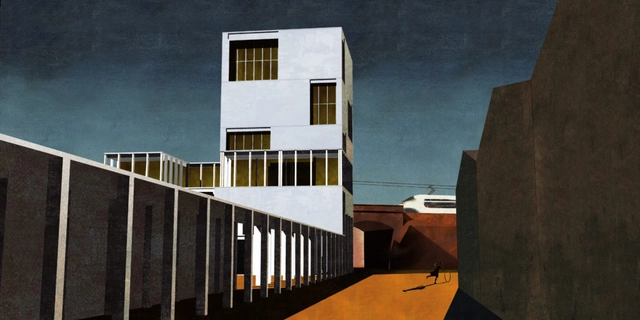
Digital technologies were supposed to kill the drawing. And in an obvious way they did, with CAD displacing hand draughtsmanship long ago. But drawing is more than mere delineation—measured construction drawings—or even the rendering, which has devolved into a mere marketing tool. Indeed, as Sam Jacob writes, it constitutes a fundamental “architectural act” that lies at the core of the discipline’s self-understanding.
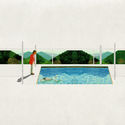
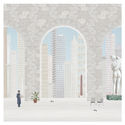
Jacob describes a new “post-digital” mode of drawing that incorporates narrative cues, art historical allusions, and software-enabled collage techniques. It recalls Mies’s sparse one-point perspectives and de Chirico’s metaphysical paintings as well as the affected irreverence of Postmodernism. It’s a style popularized by blogs such as KoozA/rch, which was founded by architect Federica Sofia Zambeletti three years ago. We spoke to Zambeletti about the resurgence of architectural drawing and how the style could soon exhaust itself.
There’s no doubt that one of the best things about architecture is its universality. Wherever you come from, whatever you do, however you speak, architecture has somehow touched your life. However, when one unexpectedly has to pronounce a foreign architect’s name... things can get a little tricky. This is especially the case when mispronunciation could end up making you look less knowledgeable than you really are. (If you're really unlucky, it could end up making you look stupid in front of your children and the whole world.)
To help you out, we’ve compiled a list of 22 architects with names that are a little difficult to pronounce, and paired them with a recording in which their names are said impeccably. Listen and repeat as many times as it takes to get it right, and you’ll be prepared for any intellectual architectural conversation that comes your way.
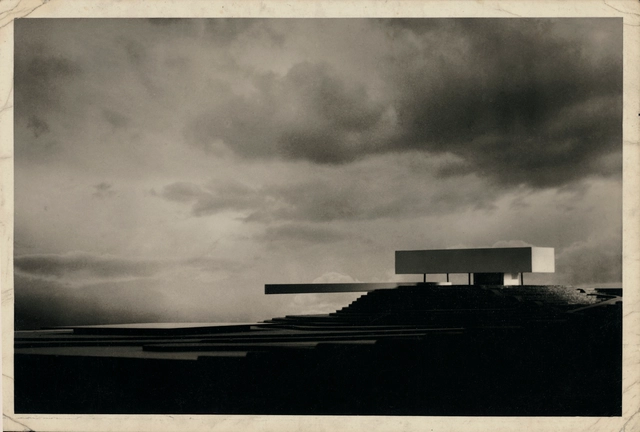
138 images, 14 albums, 20 magazines, 13 original models and one projection are part of Modeling for the Camera: Photography of architectural models in Spain, 1925-1970, the current exhibition of the ICO Museum in Madrid, curated by Iñaki Bergera, PhD of Architecture from the University of Navarra.
The exhibition is tied to the book of the same name that was published in 2016, edited by La Fábrica and the Ministry of Public Works (Spain). In times when 3D visualization software has popularized, accelerated and perfected the rendering industry, both materials choose to value the legacy of architectural model photography in the 20th century.
Mental wellbeing is a real topic of concern in architecture. A recent survey by The Architects’ Journal revealed that over 52% of architecture students expressed concern regarding their mental health.[1] When one considers the long hours, the competitive nature of the course, as well as the sheer duration of study, this perhaps isn’t that surprising. The “all-nighter” attitude of most architecture schools exacerbates the problem, as studies show a lack of sleep reduces the mind’s resilience to issues such as anxiety and depression.[2]
Yet this aspect of the architectural education system isn’t showing any sign of changing. What can architectural students (and their professional counterparts) do to minimize the impact that architecture has on their psychological wellbeing? I would argue that the answer, at least partly, can be found in the practice of mindfulness.
One general trend in today's Information Age involves the absolute transmutation of downtime into productivity or engagement of any kind, however meaningless. We hear it all the time: we have lost our ability to be still. However, as a team at Ennead Lab has observed, some of the same technologies that are causing this shift in routine also have the potential to open new, empty pockets of time in our daily lives, and affect the built spaces with which we interact.
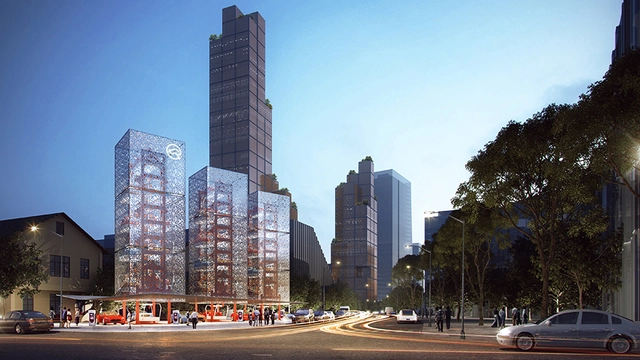
Tasked with designing an electric car charging station for a development in Shanghai, Ennead realized that the five hours required to fill up a single standard charge necessitate a place for customers to wait. In an article on Metropolis Magazine, they show that the promise of transportation-less people to stick around in one place for such a period of time opens up a host of possibilities for what could fill the latency period; the Shanghai project, however, focuses on the opportunity to create a civic space. The team has imagined the modern "gas station" as a vertical charging tower that calls upon the functionality of urban parking elevators in the 20th century, this time clad in reflective silver to serve as a beacon for customers in search of a charge. Rather than standalone charge-park towers, the projects are integrated into a system that encourages patrons to walk to neighboring zones to eat, shop, and socialize while they wait.
If I had to guess, I would say that it has been forty years since Columbus, Indiana, was the hot topic of cocktail conversations at design-related get-togethers in New York City. In those days, it was the supercharged patronage of industrialist J. Irwin Miller and his relationships with designers like Eero Saarinen and Alexander Girard that spurred a wave of innovative and provocative architecture in the small Midwestern town. Columbus, with a population of 45,000, has a Robert Venturi fire station, a John Johansen school, a park by Michael Van Valkenburgh, and several buildings by Eliel and Eero Saarinen, including the younger’s iconic Miller House.
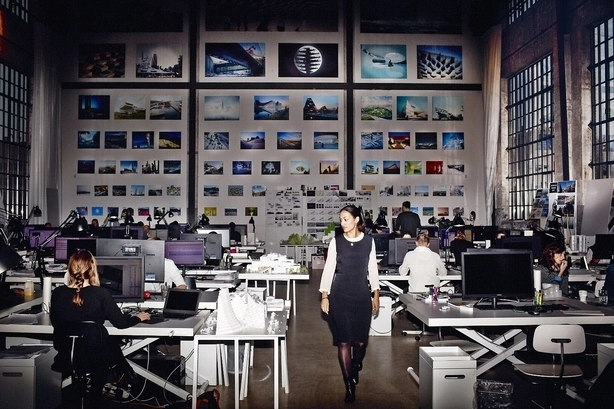
When I joined BIG–Bjarke Ingels Group in 2008, we had one office, one partner, and 45 employees. Eight years later we have 12 partners and more than 400 employees in Copenhagen, New York, and London. As we continue to expand our reach, projects, and staff I have awarded myself the luxury of looking back and distilling what has made a difference so far. These are my top eight lessons for having secured the successful growth of BIG over the past eight years.
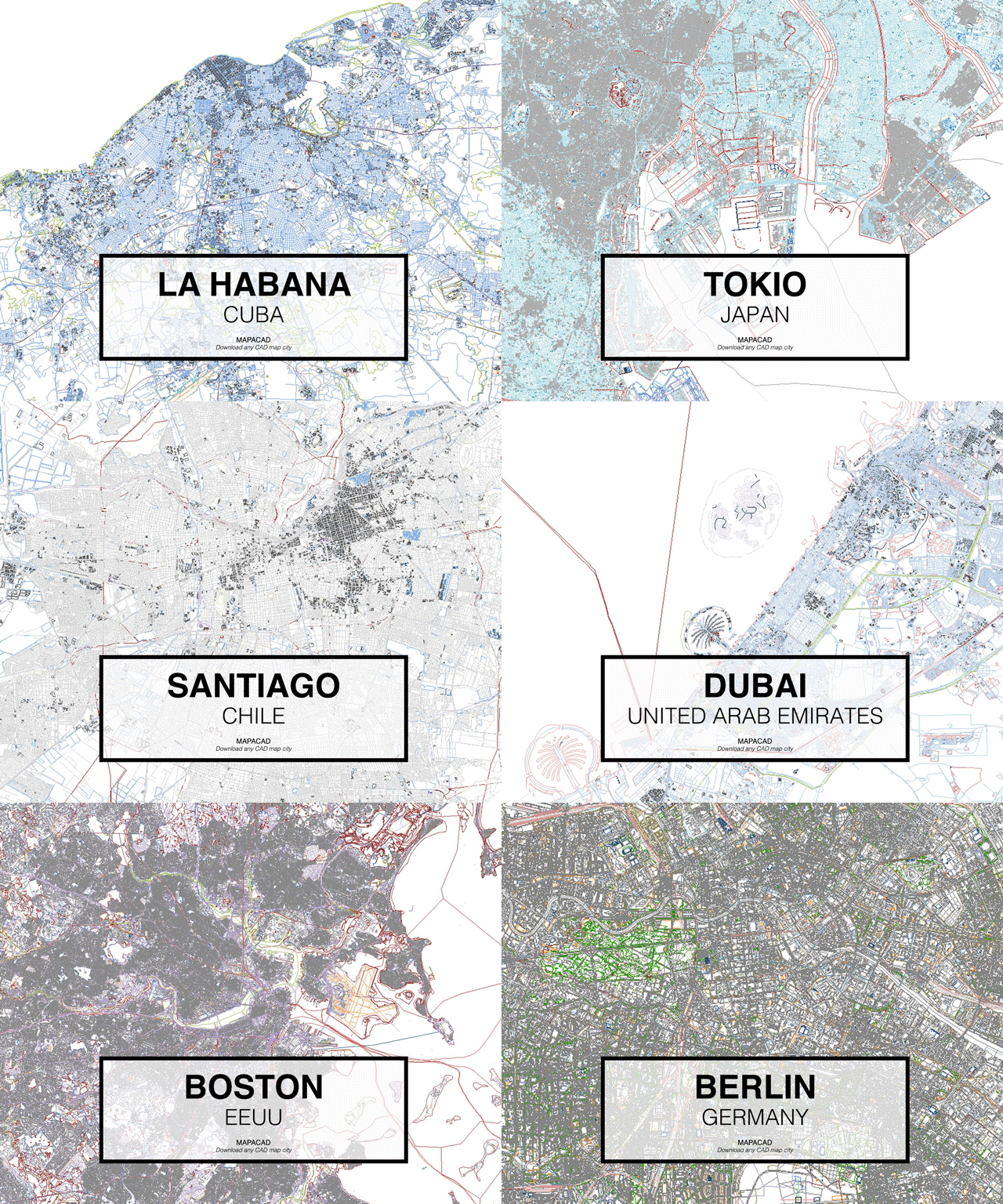
Mapacad is a website that offers downloads of .dwgs of dozens of cities. With 200 metropolises in their database, the founders have shared a set of their most-downloaded cities.
The files contain closed polyline layers for buildings, streets, highways, city limits, and geographical data--all ready for use in CAD programs like Autocad, Rhino, BricsCad and SketchUp.
Architectural projects are only as successful as an architecture firm’s ability to work together. Experience means nothing if projects aren’t rooted in creative collaboration.
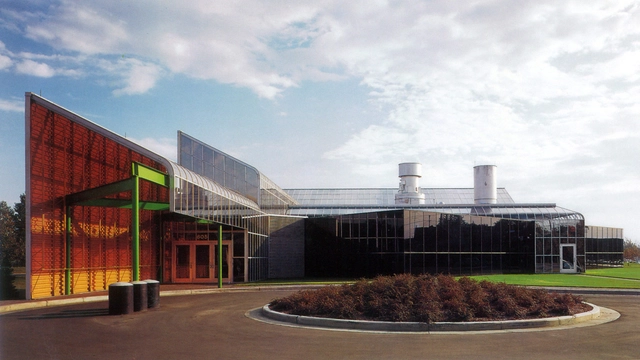
For more than 30 years, residential architects Stuart Cohen and Julie Hacker have produced a series of exquisitely designed and crafted homes in Chicago’s northern suburbs. Although known for their distinctly different personalities, this husband and wife duo has effectively created an environment where clients can be heard and understood. They know how to design together from start to finish, and that’s what makes their project results so remarkable.
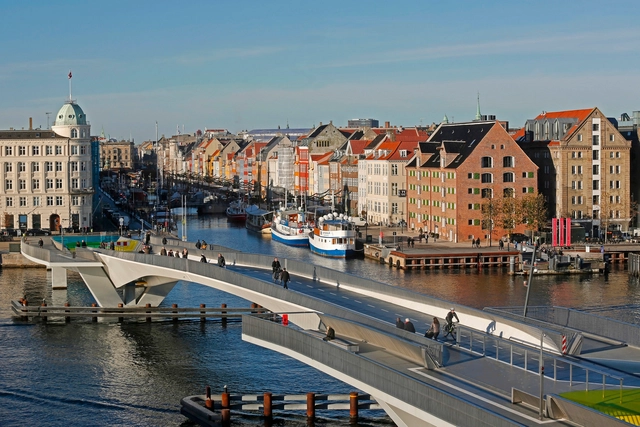
It's no secret that Copenhagen continues to invest massively in bicycle infrastructure like no other city on the planet. The network is already comprehensive and effective but the City continues to add important links, especially over the harbor and the canals. One of the more recent additions is the Inner Harbor Bridge—Inderhavnsbroen in Danish—that spans Copenhagen Harbor at a key, strategic and iconic point. It links the city center at the end of the postcard picture perfect Nyhavn with the Christianshavn neighborhood and the southern neighborhoods beyond. It is one of a series of 17 new bridges or underpasses for bicycle traffic that have been added to the City's transport network in the past few years.
The Inner Harbour Bridge was riddled with problems and was extremely delayed, as you can read here. Now, however, it's been open since July 2016. Let me be clear: I'm thrilled that we have a new, modern link over the harbor to accommodate bicycle traffic and pedestrians. I am over the moon that the number of cyclists crossing daily exceeds all projected numbers. The City estimated that between 3,000–7,000 cyclists would use the bridge but the latest numbers are 16,000. It's a massive success. But sometimes you can see the forest for the trees. I'm sorry, but Inderhavnsbro is a stupid, stupid bridge.
Despite being aimed toward a common goal, the different perspectives of the architect and the client can sometimes lead to a tense working relationship. But where there is conflict, there is humor – in these strips, Tristan Comics manages to address the topic in a truthful yet humorous way. They say laughter is the best medicine, and through comics, Tristan manages to shed light on those pertinent issues that all those in the world of architecture can relate to.
Every company wants to establish a brand on a local, regional, national or even international level. A company strives for an image that is recognizable by potential customers no matter where they are in the world. In fact, the first face-to-face interaction with a customer might be at a company’s own location. This initial impression can make or break the customer’s willingness to spend their money. Maintaining a well-loved and respected brand appearance is imperative to a company’s success.


















.jpg?1491856633&format=webp&width=640&height=580)
