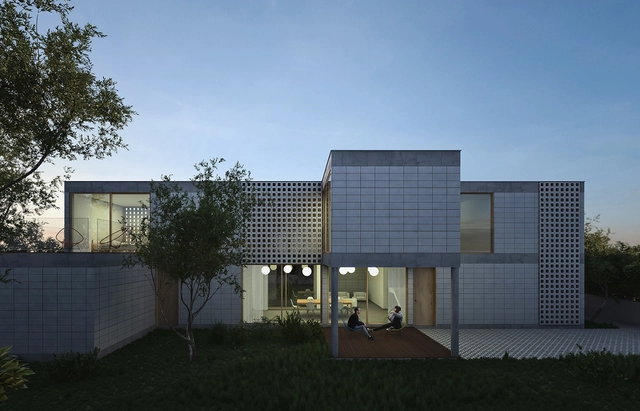
Tatiana Bilbao S.C.'s design for Paperhouses, The Module House. Image Courtesy of Paperhouses
“Architecture does not change anything. It’s always on the side of the wealthy. The important thing is to believe that it can make life better.” -- Oscar Niemeyer
As much as we'd care to deny it, Niemeyer makes a valid point here. Architecture is almost always "on the side of the wealthy"; the profession, as it has existed for about a century, rarely changes anything; and yet - and yet - it can make life better. If only for a select few.
But what if architecture could make life better for the many. What if good-quality, life-bettering architecture were open-source and available to download off the internet? For free?
Last night, the facade of Rem Koolhaas' critically-acclaimed skyscraper - De Rotterdam - became the screen for the largest video mapping project ever displayed in Europe. The A15 Project, an initiative of Natuur & Mielieu, re-envisions the A15, the Netherlands' busy highway, into a "sustainable highway." Check it out in the video above!
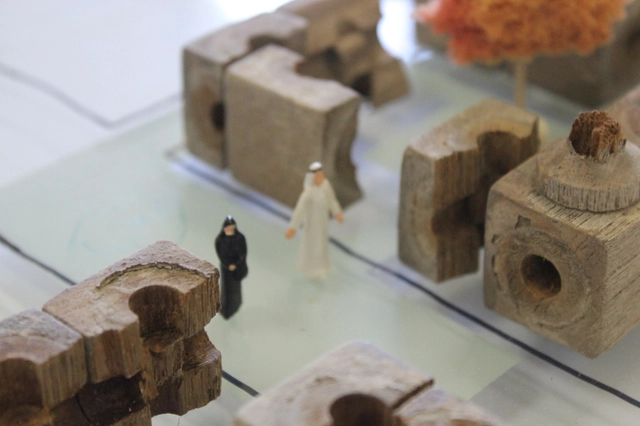
Alicja Borkowska and Iris Papadatou from you&me architects have been announced as the UK winners of the inauguralOld Doha Prize, a competition to redesign part of the old city of Doha in Qatar.
Four teams of architects have "worked intensively to develop contextual design responses to address the challenge of regenerating and maintaining the heritage of the city" as part of a British-Qatari collaborative project to "reimagine the urban landscape of old Doha." As a city defined by its strong heritage, coupled with ambitious plans for the future, the competition aimed to discover ways of regenerating parts of the city centre in a sustainable, yet vibrant, way.
The University of Chicago has chosen Bing Thom Architects to design a new home for the Chicago Booth Asia Executive MBA Program in Hong Kong. The center will begin construction in October 2014 on Mount Davis, a heritage site that was originally used as a military encampment for the British Army in the 1940s and then a detention center.
OMA’s Taipei Performing Arts Center Set for Completion in 2015.
It’s official: Taipei has been selected as the 2016 World Design Capital (WDC). This doesn’t come by surprise, as back in August they were the only city selected by International Council of Societies of Industrial Design (ICSID) to move onto the competition’s final round.
The city campaigned under the slogan “Adaptive City: Design in Motion,” focusing on how design can improve the living standards of their citizens. To strengthen their campaign, officials proposed 20 projects under the “Public Policy by Design” program that intended to strengthen the connection between designers, the public and funders. Over 600 workshops have already been conducted, encouraging collaboration between the city’s top officials and design professionals, and many more are scheduled to take place.
In Design Intelligence's annual rankings of US Architecture Schools, released earlier this month, there is certainly a lot to talk about. Of course, plenty will be said about what is shown immediately by the statistics, and rightly so - but just as interesting is what is revealed between the lines of this report, about the schools themselves and the culture they exist within. By taking the opinions of professional architects, teachers and students, the Design Intelligence report exposes a complex network which, when examined closely enough, reveals what some might see as a worrying trend within architectural education.
One of Detroit's most prominent vacant sites is slated to become one of its most iconic buildings. SHoP Architects will partner with Detroit-based Hamilton Anderson Associates to transform the site formerly occupied by Hudson's Department Store. Located at Grand River and Gratiot in the city's Central Business District, the two-acre site has remained a scar in the urban landscape since the implosion of the Hudson's building in 1998.
https://www.archdaily.com/452116/shop-architects-selected-for-design-of-iconic-site-in-downtown-detroitRennie Jones
Young architects and designers are invited to submit work to the annual Architectural League Prize Competition. Projects of all types, either theoretical or real, and executed in any medium, are welcome. The jury will select work for presentation in lectures, digital media, and an exhibition opening in June 2014. Winners will receive a cash prize of $1,000. A catalogue of winning work will be published by The Architectural League and Princeton Architectural Press.
Now in its 5th edition, the Bi-City Biennale of Urbanism / Architecture (UABB) is the only biennial exhibition in the world to be based exclusively on the themes of urbanism and urbanization. The Biennale is co-organized by Shenzhen and Hong Kong, two of the most intensely urban cities in the world, where political and economical contexts have shaped unique urban dynamics.
The Hong Kong Biennale is led by Chief Curator Prof. Colin Fournier along with Joshua Lau and Allen Poon of TETRA and Travis Bunt and Tat Lam of URBANUS. As reported earlier, the Shenzhen edition will be curated by Ole Bouman and Team Li Xiangning + Jeffrey Johnson.
As Asia’s leading architecture, design and planning event, it will exhibit work by leading international and local design professionals and engage in a three month cultural dialogue that will include satellite exhibitions, performances, fi lm screenings, forums, workshops, guided tours and lectures.
The Biennale "will be informed by the singularity of Hong Kong but it will not be primarily about Hong Kong, just as the Venice Biennale is not about Venice: it will be about the cities of the world, making use of the unique bi-city setting of the Biennale as a platform to address global issues in a visionary and critical way."
ArchDaily will be present at the opening of the Shenzhen edition to bring you all the insights of the event.
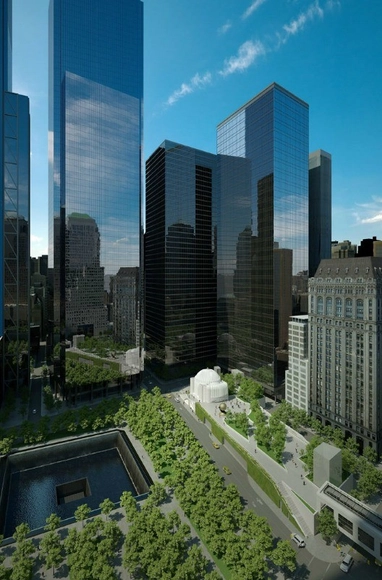
Early Schematic Rendering of St. Nicholas Greek Orthodox Church and Liberty Park. Image Courtesy of Tribeca Citizen
The World Trade Center’s “best-kept secret” has been revealed. As reported by the New York Times, the Port Authority released details on what will be “Liberty Park,” an acre-sized, elevated park lifted 25 feet above Liberty Street on the WTC site. Planned for completion in 2015, the $50 million landscaped terrace will connect the financial district with Battery Park City, while providing a panoramic view of the National September 11 Memorial and serving as a forecourt for the new St. Nicholas Greek Orthodox Church. More information on Liberty Park can be found here.
The concept of the open plan revolutionized architecture - promising light, space, and effortless collaboration (not to mention a more cost-effective way of getting lots of people into one space). Today, it's practically become a standard of design - but at what cost?
A new report from researchers Jungsoo Kim and Richard de Dear, published in the Journal of Environmental Psychology, concludes that the open plan comes with some serious collateral damage - namely a lack of "sound privacy" - which outweighs its positive qualities. What's more, according to their results, the open plan doesn't even make a measurable improvement in communication at all.
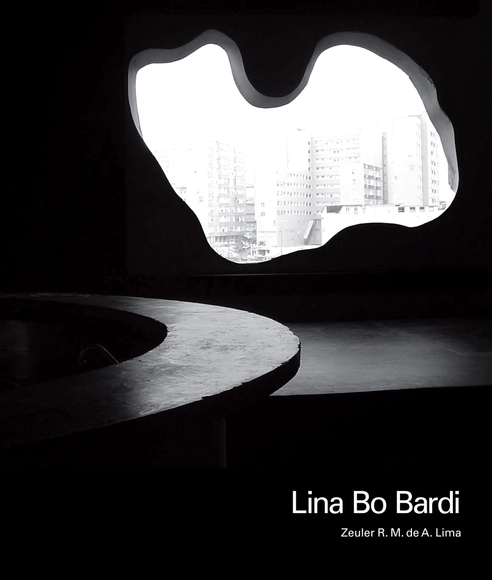
UPDATE: Congrats to Susana Duarte of Portugal, winner of the "Lina Bo Bardi" giveaway! Thank you to all those who participated. Keep your eyes peeled for another fantastic giveaway, courtesy of Yale University Press, in the coming weeks.
https://www.archdaily.com/451627/giveaway-lina-bo-bardiJose Luis Gabriel Cruz
Biopharmaceutical company AstraZeneca has commissioned Herzog & de Meuron to design their new Global R&D Centre and Corporate Headquarters. Planned for the Cambridge Biomedical Campus on the southern outskirts of the city, the new £330m project will be home to one of the company’s three global strategic research and development centres as well as its corporate headquarters.
The Cultural Landscape Foundation recently launched its newest documentary as part of the ongoing Oral History series, this time focusing on the ideas and career of Laurie Olin, a recipient of the National Medal of the Arts and one of the greatest landscape architects of our time. Olin's influential work as a practitioner, educator and author over the past forty years has helped to guide the future of landscape architecture and shape urban life around the world.
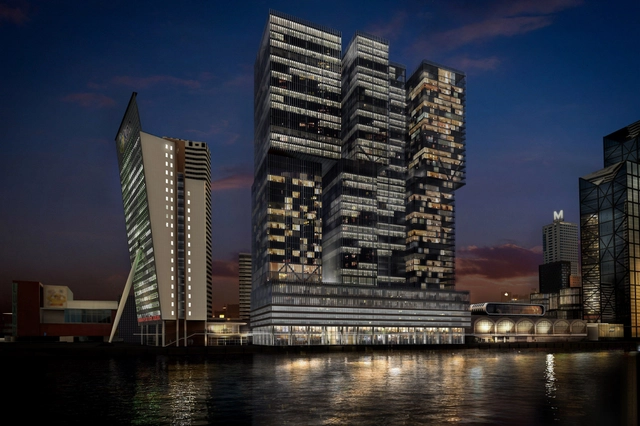
In the architectural stomping ground that is Rotterdam, it's no small task to design a building that actually stands out. But, according to The Guardian's Oliver Wainwright, the recently completed De Rotterdam building manages to. Although the Koolhaas-designed structure, which houses offices, apartments and even a boutique hotel, may at first seem simple (simplistic, even), Wainwright praises how the shifting masses cleverly play tricks on your perception. The building is undoubtedly impressive, but is the unconventional envelope enough to distract from a bland-at-best interior? Read the rest of Wainwright's critique here. evaluate
https://www.archdaily.com/450513/wainwright-weighs-in-on-rem-s-de-rotterdamKatherine Allen
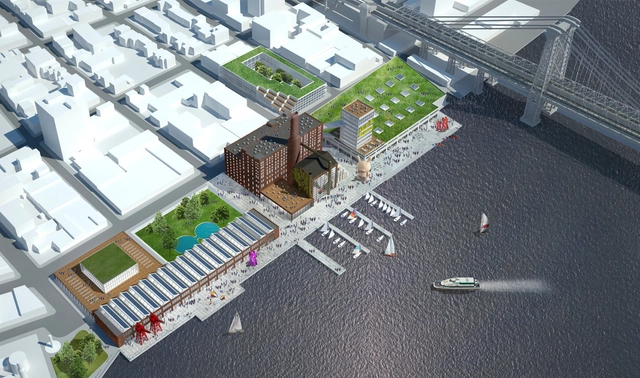
HAO's counter proposal seeks to adaptively reuse the existing factory buildings, including the iconic Civil War-era Domino Sugar Refinery — which has defiantly held its ground amidst heavy redevelopment in surrounding areas. Not unlike SHoP's proposal, HAO aims to regenerate these spaces into a "world-class cultural destination" that combines public and private programs.
https://www.archdaily.com/451552/hao-makes-counter-proposal-to-save-sugar-factory-and-stop-luxury-apartments-in-brooklyn-s-waterfrontJose Luis Gabriel Cruz
From Atlanta's Beltline to Los Angeles' Spring Street "Parklets," architecture and design is increasingly more relevant in the fight against obesity and chronic disease, conditions which have reached epidemic levels in the United States. In the article, "Toward a Fit Nation," the AIA and FitNation identify 18 projects from around the country, ranging from large complexes to temporal installations, that encourage physical activity and healthy lifestyles. The AIA National Headquarters will be curating the FitNation exhibit till January 31, 3014. Read the article here.
https://www.archdaily.com/451594/toward-a-fit-nation-18-projects-that-promote-healthy-lifestylesJose Luis Gabriel Cruz
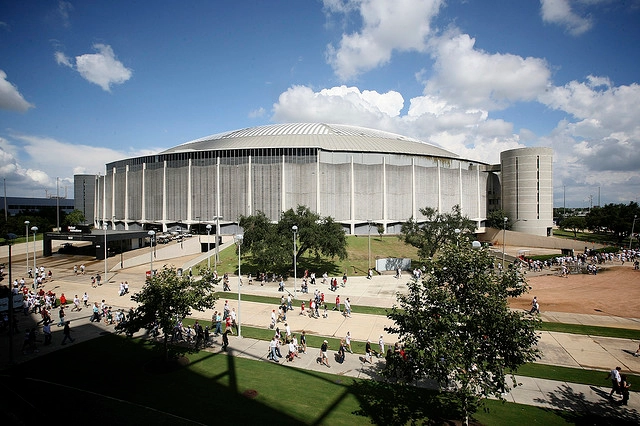
According to LA Times architecture critic Christopher Hawthorne, buildings experience a pretty distinct mid-life crisis. After seeing the demise of mid-century gems such as the Houston AstroDome and the Prentice Women's Hospital in Chicago, it's difficult to disagree. But unfortunately architectural value isn't convincing enough an argument - if preservationists want to get serious about their cause, he suggests, they will have to pick their battles far more strategically.
https://www.archdaily.com/450516/how-to-get-a-building-through-its-mid-life-crisisKatherine Allen
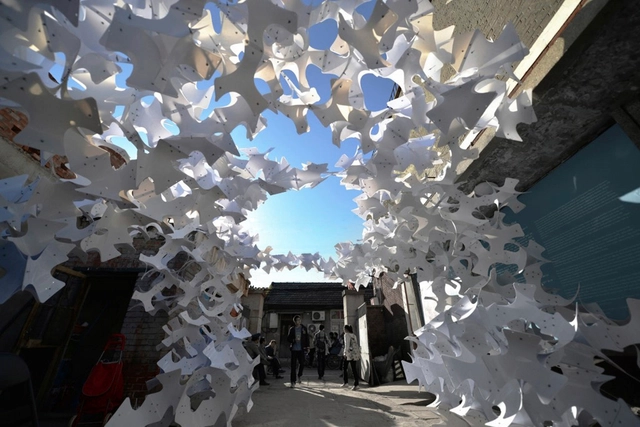
"As Autumn Leaves" (AAL) is a spatial installation designed and built by students of the Laboratory for Computational Design (LCD) for Beijing's 2013 Design Week. Located in a historic hutong district in Beijing, AAL highlights the existing entrance to Dashilar Factory where emerging creatives exhibit their design. The concept is based on ephermerality of nature. As temperatures change, autumn turns to winter, and trees shed their leaves, AAL recalls the passage of time through changing seasons.
https://www.archdaily.com/451572/lcd-exhibits-as-autumn-leaves-at-beijing-s-2013-design-weekJose Luis Gabriel Cruz
And secrets they must be because Kemp’s little company, Digital Physical, has kept under the radar, housed away in some nondescript loft space in Los Angeles. What Mr. Kemp and his bearded acolytes have developed is something so simple, so obvious, and yet utterly revolutionary. It’s one of those inventions that all architects are soon going to realize they need - and clients will soon start to expect.
Robert Miles Kemp is going to be one of 2014’s Innovators of the Year. Mark my words. If I worked for Autodesk, I’d be calling him up right about now - or at the very least trying to steal his secrets.
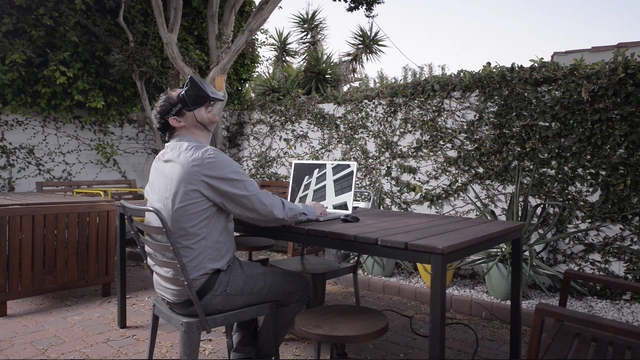
The “it” is Spacemaker VR, architecture’s first virtual reality system made for designers. Yes, you have to wear a VR headset, but you won’t care if you look like a dork because you (and your big clients) will be blown away by the fact that you’re looking, flying around a 3D model of a future-space - all while being firmly in the present.