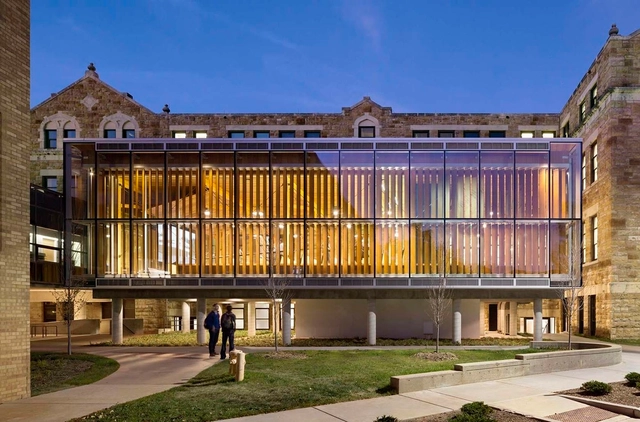
There is a dichotomy to the business of educating architects. While the real world profession is a collaborative field, one in which projects of even the largest and most publicly-acclaimed offices are team-led initiatives, the study of architecture is often insular, myopic, and devoid of such partnerships. Certainly there is a benefit to this style of teaching - it builds confidence for one thing - but it is troubling to think that in a socially-oriented and practically-minded field like architecture, there can be such major disconnects between the process of designing and the act of building. As many critics of current architectural education have pointed out, incorporating design-build projects into school curriculums is a pragmatic solution oriented towards correcting such imbalances.
The fact that more schools don't have programs for students to both design and build their projects is especially perplexing when most universities, particularly those located in the United States, are in such a prolonged period of institutional and budgetary expansion. With many schools now governed like corporate entities, it’s surprising that architecture programs and students are not treated like in-house resources. Why aren’t architecture students treated like assets, the same way that student doctors and nurses are brought into university led medical facilities or scientists into campus research labs?
Following an international open call for 'Intervention Strategies' which connect and correspond to the 2016 Oslo Architecture Triennale’s theme—After Belonging—five proposals have been selected to be developed as part of its core program, to be displayed and discussed throughout the course of the event. The jury have been "pleased and impressed by the wide range of proposals, their creativity, seriousness and sometimes also the humor with which [the submissions] approach issues of real gravity, and by the care and hard work that was evident in almost all of them."
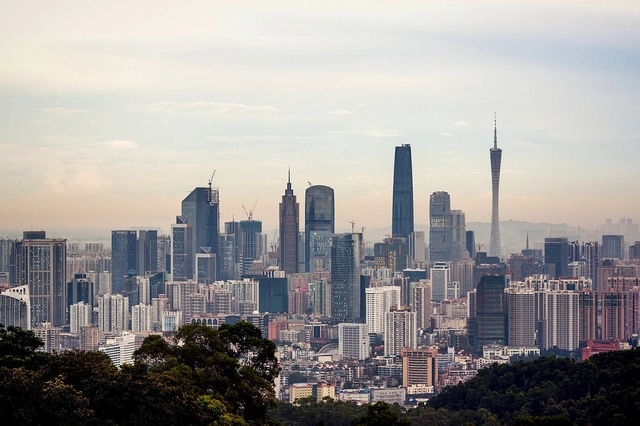
Guangzhou, China's third largest city, is planning to rebuild four bridges in its region - the Renmin, Jiangwan, Haiyin, and Liede Bridges. Three teams have been shortlisted for each bridge, all of which are Chinese practices with the exception of Zaha Hadid Architects, Knight Architects and NEXT Architects. As BDOnline reports, the finalists are expected to propose a range of options, from small upgrades to complete rebuilds. A winner for each will be selected in February, after the Chinese new year.
The shortlisted practices for each bridge include...
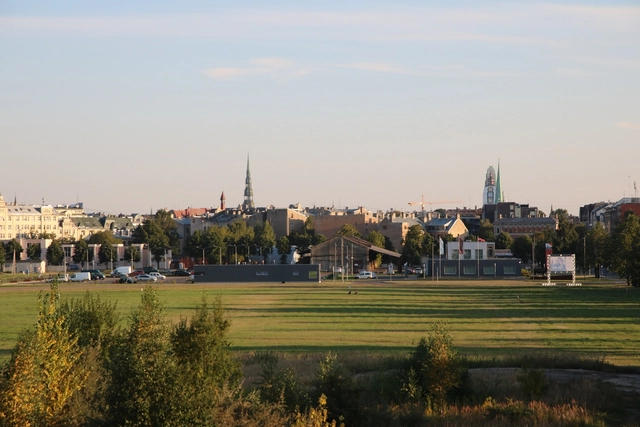
Adjaye, Henning Larsen, and wHY are among seven practices shortlisted in an invited design competition to design the Latvian Museum of Contemporary Art (LMoCA). The new museum, planned for the center of Riga, Latvia, hopes to become "the most visited art museum in the Baltic States, as well as a cultural arts center of interregional significance." It's collection will feature regional art and visual culture from the 1960s.
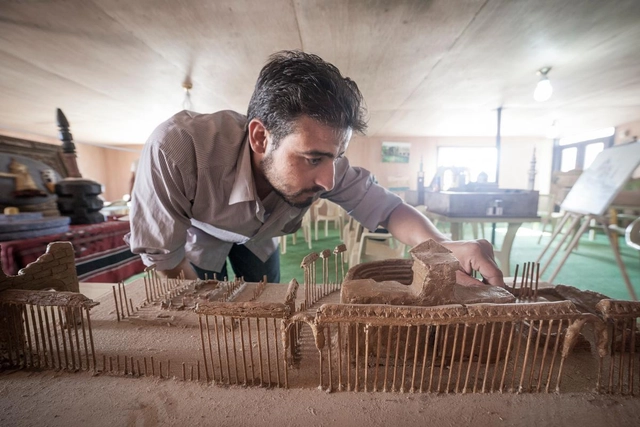
Mahmoud Hariri building a model of Palmyra using clay and wooden kebab skewers. Image Courtesy of UNHCR Tracks
Throughout Syria’s four-year war, many of the country’s ancient monuments and artifacts have been demolished by ISIS and Syrian bombs targeted at Islamic militants. In August, ISIS destroyed Palmyra, one of the most important cultural centers in the world.
Yet a group of Syrian refugee artists in Jordan, with the support of the United Nations and Internal Relief and Development, have been salvaging some memories of their country’s destroyed artifacts. Since November 2014, these artists have been constructing miniature models of Syria’s ancient architecture through a project called Syria History and Civilization, according to a reporty by Buzzfeed News.
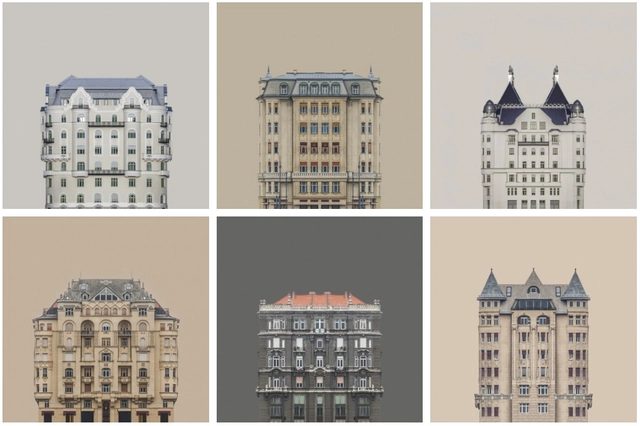
Budapest-born printmaker and photographer Zsolt Hlinka has created Urban Symmetry, a Wes Anderson reminiscent photo series depicting perfectly-symmetrical buildings on the banks of the Danube River. Using partial photos of the buildings, Hlinka creates fictitious compositions through reflections, resulting in new personalities and character in the portraits.
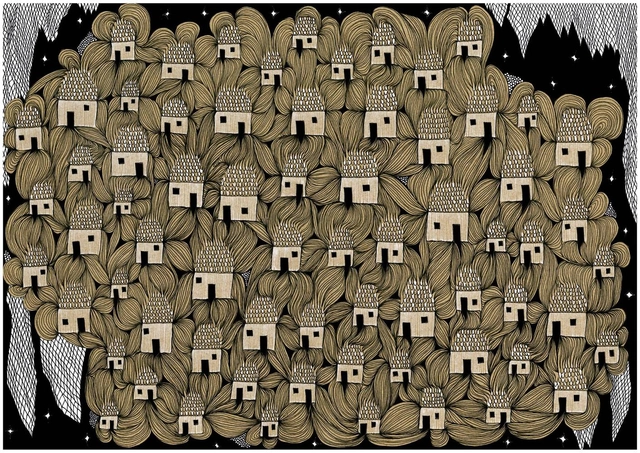
Lima-based architect Karina Puente has a personal project: to illustrate each and every "invisible" city from Italo Calvino's 1972 novel. The book, which imagines imaginary conversations between the (real-life) Venetian explorer Marco Polo and the aged Mongol ruler Kublai Khan has been instrumental in framing approaches to urban discourse and the form of the city. According to Puente, who has shared six drawings with ArchDaily, "each illustration has a conceptual process, some of which take more time than others." Usually "I research, think, and ideate over each city for three weeks before making sketches." The final drawings and cut-outs take around a week to produce.
Courtesy of Noe & Associates and The Boundary; Via The Architects' Newspaper
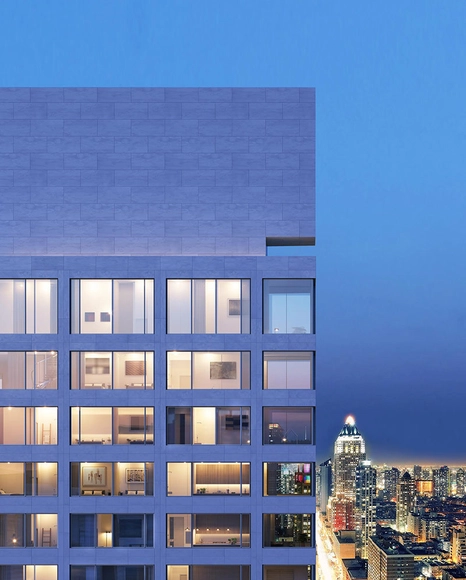
An image of Álvaro Siza's first US building has been released. The luxury New York tower, planned for the corner of West 56th Street and Eleventh Avenue in Midtown, will rise up to 120 meters (just over 400 feet) and offer 80 units, a private roof garden, sun deck, spa and fitness center, and more.
Construction is underway on a new office and retail tower in the Dubai International Financial Center district (DIFC). Designed by Foster + Partners, the 1.5-million-square-foot "ICD Brookfield Place" has officially broke ground and is expected to be completed by late 2018.
"The beginning of construction at ICD Brookfield Place marks the next phase of one of Dubai's most prestigious developments at the DIFC. We were honored to be chosen by ICD Brookfield to design a project that we believe will become a new social focus for Dubai, combining world class office space with a major civic plaza," says Foster.
2015 was an excellent year for ArchDaily. As we've continued to grow, we've delivered more information and tools to more people all around the world, leveling access to architectural knowledge and encouraging an exchange of ideas from professionals of diverse backgrounds, opening architectural up to everyone rather than just the privileged few.
Now for the 7th consecutive year, we are tasking our readers with the responsibility of recognizing and rewarding the projects that are making an impact in the profession with ArchDaily's 2016 Building of the Year Awards. By voting, you are part of an unbiased, distributed network of jurors and peers that has elevated the most relevant projects over the past six years. Over the next two weeks, your collective intelligence will filter over 3,000 projects down to just 14 stand-outs - the best in each category on ArchDaily.
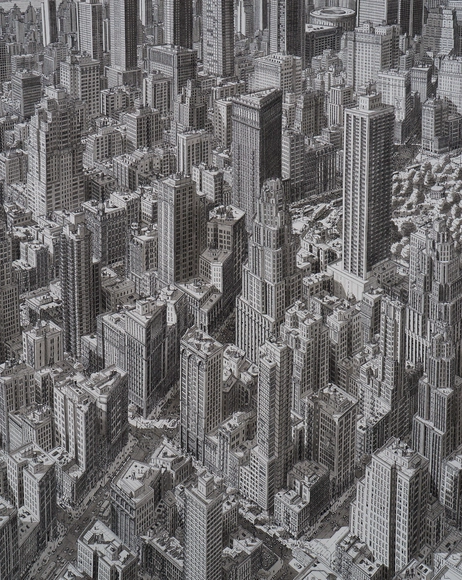
Over the past few years, Netherlands-based artist Stefan Bleekrode has been creating cityscape drawings from memory of cities across the globe. Basing his work on impressions from trips throughout Europe and North America, Bleekrode utilizes pen and ink with watercolor shading to bring urban landscapes to life.
“Scott Merrill has demonstrated how the principles of classicism can be used as a foundation for designing buildings that respond to and express regional character while employing the richness of precedents found throughout the ages, including our own,” said Michael Lykoudis, Driehaus Prize jury chair and Francis and Kathleen Rooney Dean of Notre Dame’s School of Architecture. “His applications of architectural forms from various times and places to modern settings are used to reinforce the values of community, beauty and sustainability without sacrificing economy.”
For the first time in history, a John Hejduk structure has been permanently installed in a public space. The American architect's Jan Palach Memorial has officially opened last week at Jan Palach Square (formerly Red Army Square) on the Alšovo Riverbank in Prague after 25 years in the making.
"The work, entitled House of the Suicide and House of the Mother of the Suicide, which was originally built in Atlanta in 1990, then Prague in 1991, honors the Czech dissident Jan Palach, whose self-immolation in protest of the Soviet invasion of 1968 served as a galvanizing force against the communist government in Czechoslovakia. A plaque at the base of the monument displays the poem The Funeral of Jan Palach, by former School of Architecture Professor David Shapiro," says The Cooper Union.
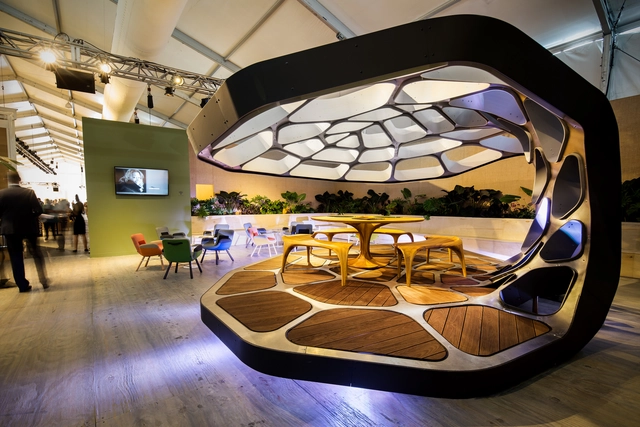
With recent advancements in building technology, Revolution Pre-Crafted hopes to democratize the design of pre-fab structures, offering a line of products that incorporate the distinct spatial and social brands of the designers. See a selection of the Revolution Precraft line after the break.
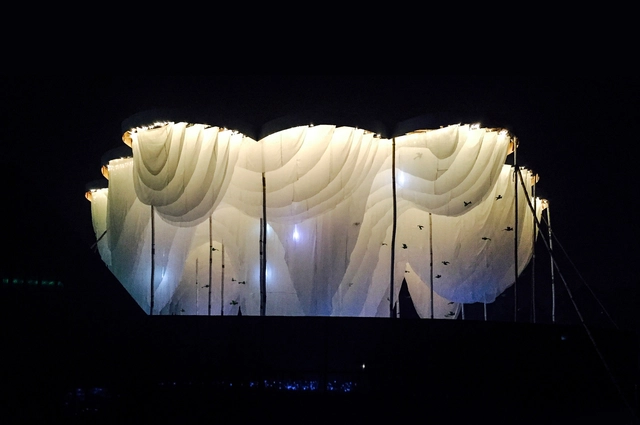
India based Abin Design Studio has designed and constructed a pavilion of canopies for a religious festival in West Kolkata. The design is based on the celebration of tribal life and the symbiotic relationship between the community and the forest. By highlighting the importance of the forest in their lives, the community hopes to raise awareness about conservation of the lands.
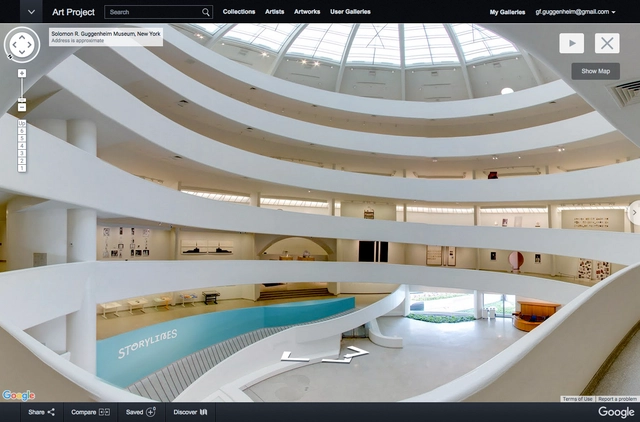
The Google Cultural Institute have teamed up with New York City's iconic Solomon R. Guggenheim Museum, designed by Frank Lloyd Wright and completed in 1959, to open its doors through Street View. Additionally, the Solomon R. Guggenheim Foundation has made over 120 artworks from its collection available for online viewing. "Using Street View technology, it will now be possible to tour the museum’s distinctive spiral ramps from anywhere online," the Foundation said.
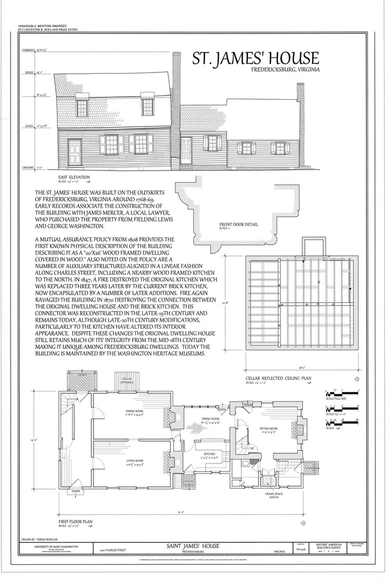
The St. James’ House in Fredericksburg, Virginia, by Teresa Boegler. Image via The Library of Congress
The Library of Congress has announced the winners of the 2015 Holland Prize, which recognizes the best single-sheet, measured drawing of a historic building, site, or structure, completed to the standards of the Historic American Building Survey (HABS), Historic American Engineering Record (HAER), or the Historic American Landscapes Survey (HALS).
Brooklyn-based artist and designer Ekene Ijeoma has created Wage Islands, an interactive art piece that “expands New York City’s ‘tale of two cities’ by revealing the geographies of access to housing based on wages.”
In the project, a 3D map of the city is submerged in a box filled with black water, showing only the parts of the city that have affordable housing based on a wage of $8.75 and median monthly housing costs from $271 to $4001. Viewers press a button, which increases the wage on the display up to $77, concurrently raising the map out of the water to highlight the severity of the wage gap in relation to housing.
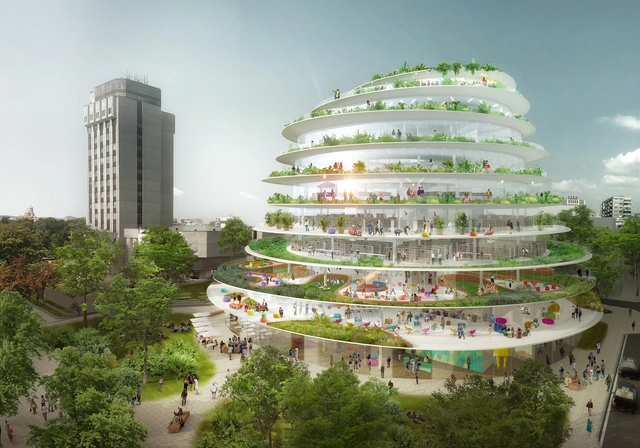
Render by Luxigon. Image Courtesy of Stewart Hollenstein
Sydney-based firm Stewart Hollenstein has been awarded an Honorable Mention in the international design competition for a new 17,000 square-meter library in Varna, Bulgaria. Their design scheme focuses on Varna's rich history as a city known for its public gardens, and seeks to make the library a cultural center of the city.
Despite often designing homes larger than 15,000 square feet for their clients, Houston-based design team Mark Schatz and Anne Eamon have designed and built a 980 square-foot house for their family of four. The couple designed and built the home largely on their own, out of leftover materials collected from projects their firm has worked on over the past few years.
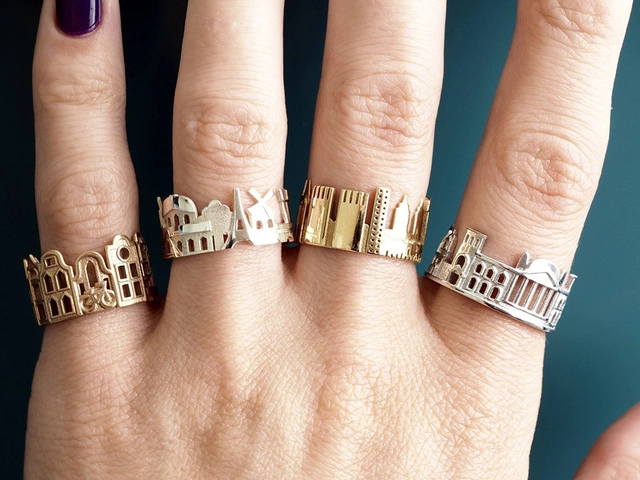
Have you ever fallen in love with a city, and wished you could carry the image of the skyline with you everywhere you go? Now you can turn that longing into a reality with these cityscape-inspired rings by North Carolina-based jewelry maker, Ola Shekhtman.
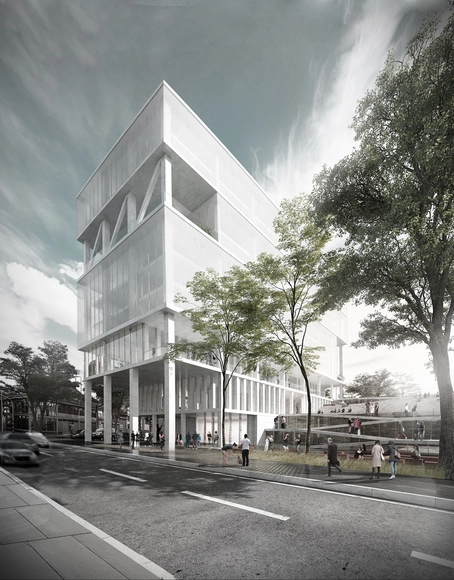
MOBO Architects has won the Colombian Society of Architects’ (SCA) public competition to design an institutional building for the department for social integration in the city of Bogotá.
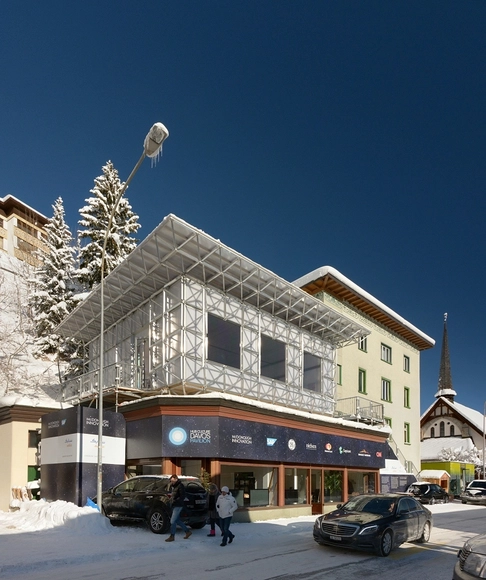
Designer William McDonough has unveiled the next step in cradle-to-cradle manufacturing: The Innovation for the Circular Economy house (ICEhouse) in Davos, Switzerland. The ICEhouse aims to show the “positive design framework described in the book Cradle to Cradle: Remaking the Way We Make Things, the sustainable development goals of the United Nations, and the reuse of resources implicit in the circular economy."
The house was used as a place of gathering and discussion for the World Economic Forum annual meeting. After being used for the week, the building will be disassembled and reconstructed elsewhere.
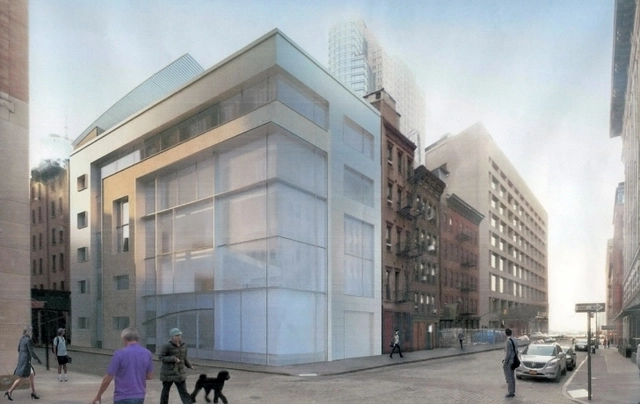
Maya Lin has been commissioned to design a 20,000-square-feet urban mansion in New York's Tribeca neighborhood. The five-story proposal, seen first on Tribeca Trib, aims to replace a 1980s mixed-use building on 11 Hubert Street. If approved, the of metal, glass and limestone building would rise 70-feet and house five bedrooms, 11 bathrooms, a dog room, wine closet, screening room, landscaped courtyard, 5,000-square-foot fitness center, basement, garage and more.