Buildner has announced the results of the Howard Waterfall Retreat architecture competition, an international design challenge developed in close collaboration with the Howard Family Trust. The competition invited architects and designers to propose a multi-generational family retreat set within a privately owned, forested landscape in Northwestern Pennsylvania, centered on the dramatic presence of Howard Falls and the surrounding gorge.
Rather than prescribing a singular architectural solution, the brief emphasized a careful dialogue between architecture and nature. Participants were asked to consider how a retreat could balance shared and private living, respond to steep topography and water systems, and integrate sustainably within a sensitive ecological setting. The project also called for an interpretation of family legacy, encouraging designers to acknowledge the history of the site and the original summer cottage while imagining a retreat capable of evolving across generations.
The competition drew a wide range of submissions from around the world, reflecting diverse architectural responses to landscape, memory, and domestic life. Many proposals explored ways of framing the waterfall and forest, working with elevation changes and floodplain constraints, and using material strategies that emphasized longevity, environmental responsibility, and a restrained architectural presence.
Following a comprehensive jury review, three winning projects were selected, along with special award recipients and honorable mentions. The jury highlighted projects that demonstrated clarity in spatial organization, sensitivity to the site's natural systems, and a balanced approach to multigenerational living. Taken together, the selected works show how residential architecture can operate not only as a place of retreat, but also as a long-term expression of stewardship, continuity, and respect for place.
Buildner's other ongoing competitions include The Unbuilt Award 2026, celebrating visionary unbuilt projects across three scales, with a 100,000 EUR prize fund; The Architect's Stair Edition #3, a conceptual exploration of one of architecture's most symbolic elements; and The Next House: USA, which invites innovative ideas for a new American suburban prototype: a home that is compact yet generous, adaptable yet grounded, replicable yet sensitive to place.
Projects:
First Prize Winner
Project title: Strata House
Author: Mathieu Henri Pierre Nouhen, from France
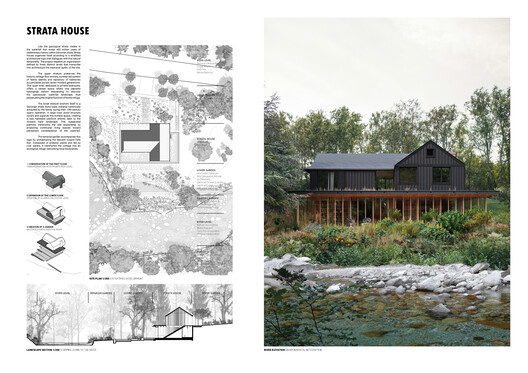
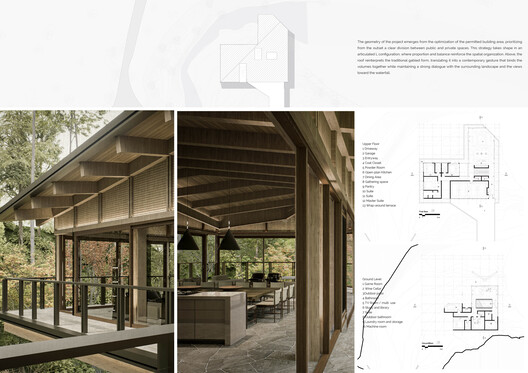
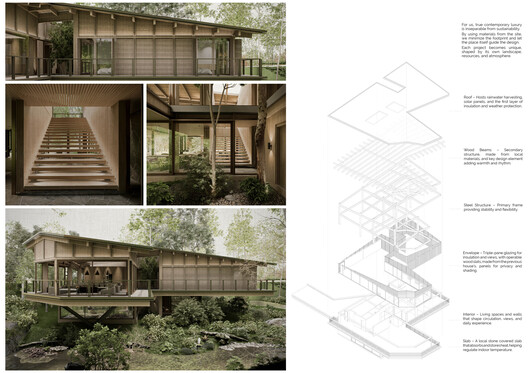
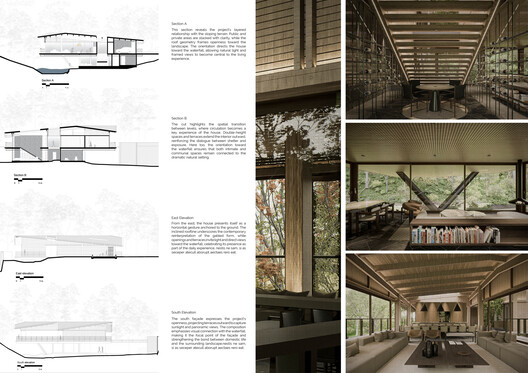
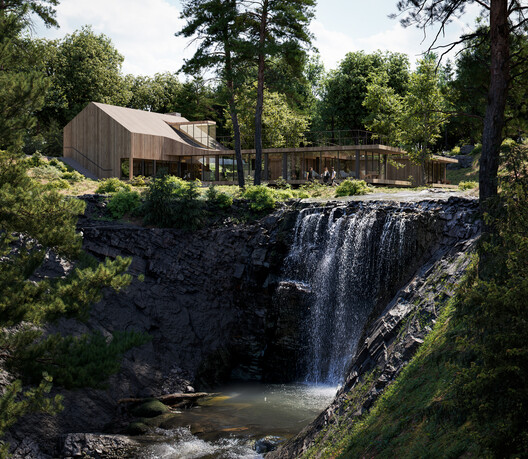
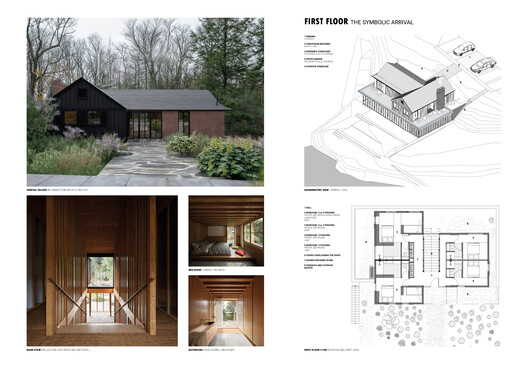
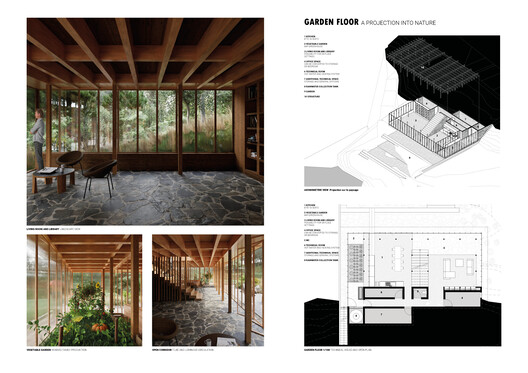
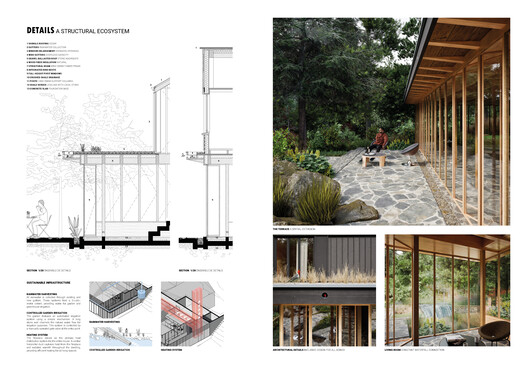
Strata House preserves the historic upper structure of the original cottage while introducing a new lower-level volume subtly embedded in the terrain. The design organizes movement as a slow descent from arrival to river's edge, culminating in a communal space immersed in the landscape. The upper floor retains private functions, while the garden level hosts shared spaces including a library, kitchen, and indoor garden. Architectural interventions remain minimal and sensitive, emphasizing continuity with site and history. Sustainability is addressed through rainwater harvesting, controlled irrigation, and passive thermal strategies, with the overall composition reflecting the geological strata of the site.
Second Prize Winner
Project title: Branch
Authors: Aleksandra Zofia Forystek, Min Kyu Kim, and Zehua He, from the United States
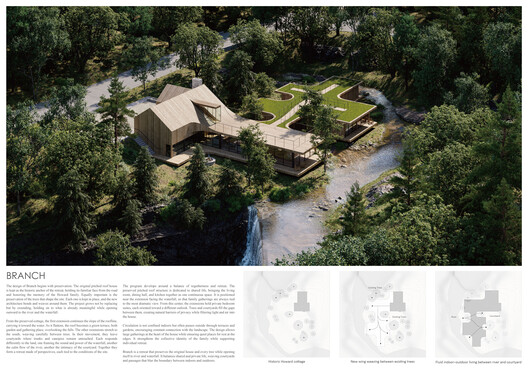
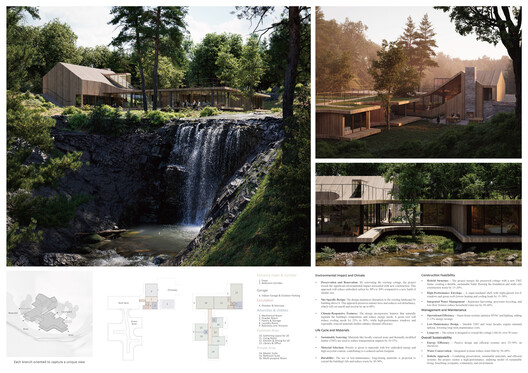
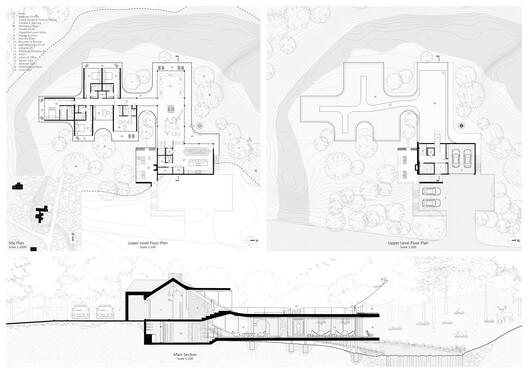
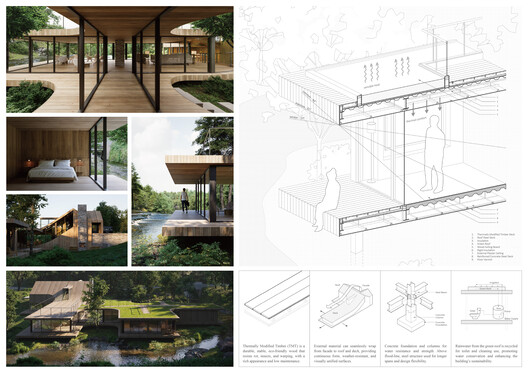
Branch House retains the pitched roof form of the original cottage while introducing a sprawling, horizontal addition that responds to the site's topography and ecological richness. The new volumes extend outward like branches, each oriented to frame views of the river, waterfall, and forest, while maintaining a respectful deference to the historic structure. A generous roof deck and green roof system double as an elevated landscape, merging architecture and terrain. The plan is clearly zoned, separating communal, private, and service areas, and offering seamless indoor-outdoor connections across levels. Structural lightness is achieved through a stilted foundation system that minimizes ground disturbance and elevates living spaces above the stream. Sustainability strategies include material reuse, passive solar design, thermal massing, and rainwater recycling, resulting in a low-impact, high-performance retreat. The architecture proposes a contemporary reinterpretation of the cottage typology while crafting a strong spatial narrative rooted in immersion and preservation.
Third Prize Winner
Project title: Triptyque
Authors: Jamie Kevin Willmer and Maureen Armida Vivienne Soupe, from the United Kingdom
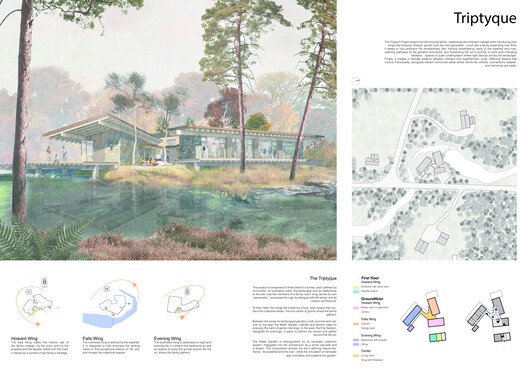
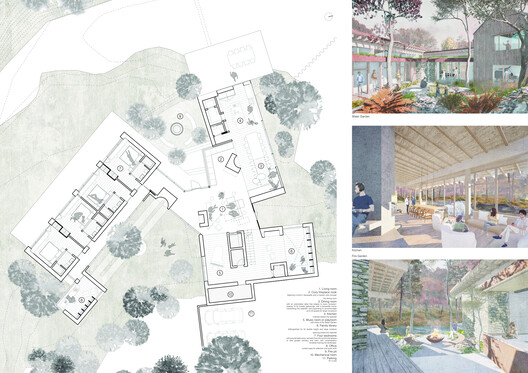
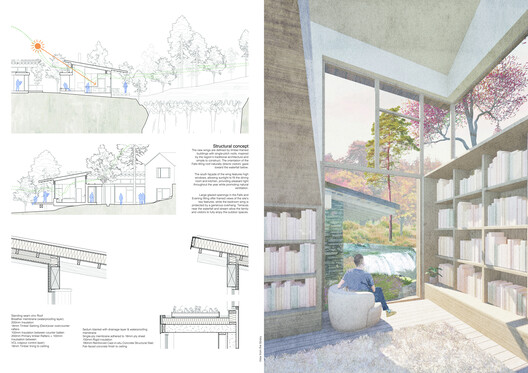
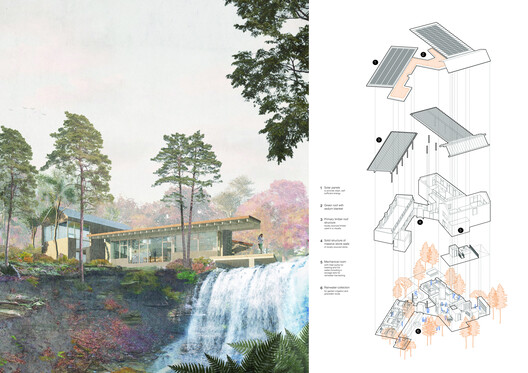
Triptyque honors the site's inherited cottage while expanding the program into three distinct wings that mirror the rhythms of daily life—morning, day, and evening. Anchored to the terrain and oriented to the waterfall, the composition carefully navigates the landscape through low-slung forms that emphasize horizontality. Each wing is shaped by site exposure: the Howard Wing recalls the legacy of the original home; the Falls Wing opens to communal life near the water's edge; and the Evening Wing offers retreat, views, and warmth around a fire garden. A shared garden axis ties these volumes together with delicate landscaping, curated views, and ecological intent. The architecture is restrained yet expressive—allowing the topography, geology, and light to guide spatial sequence and atmosphere. Sustainable design strategies include rainwater harvesting, green roofs, and solar energy, all subtly integrated to reinforce the project's deference to its environment and legacy.
Buildner Sustainability Award
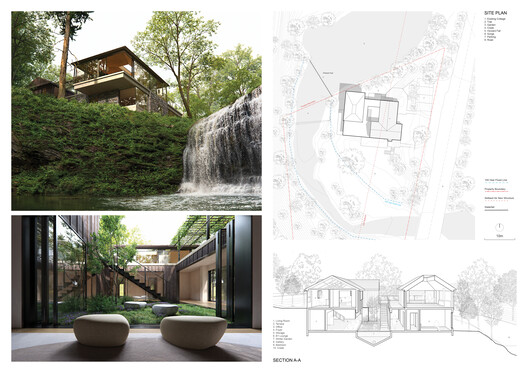
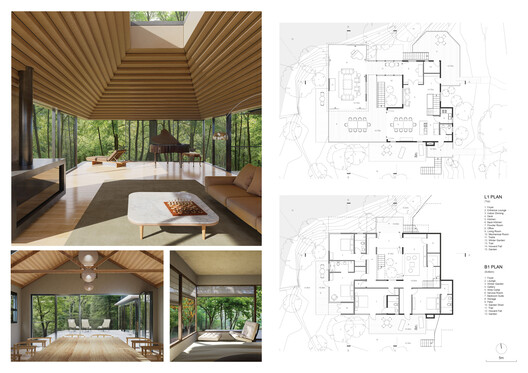
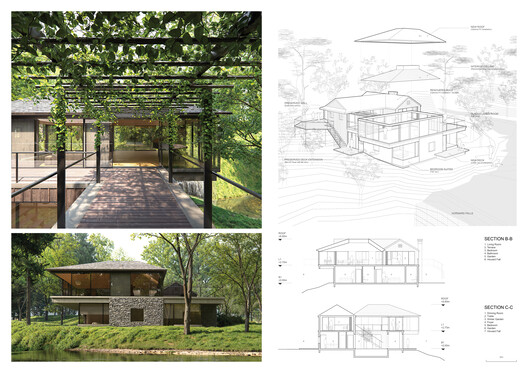
Project title: Nature Within | Forest Around
Authors: Weichen Wang, Mengyu Zhao and Viktor Fomin, from the United States
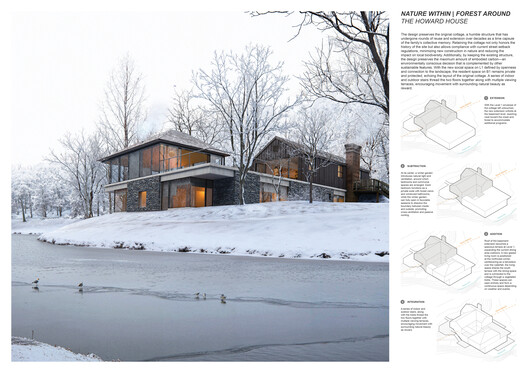
Nature Within preserves and repurposes the modest historic cottage by embedding it within a broader architectural and ecological strategy. The design extends the existing structure horizontally, maintaining its symbolic prominence while introducing a new pavilion-like living room and a lower-level courtyard surrounded by bedrooms. This arrangement allows a natural sequence of movement across the sloped site—from communal spaces to private rooms—while celebrating both the waterfall and forest surroundings. The integration of seasonal strategies, passive thermal cooling, and multiple exterior thresholds encourages year-round engagement with the landscape. Through restrained subtraction, thoughtful addition, and formal integration, the project succeeds in respecting the site's memory and topography without overpowering it.
Buildner Student Award
Project title: Roll the Dice
Authors: Matěj Čech and Filip Ježdík, of Czech Technical University in Prague (České vysoké učení technické v Praze), Czech Republic
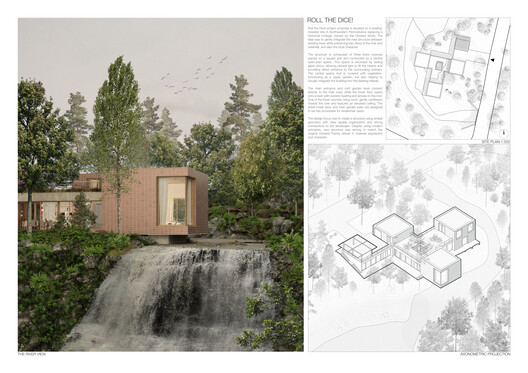
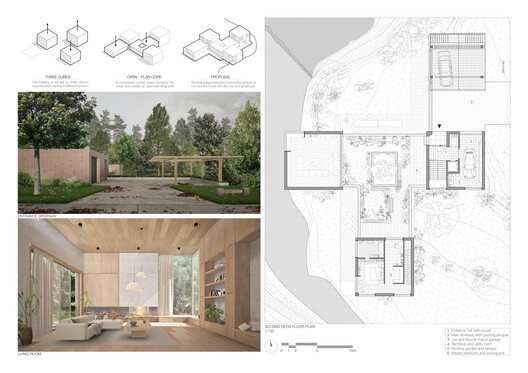
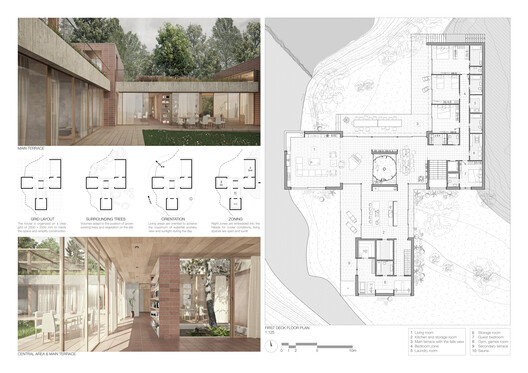
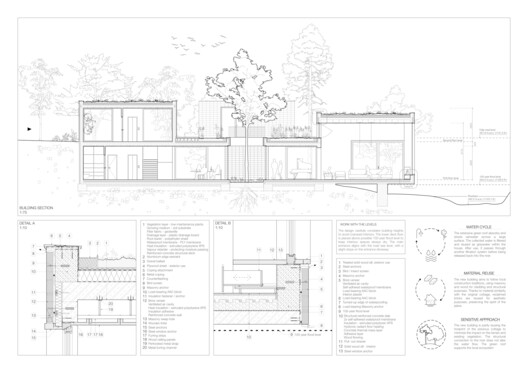
Roll the Dice is a contemporary reimagining of a forested family retreat, composed of three modular brick volumes carefully arranged around a central open-air courtyard. The project emphasizes internal spatial relationships over formal monumentality, using a grid-based logic to organize living spaces, terraces, and private rooms into a fluid yet compartmentalized plan. Each volume serves a distinct function and is linked by transparent connectors that frame curated views and preserve existing trees. The architecture is minimal and orthogonal, with subtle shifts in level responding to the sloped site. A rooftop garden and extensive green roof strategy reinforce the ecological narrative, while natural materials and warm interior finishes support a domestic atmosphere. However, the proposal chooses to fully replace the original cottage with a more abstract composition, engaging selectively—rather than holistically—with the site's history, terrain, and hydrological constraints. While the overall organization is refined and the courtyard strategy elegant, the siting strategy remains somewhat ambiguous in relation to the floodplain and pre-existing conditions.
Highlighted submissions
Project title: Memory Through Matter
Author: Neil Sergio Damy Novoa, from Mexico
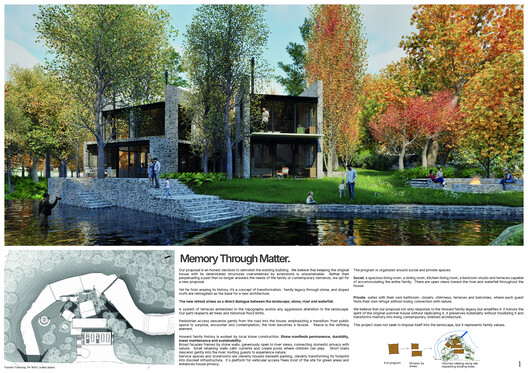
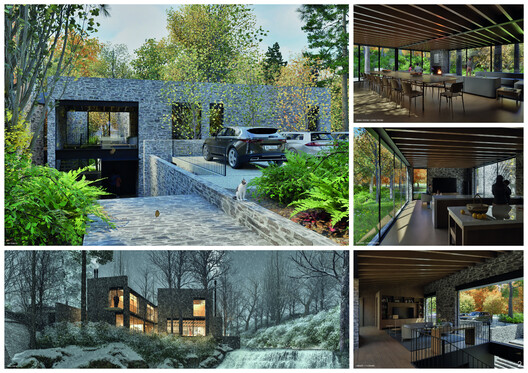
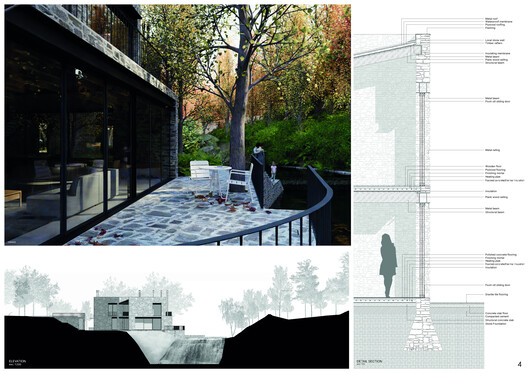
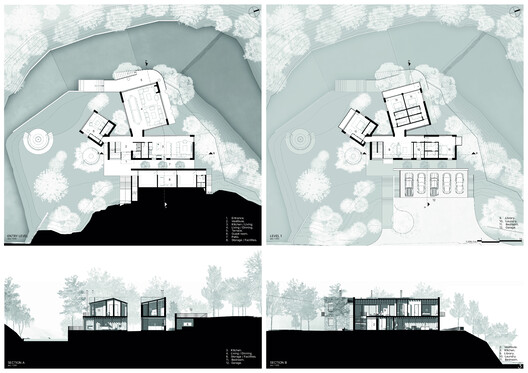
Memory Through Matter proposes a complete replacement of the existing house at Howard Falls, arguing that the accumulated extensions and deteriorated structure no longer provide a sustainable or meaningful framework for contemporary family life. Rather than preserving the building itself, the project reframes continuity through material and spatial memory, drawing on local stone construction and sloped roof forms as abstracted references to the family's legacy. The new retreat is embedded within the landscape through a system of terraces that follow the natural topography, respecting existing trees and historical flood limits while minimizing ground disturbance. Access descends gradually from the road, marking a transition from public approach to a quieter domestic setting, where the river and waterfall become primary spatial references. Social spaces are organized to open broadly toward the water, while private suites are distributed to provide individual retreat without losing visual and material connection to the landscape. Service functions are consolidated beneath the parking platform to reduce surface impact and preserve the site for open green areas. The project treats architecture as a mediator between memory, family life, and landscape, translating permanence and continuity into a contemporary domestic structure rather than a literal reconstruction of the past.
Project title: Howard Waterfall Retreat
Author: Laert Hoxha, STUDIO HOXHA, France
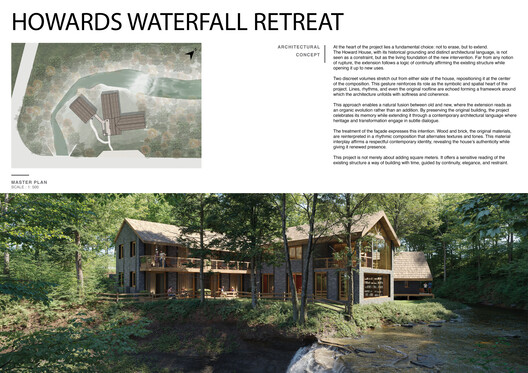
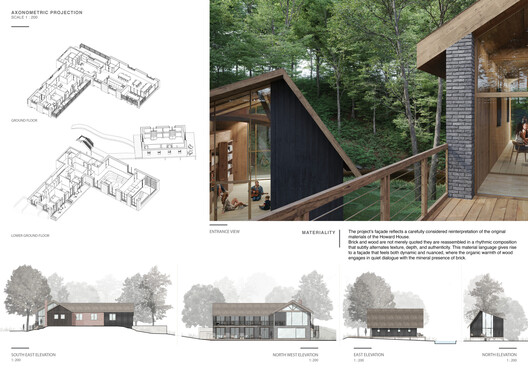
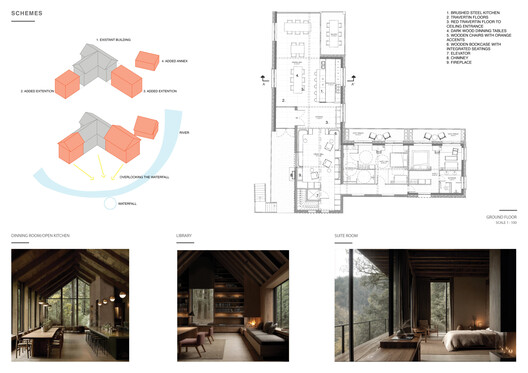
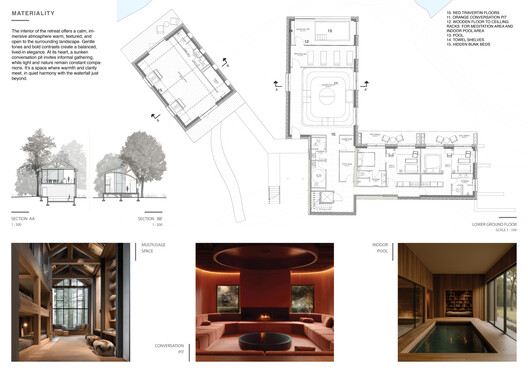
This proposal for the Howards Waterfall Retreat is centered on the decision to extend, rather than replace, the existing Howard House, treating it as the spatial and symbolic core of the project. The design introduces two new wings that stretch outward from the original structure, repositioning it at the center of the composition and allowing the retreat to grow through continuity rather than rupture. The extensions echo the scale, rhythms, and rooflines of the original house while opening the interior more fully toward the surrounding forest and waterfall. Brick and wood are reinterpreted in a restrained, rhythmic material palette that balances texture, warmth, and permanence, establishing a quiet dialogue between old and new. Programmatically, the retreat is organized to support collective family life alongside more intimate spaces for rest and reflection, with living areas oriented toward shared views of the landscape and private rooms offering individual refuge. The project frames architectural intervention as an evolutionary process, where memory, material, and contemporary use are woven together through careful extension rather than formal contrast.
Project title: Weave
Author: Karin Annika Kristina Krokfors, from Finland
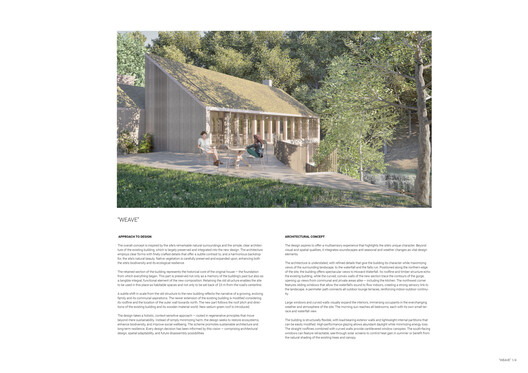
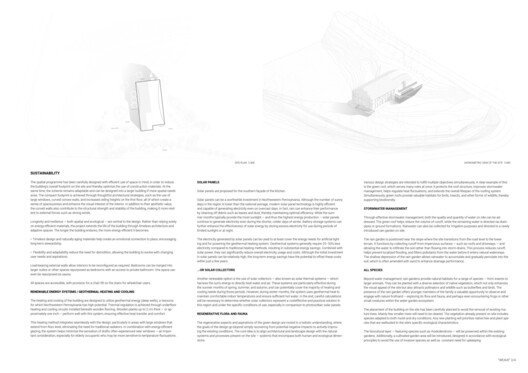
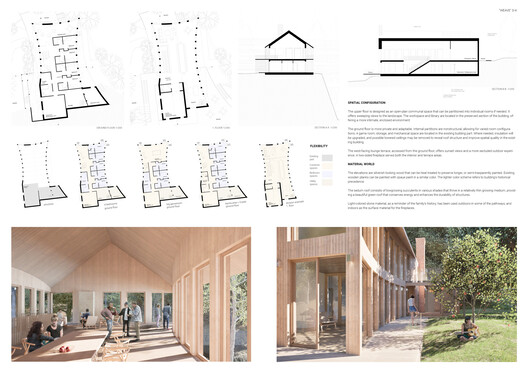
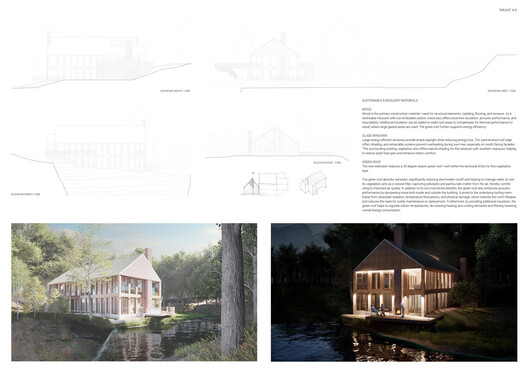
Weave proposes an incremental transformation of the existing house through a strategy of preservation, extension, and ecological repair, treating the original structure as the historical and spatial anchor of the project. Rather than replacing the building, the design retains its core and extends it carefully to accommodate evolving family needs, allowing the architecture to grow over time while remaining adaptable. The new volumes follow the logic of the existing roof form and timber construction, introducing a restrained extension that opens the house toward the surrounding forest and waterfall. Spatial organization emphasizes flexibility, with communal areas designed as open, reconfigurable spaces and more intimate rooms embedded within the retained structure. The project integrates sustainable strategies, including green roofs, solar energy systems, stormwater management through rain gardens, and geothermal heating, framing architecture as part of a broader ecological system. Through its material choices, spatial adaptability, and landscape integration, the project positions reuse and extension as a long-term approach to resilience, continuity, and environmental stewardship.
Project title: Like Water
Authors: Temitope Israel Akinsiku, Deborah Kikelomo Oluwade, and Victor Chukwuemeka Igene, from Canada
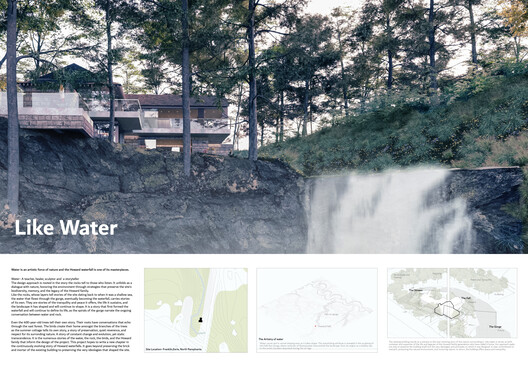
This proposal is shaped by the idea of water as a generative force that carves, guides, and defines both landscape and architecture. The design extends the existing house while maintaining its primary orientation, allowing new volumes to unfold in response to the gorge, forest, and waterfall. Spatial organization follows the logic of flow and erosion, with communal living areas opening toward the water and more intimate rooms positioned for retreat and reflection. Architectural elements frame views and choreograph movement across terraces and platforms, reinforcing a continuous dialogue between interior and exterior. Material strategies combine existing structures with carefully introduced new elements, emphasizing continuity, adaptability, and long-term resilience, while landscape interventions preserve native vegetation and manage water as an integral part of the site's ecological system.
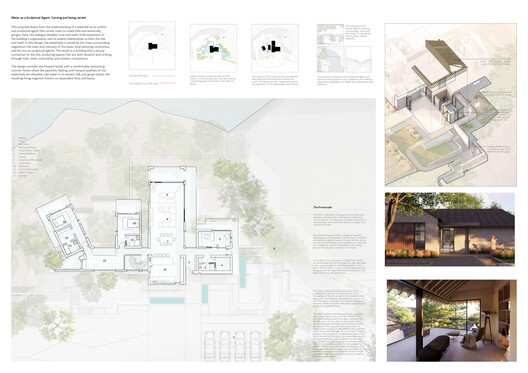
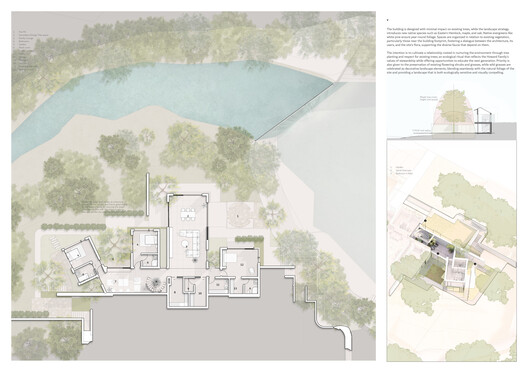
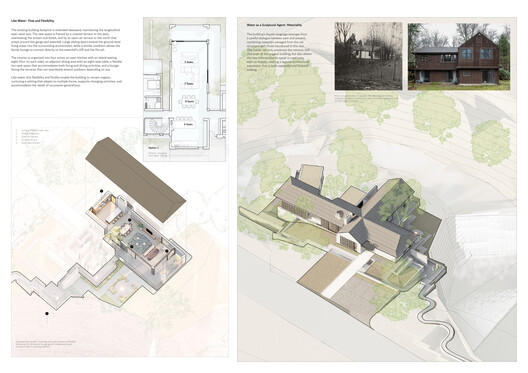
Project title: Woodenstone Retreat
Authors: Jenny Bucay, Paulina Hidalgo Monroy Kunz, and Ana Lucia Muñoz Sanchez, from Mexico
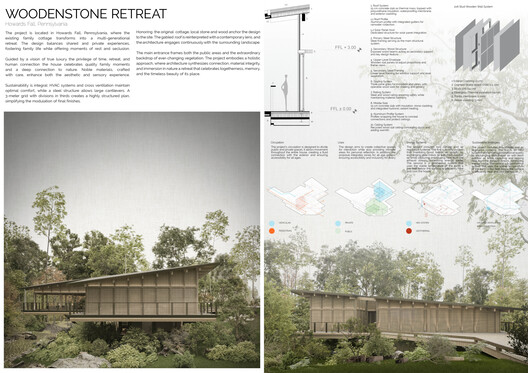
Woodenstone Retreat proposes a multi-generational family dwelling in Howards Fall, Pennsylvania, rooted in the reinterpretation of the site's original cottage through a contemporary architectural language. The project extends horizontally along the sloping terrain, organizing shared and private spaces around clear visual connections to the surrounding forest and waterfall. Local stone and wood anchor the building to its context, while a lightweight structural system allows for generous overhangs, terraces, and large openings that frame the landscape. The interior emphasizes continuity between levels, with circulation designed to support both collective gatherings and moments of retreat. Sustainability strategies, including cross ventilation, geothermal systems, and passive shading, are integrated into the architectural logic, positioning the retreat as a balanced synthesis of material restraint, environmental performance, and long-term adaptability.