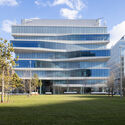
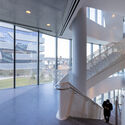
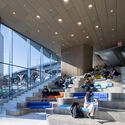
The Metropolitan Museum of Art in New York has selected Mexican architect Frida Escobedo to design the new $500 million modern and contemporary art wing. The Met does not have, until now, a thematic area that would house pieces corresponding to this temporality in art.
David Adjaye Associates has been commissioned to design an exhibition with rare and previously unreleased work of Jean-Michel Basquiat, to be hosted at the Starrett-Lehigh Building in West Chelsea, New York. "Jean-Michel Basquiat: King Pleasure" is the first show organized by the artist's family after his death and will feature over 200 paintings, drawings and artefacts, together with recreations of Basquiat's New York art studio and the Michael Todd VIP Room of the Palladium nightclub, for which the artist created two paintings.
As OMA New York / Jason Long's Greenpoint Landing residential towers near completion, new renders have been released that showcase the amenities, interior spaces, and landscape of the project. Developed by Brookfield Properties and Park Tower Group, the Eagle + West Towers feature 745 units of mixed-income housing, 8,600 sq. ft. of retail space, along with recreational amenities such as a pool, lounge, gym, workshops, and test kitchen.
Recently, the Nobel laureate economist Paul Krugman wrote in the New York Times about the causes of unaffordable housing in New York City. He blamed the crisis on a few things, including a powerful financial “monoculture” in the city, NIMBYs, and the city itself blocking new construction. That last element, however—that the city blocks new construction—is an increasingly popular myth that needs examination.
Seven decades after designing Lever House, SOM returns to the iconic modernist building to resume its restoration, continuing its long-lasting stewardship of the project. SOM previously revisited the building in 2001, restoring its façade using high-performance materials while preserving the original architectural image. This time, the intervention concerns the ground floor and the third level terrace, as well as the mechanical systems, to significantly improve the building’s energy performance. When complete in 2023, the renovation will become an important example of extending the life of the midcentury built environment.
The Architectural League of New York announced the 2022 Emerging Voices, highlighting eight new practices that show “the potential to influence the disciplines of architecture, landscape design, and urbanism.” One of the most prominent accolades in North American architecture, the Emerging Voices program reviews the design and academic accomplishments of individuals and firms based in the United States, Canada, and Mexico, selecting the best work through a juried, invited portfolio competition. This year’s winners showcase a wide range of preoccupations and design approaches that they explore through various mediums, thus illustrating a whole new spectrum of architectural inquiry.
BIG's Wildflower Production Studio has received its building permit from the Department of Buildings (DOB), indicating that the project’s construction will now commence. In late 2019, American actor, producer, and director Robert De Niro’s Wildflower Development Group and BIG revealed the first images of their 650,000 square foot (approx. 60,400 sqm) production studio design proposal, located in the Astoria neighborhood of northwest Queens, New York. Once complete, the project is set to become the first vertical commercial film, television, and creative studio in the world.
Fotografía base via Wikipedia. Autor: AngMoKio. Licencia bajo CC BY-SA 2.5 . Image Cortesía de 90Grados Arquitectura-Renderings
90Grados specialises in creating high-quality architectural renderings - and this time they present the virtual construction of a skyscraper that was left unfinished in New York after the Great Depression of 1929: the Metropolitan Life North Building.
https://www.archdaily.com/975817/what-would-the-unfinished-metlife-north-building-in-new-york-have-looked-likeArchDaily Team
Earlier this month, a series of cities worldwide have revealed various initiatives that would help them better understand the effects of climate change and shape a more environmentally conscious environment. From several American cities creating digital twins to help curb carbon emissions to the city of Brighton mandating bee bricks to foster biodiversity and Central Park becoming a laboratory for studying climate change adaptation in urban parks, cities take on a multidisciplinary and multi-scalar approach to environmental issues.
Architect Cino Zucchi (b. 1955) grew up and practices in Milan, Italy. He was trained at MIT in Cambridge and the Politecnico di Milano, but claims to be largely self-taught, although influenced by such of his countrymen as Aldo Rossi and Manfredo Tafuri. He is internationally known for diverse projects across Europe. Many are both abstracted and contextual residential complexes in Italy, particularly in Milan, Bologna, Parma, Ravenna, and, most notably, in Venice. Zucchi’s D residential building in Giudecca, attracted international attention and praise when it was completed in 2003. I met Cino Zucchi last year during the Venice Architecture Biennale; that meeting led to an extensive interview that we recently engaged in over Zoom between New York and the architect’s sunlight and books-filled Milan studio.
Boating on The Lake in the northern reaches of Central Park. Image Courtesy of Harry Gillen on Unsplash
As temperatures rise across the globe with no sign of slowing down, the parks of the future will be subjected to droughts, flooding, punishing heat, and more abundant snowfall as warmer air is capable of holding more moisture than colder air. (It’s often said the world of the future will be wetter and wilder for that exact reason.)
So how can urban parks harden themselves for the coming decades? The Central Park Conservancy, the Yale School of the Environment, and the Natural Areas Conservancy have teamed up to turn New York City’s most iconic park into a hub for studying climate change adaptation and potential mitigation strategies. The Central Park Climate Lab was announced on January 12 by the conservancy, and the insights gleaned from the program will expand to other parks across New York city and eventually, other parks across the country.
Over the past year, established practices have continued to champion the transformation of existing structures, with adaptive reuse and renovations increasingly becoming a defining aspect of contemporary architecture From the renovation of landmark structures to the adaptive reuse of obsolete facilities, the idea of giving new life to existing buildings has been embraced as the premise for a more sustainable practice, but also as a means of reinforcing the urban and cultural identity of cities. Discover 8 designs and recently completed projects that showcase a new common practice of reusing existing building stock.
The dawn of the Anthropocene has thrown the idea of adaptive reuse into the limelight: effectively the pinnacle of urban regeneration and revitalization. It utilizes the presence of existing buildings with historic and cultural value and re-purposes them to be functional. Essentially a form of architectural salvage; a sustainable and viable means of rebuilding.
Recent events such as the pandemic has highlighted inequalities in our cityscape, the inadequate segments in a state of disuse and disrepair. Adaptive reuse can replenish these areas and create new cultural hotspots, encouraging activity and creating vibrant and healthy mixed-use environments.
Below is a diverse selection of cultural hotspots using Adaptive Reuse
The Second Studio (formerly The Midnight Charette) is an explicit podcast about design, architecture, and the everyday. Hosted by Architects David Lee and Marina Bourderonnet, it features different creative professionals in unscripted conversations that allow for thoughtful takes and personal discussions.
A variety of subjects are covered with honesty and humor: some episodes are interviews, while others are tips for fellow designers, reviews of buildings and other projects, or casual explorations of everyday life and design. The Second Studio is also available on iTunes, Spotify, and YouTube.
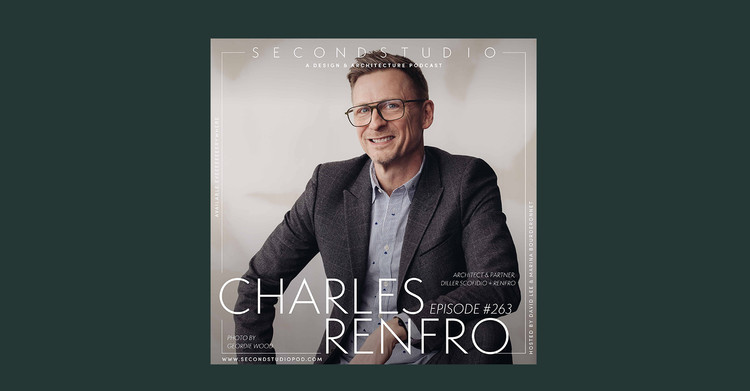
This week David and Marina are joined by Charles Renfro, Partner at Diller Scofidio + Renfro, to discuss Charles’ childhood and early interests in architecture, his education and linking ideas of sexual freedom with architecture, joining Elizabeth Diller and Ricardo Scofidio, becoming a partner at his office, his design philosophy, how New York has changed, and more.