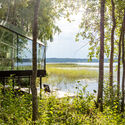
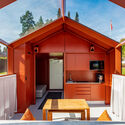
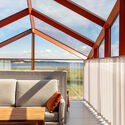
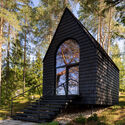
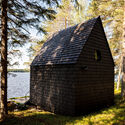
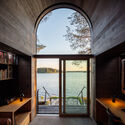
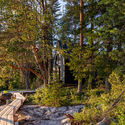
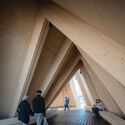
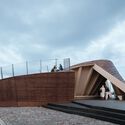
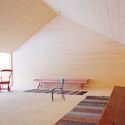
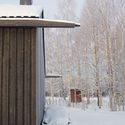
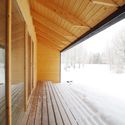
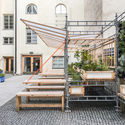
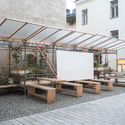
Led by American architect and professor, Travis Price, FAIA, the Kalevalakehto / Shaman’s Haven of the Kalevala project was the result of an international exchange among Finnish and American students of architecture, from the Catholic University of America in Washington, and Aalto University in Helsinki. It was designed during a 9-day intensive charette held at the Embassy of Finland in Washington, DC in January 2010, and constructed in Helsinki by the students over 9 days in late August 2010. The design of the installation is inspired by the themes of the Finnish epic Kalevala: the myth of the 7 eggs of the world’s creation, the mysteries of the Sampo as a metaphor for creativity and innovation, and the shape-shifting shamanic character of Väinämöinen, the main character of the Kalevala. Located on Seurasaari, an island near the city center which serves as a nature reserve, and open-air museum of historic wood architecture, the installation will function as a “think tank,” a meeting place for reflection and creative dialogue.
Finland
Architects: Huttunen-Lipasti-Pakkanen Architects
Location: Somero, Finland
Directors in Charge: Risto Huttunen, Santeri Lipasti
Project Area: 111 sqm (villa) & 26 sqm (sauna)
Project Year: 2002
Photographs: Marko Huttunen
Architects: Huttunen-Lipasti-Pakkanen Architects
Location: Espoo, Finland
Site Area: 2,300 sqm
Project Area: 87 sqm
Project Year: 2004
Photographs: Marko Huttunen

Courtesy of Daniel Andersson
Daniel Andersson shared with us his project Icebergs. An iceberg only shows the tip above the water surface, the rest stays hidden below. These floating summer cottages in sheltered bays an lakes around Åland Islands, Finland investigates this concept. See more images and architect’s description after the break. read more »
While designing a house for their friends, Huttunen + Lipasti + Pakkanen Architects’ residence enhances a simplistic form with an acute attention to material selection and detailing. Situated in the rocky island terrain of Naantali, Finland, Villa Mecklin was built at a leisurely pace with the architects working through construction details on site. “Villa Mecklin has mainly been a self-build project. Contract documents or complete working drawings were not necessary because any problems were resolved on site,” explained the architects.
More photographs and more about the residence after the break. read more »
Architects: Lassila Hirvilammi Architects
Location: Jyväskyla, Finland
Chief Architect: Anssi Lassila
Interior Architect: Teemu Hirvilammi
On Site Architect: Jani Jansson
Client: Parish of Jyväskyla
Collaborators: Virve Väisänen, Juha Pakkala, Janne Kähkönen, Matias Topi, Yoshimasa Yamada
Project Area: 1,311 sqm
Project Year: 2008-2010
Photographs: Jussi Tianen
Architects: ARK-house Architects
Location: Helsinki, Finland
Project Team: Pentti Kareoja, Seung-Ho Lee, Pasi Kinnunen
Project Year: 2009
Photographs: Jussi Tiainen
Architects: AFKS / Frondelius + Keppo + Salmenperä
Location: Espoo, Finland
Client: City of Espoo
Project Area: 1,060 sqm
Project Year: 2005-2009
Photographs: Jussi Tiainen

There are certain publications that capture a unique moment on a certain architectural scene, becoming a must have for your bookshelf. And trust me, Newly Drawn is one of those.
Aalto and Saarinen marked some points along the modern architecture timeline, and now this book presents us the new breed of finnish architects, starting by individualizing each of them on the cover, stating that they are young and with character.
The books is organized by practices, showing recent built and un-built works in detail, with good photos and drawings – something that is always appreciated by architects, but not always accomplished by the publishers.
Some of the works included on this book have been already featured in ArchDaily, such as the The University of Helsinki City Campus Library by Anttinen Oiva arkkitehdit and the Lakeside House by NOW for Architecture and Urbanism.
More details of the book and where to buy it after the break.
Architects: Lassila Hirvilammi Architects
Location: Seinäjoki, Finland
Architects in Charge: Anssi Lassila, Teemu Hirvilammi
Project Area: 300 sqm
Project Year: 2004-2008
Photographs: Courtesy of Lassila Hirvilammi
The Finnish pavilion at Shanghai World Expo 2010 is called “Kirnu” (“Giant’s Kettle”). Designed by a team from Helsinki-based architect’s office JKMM, Kirnu won first prize among 104 entries in the design competition, which was announced in May 2008.
The results were made public in October 2008 in Helsinki. The planning started immediately, and construction began in April 2009, with the pavilion due to be completed in December 2009. The head designer of the pavilion is architect Teemu Kurkela. Below is a description of the Kirnu concept as seen by the architect.
More images, video and architect’s description after the break. read more »
Architects: NOW for Architecture and Urbanism / Tuomas Toivonen
Location: Saimaa lake, Finland
Client: Private
Project area: 140 sqm
Project year: 2009
Sketches: Nene Tsuboi
Photographs: Maija Luutonen
Architects: Anttinen Oiva Architects
Location: Helsinki, Finland
Project Manager: Vesa Oiva
Collaborators: Jussi Kalliopuska, Selina Anttinen, Antti Lehto
Building services consultant: Aila Puusaari, DI, Pˆyry Building Services Oy
Construction-engineering consultant: Sami Lampinen, DI, WSP Finland Oy
Library consultants: Irma Pasanen, office chief, Library of Helsinki University of Technology / Risto Maijala, library amanuense, Library of Helsinki University of Technology
Client: University of Helsinki
Project Area: 32,000 sqm
Design year: 2008-2010
Construction year: 2010-2012
Images: Courtesy Anttinen Oiva Architects
City as Living Factory of Ecology, winning entry by ARUP, Sauerbruch Hutton, Experientia and Galley Eco Capital.
In my opinion, the best sustainable projects have been in small scales. Urban scale projects have been more difficult to get going, due to the their inherent complexity.
But I am confident that recent initiatives are about to make the step forward, specially the ones that are being produced on countries that have the have their governments focused on this.
On of this examples is the recently awarded Low2No design competition, organized by Sitra (Finnish Innovation Fund) and the City of Helsinki, to find a on design a large building complex on a reclaimed harbour at the western edge of Helsinki’s central business district.
Given that the repertoire of sustainable urban development models is still in its infancy, the question of “who & how” is our question of first order. WHO: We believe that identifying the best team and approach is the key factor impacting the robustness of the final solution. HOW: Our competition is designed to seek approaches for four central objectives applied at the scale of a city block:
- low- and one day no- carbon emissions
- energy efficiency
- high architectural, spatial and social value
- sustainable materials and methods
The finalists included top practices and consultants such as ARUP, Sauerbrunch Hutton, Space Syntax, Transsolar, ARO, REX, Front, BIG, among others. The award went to C_Life by ARUP, Sauerbruch Hutton, Experientia and Galley Eco Capital.
Videos and boards for the winning and finalists entries after the break.
Architect: Pieta-Linda Auttila
Location: Valkosaari island in Southern Harbour of Helsinki, Finland
Building owner: UPM Kymmene
Construction: 30 to 40 m² / 150 m³
Structure: Wood
Coating: Native woods, Glass
Concept and Communication: Trust Creative Society
Project Year: 2009
Photographs: UPM
“By bending the block I forced the slats into a new form that contrasts with the original arrangement. That which is solid turns partly transparent, that which is strictly geometrical, organic,”
Pieta-Linda Auttila, architect
“Edge-Paracentric Architecture”, the 11th International Alvar Aalto Symposium will take place in Finland between August 7 and August 9.
Inside the urban hubs of the Western world, a feeling of safety prevails. We continue to enjoy the highest standard of living ever known to humankind. At the same time, we are fully aware of the results of our culture of consumerism. Therein lies the greatest paradox: We are forced to actively forget reality to be able to enjoy the facade of excess we have created around us.
Yet outside the main stages of the metropolis is where our work is needed. There are a few architects who challenge the conventions of the profession and the ever-dictating forces of the market; they go where the real problems are and try to solve them with insight, economy and wit. These people are the pathfinders towards the next revolution in architecture, which will not focus on style, but on the balance between man and nature -or, in short, survival.
The symposium venue is in the main auditorium of the University of Jyväskylä. Lecturers include Alexander Brodsky, Yrjö Haila, Anna Heringer, Saija Hollmén, Geir Tore Holm, Bijoy Jain, Francis Kéré, Olavi Koponen, Juhani Pallasmaa, Mauricio Pezo, Dan Rockhill, Patama Roonrakwit, Carin Smuts, Mark Isitt (Moderator), and Sami Rintala (Chairman).
More information on the official website.

Visiondivison shared their entry for the Koivusaari Idea Competition to create a new city district on an island just outside Helsinki, Finland. The competition asked participants to organize a master plan for the island that would provide the framework for further planning. Visiondivison’s proposal, Urban Fade, is comprised of a highly efficient city grid that allows users the option of moving around the district to interact with the different areas.
More about the proposal after the break. read more »

Architect: Beckmann-N’Thépé architects – Aldric Beckmann, Françoise N’thépé
Landscape design : TN+ / Bruno Tanant & Jean-Christophe Nani
Location: Helsinki, Finland
Project Manager: Wilfried Daufy
Project Architect: Anne-Catherine Dufros
Assistant Architects: Constance Héau, Jessica Pallatier
Landscape design team: Guillaume Derrien & Agathe Turmel
Zoo expert: Jean Marc Lernould
Constructed Area: 26,2 ha

Architects: SARC Architects
Location: Joensuu, Finland
Building Owner: Senaatti-kiinteistöt
User: The Finnish Forest Research Institute, Joensuu Forest Research Institute
Building consultant: ISS Proko Oy (Engel Rakennuttamispalvelut Oy)
Constructed Area: 7,650 sqm
Project Year: 2004
Photographs: SARC Architects

Architects: JKMM Architects
Location: Turku, Finland
Main Designer: Asmo Jaaksi architect SAFA
Design Team: Teemu Kurkela, Samuli Miettinen, Juha Mäki-Jyllilä, Mikko Rossi, Katja Savolainen architects SAFA, Päivi Meuronen interior architect SIO
Landscaping: Molino Oy
Structural Design: Narmaplan Oy
Lighting: Eficientysul
Main Contractor: NCC Rakennus Oy
Constructed Area: 6,900 sqm
Project Year: 2007
Photographs: Arno de la Chapelle, Asmo Jaaksi, Harri Falck, Jonny Holmen, Jussi Tiainen, Michael Perlmutter, Patrik Rastenberg