The design proposal of the Badel Block Complex by Popular Architecture is a combination of polyvalent and stable, both a massing inviting interpretation and detailed development by others, and an anchor seeking to re-channel the site’s positive qualities. Conceptually, the project begins with making a direct link between the former distillery building and the preserved façade of the Gorica Factory — two features required to be kept. Treating the factory façade as a gateway, the plan pulls in the existing context of an active street market — into the heart of a site cut-off from the city for decades — while also avoiding direct replication of the area’s pervasive perimeter block typology. More images and architects’ description after the break.
The proposal by reSET Architecture for the Klaksvík city center unites the two town halves and acts as a place of meeting, relaxation and celebration. Their design creates a place that represents the new born heart of Klaksvík. The architects believe that the city should be attractive to more than just the people of Klaksvík itself, a place that attracts people from the Faroer and abroad. More images and architects’ description after the break.
With a challenge to make a series of random ephemeral public spaces using a simple structure in the Seattle Center, the intervention by Hoshino Architects proposes areas of such spaces to be transformed to voids and purely leave the circulation spaces on the ground level. In contrast, the public contents circles are randomly scattered on the field level. As normal urban spaces, the circulation spaces sometimes change to unexpected functions, such as a viewing gallery for the event staged at the field level. This dual layer structure intertwines and creates the complex ‘Porous-scape’. More images and architects’ description after the break.
Organized by Europan Europe, 2:pm Architectures & CUAC Arquitectura met for a 4-days long international workshop to explore how agriculture and architectural development are in symbiotic relationship. In analyzing the growth of Vienna and Oberlaa, they can easily understand how architecture born on agricultural results in footprints so they offered a system to develop Oberlaa. It’s a system which is able to offer countryside qualities within contemporary city density. More images and architects’ description after the break.
Despite all of the preconceived notions about New York City being overpopulated, noisy and constantly bustling, there are numerous pockets within the five boroughs that offer respite from the city. This design strives to be one such pocket – or island. Governors Island has a long military history that dates back to 1776. It was controlled by the U.S. Government first for the U.S. Army and later for the Coast Guard. In 2002 the island was “sold” to the people of New York and declared a national monument. In 2010, Mayor Bloomberg and Governor Paterson agreed on the future operations, planning and redevelopment of the island through the Trust for Governors Island. Since then, the island has been open during the summer months for visitors to enjoy the unique seclusion offered by the the old military grounds. But the Trust had bigger plans. Choosing a team of architects, urban planners, designers and landscape architects that include Rogers Marvel Architects, Diller Scofidio + Renfro, Mathews Nielsen and led by West 8, plans began to unfold that would reimagine the island as a getaway for New Yorkers. Playing up to its isolation, its abundance of lawns and trees, and the views that it offers, the first phase of the plans have officially broken ground and are scheduled for completion in Fall 2013.
The main objective of the project for the Ödemis New City Center by Onat Öktem is to integrate urban functions to ensure the continuity of the pedestrian and green axis while creating a new structure. In this context, defined and undefined urban spaces have been reorganized to increase the physical, social and cultural wealth of the citizens. Green axis, squares and spaces in the city have been evaluated as an advantage for the social, cultural and physical development. More images and architects’ description after the break.
The proposal for the new city center of Klaksvik by Group 8 aims to become a model of design that is environmentally, economically and socially sustainable; a place synonymous with modern ideals for living, working, being. The design is inspired by a dense and controlled scale of intervention, based on a strong network where each part of the town will be interconnected through sustainable methods of moving, thus providing a green means of living to all inhabitants. The inter-connected city enhances the close relationship between the actors within and is ready to answer to the new ambitions of the town, while maintaining strong traditions. More images and architects’ description after the break.
In the proposal for the Badel Block competition, WAU Design considered the site and its position as an opportunity to create a new center for the locals as well as a new entrance for the city through the ‘Communities of a Single Roof’ design. Considering the relative lack of public space and facilities in the neighborhood, they propose to extend the square and the market inside the Badel block and enlarge the space devoted to culture and leisure in order to strengthen the sense of community and centrality. More images and architects’ description after the break.
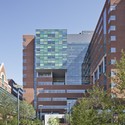
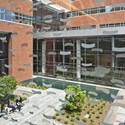
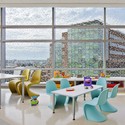
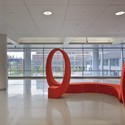
The new facility designed by Perkins+Willfor the John Hopkins Hospital in Baltimore, Maryland approaches the design as a total experience of healing that includes architecture and urban design. The project proposes to redefine the hospital experience with The Charlotte R. Bloomberg Children’s Center and the Sheikh Zayed Tower, whose goal is to emphasize transformative patient-centric care.
With a key concept for the Badel Block proposal of creating the core as a living icon, the existence of such a rich structure as the old distillery building defines this approach. As an opportunity to develop a new structure that enhances new urban routines, this project becomes a strong new urban value. Designed by Pablo Pita Architects, the mixed-use proposal defines the morphology of the construction ring, breaking it down in several pieces. This enables the intervention to be phased and sets the right urban scale. More images and architects’ description after the break.
“Flip/City”, a proposal by PinkCloud.DK which was shortlisted in the 2012 Rethinking Shanghai competition, proposes a new urban identity for Shanghai as a model for the development of future cities. By flipping the horizontal cityscape to the vertical, footprints of Shanghai’s existing typologies, only visible by plane, embody the new face of the vertical city. By expanding Shanghai up along the vertical plane, unused urban voids will be activated. More images and architects’ description after the break.
The design proposal by SANGRAD Architects + AVP Arhitekti for the Badel Block Complex, a mixed-use project within the city center of Zagreb, Croatia, consists of enclosing the continuity of the existing block and positioning the vertical into its center. Following the instinct of creating a free, public space as large as possible, and yet also in keeping with the proposed program, with uniform treatment of the existing urban archaeology, represents the main guidelines of this concept. More images and architects’ description after the break.
Designed by Gustafson Guhrie Nichol (GGN) and produced in collaboration with Landscape Forms, UrbanEdge is a collection of landscape framing and furniture elements for urban spaces. The project responds to the demand for more outdoor public spaces with an interest in less formal, more welcoming and effective use of urban locations. UrbanEdge pairs GGN’s experience in designing urban spaces with Landscape Forms’ expertise in developing beautiful site furnishings that address issues in urban environments; built to perform and endure under conditions of high-usage. More images and architects’ description after the break.
As a part of the exhibition “Water Brick” held by the Association of Siamese Architects (ASA) in The Architect’12 Expo this last April, Shma shared with us their Water City proposal. Their visionary project focused on a response to the severe flood that inundated most of central plain of Thailand in 2011. They focused on Ayutthaya, the old capital of Thailand and the UNESCO’s World Heritage, in the project named “2050 Ultra Flood Plain”. More images and architects’ description after the break.
Henning Larsen Architects has won the competition for developing a 150,000 sqm area in the second-largest city in the Faroe Islands, Klaksvík. The area will comprise a cultural house, a museum, residences, offices and shops. 154 competition proposals were submitted in the open, international competition. More images and architect’s description after the break.
The proposal by Amann-Cánovas-Maruri in the ideas competition for the organization and design of the access to the city of Murcia through El Palmar Avenue establishes a slanted axis that generates different urban scenes. In creating a sustainable action based on participatory urbanism and new high density urban nodes in contact with and related to the farmland, the architects generate public spaces that link together both sides of the boulevard. More images and architects’ description after the break.
Located in the Tongzhou district of Beijing, Urban Creek is an attempt at having architecture merge within various spheres of public space. Designed by ATOL Architects, the project is focuses around the idea that architecture should be conceived as a cultural connective tissue that creates opportunities to link spaces and neighborhoods together. In redefining the very notion of mixed-use from a free standing commercial box/podium/tower typology, this design aims at creating an ever evolving city center to reconnect with its secret past. More images and architects’ description after the break.