Scheduled to be the tallest tower in China and the second tallest building in the world by 2015, Kohn Pedersen Fox’s 660-meter-high Ping’an International Finance Center has received a major unexpected set back. Following an industrywide inspection conducted last week, Shenzhen government officials have discovered that a low-quality sea sand has been used by developers to create substandard concrete for KPF’s supertall skyscraper and at least 15 other buildings under construction.
The Dwight D. Eisenhower Memorial saga continues, as Rep. Rob Bishop (R-Utah) proposed legislation that would forego Frank Gehry’s controversial design and eliminate federal funding. Although Bishop’s radical bill would save $100 million in future funding, it ignores any possibility of compromise.
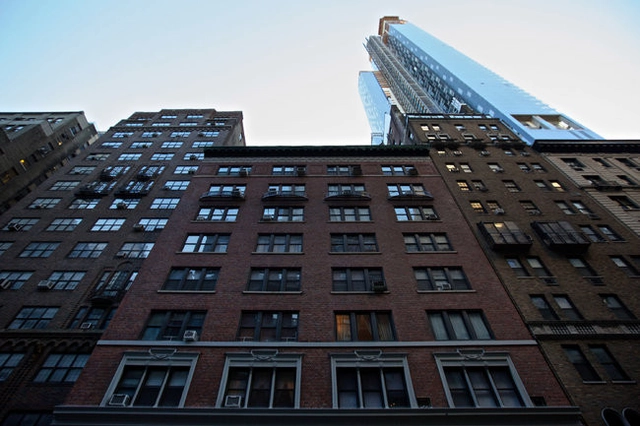
The air rights to 140 West 58th Street were bought by the developer of the 90-story One57. Image via The New York Times
"There's a price on everything in New York, and the air is no exception." - Ross F. Moskowitz, Strock & Strock & Lavan
All of us are familiar with the practice of buying and selling property in the form of land, residential and commercial space, but the buying and selling of the air surrounding these spaces is a concept well-understood by few. With the recovery of the condominium market in New York City, residential development is at an all-time high, and this means taller and even more luxurious towers are fighting each other tooth and nail for the best possible views of the city. Because of this, the price of air above and around these potential developments is becoming more and more expensive, since a room with a view is worth a whole lot more than one without. Is it possible that these empty, vertical pockets are now worth more than the ground below them?
Read more about New York City's air rights to find out.
So what exactly are air rights? They can be defined as a building's "unused or excess development rights" measured by square foot and can be transferred from one building to another if zoning in that specific area permits. Air rights in NYC typically sell for 50-60% of what the ground below them is worth; some, however, can be worth much more than that, as in the case of air rights along the High Line.
US Embassy in London / KieranTimberlake Architects
"The works of our artists, architects, and preservationists provide us with another language of diplomacy. A transcendent language that allows us to convey values that are at once uniquely American yet speak to all of humanity. Increasingly in this world, art and architecture help us maintain our sense of openness and liberation." -- Former Secretary of State Hillary Rodham Clinton, April 12, 2010
An embassy is much more than a building or a work of architecture; it functions as a symbolic representation of countries' relationships to one another. It represents the universal language of diplomacy - "communicating values and ideals, extending well beyond any moment in time". An embassy has the difficult task of representing two diametrically opposed concepts: security and openness. The former typically overpowers the latter in importance, which is most probably why when we think of foreign embassies, it conjures up images of stately monolithic buildings surrounded by tall fences and menacing guards or "bunkers, bland cubes, lifeless compounds", according to Tanya Ballard Brown of NPR's All Things Considered.
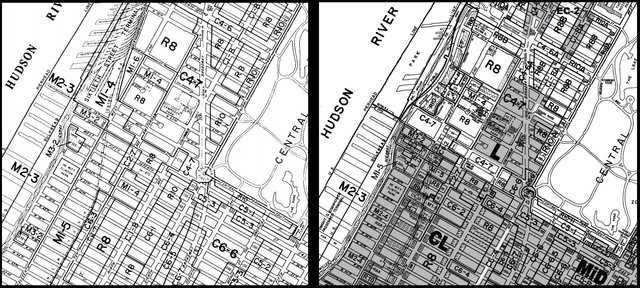
Let’s dump the word “zoning,” as in zoning ordinances that govern how land is developed and how buildings often are designed. Land-use regulation is still needed, but zoning increasingly has become a conceptually inappropriate term, an obsolete characterization of how we plan and shape growth. - Roger K. Lewis
Zoning, just over a century old concept, is already becoming an outdated system by which the government regulates development and growth. Exceptions and loopholes within current zoning legislation prove that city planning is pushing a zoning transformation to reflect the goals and needs of city building today and in the future. To determine how zoning and land use need to change we must first assess the intentions of future city building. Planners and architects, legislators and community activists have already begun establishing guidelines and ordinances that approach the goals of sustainability and liveability. The AIA has established Local Leaders: Healthier Communities through Design and has made a commitment to the Decade of Design: Global Solutions Challenge. NYC has come up with Active Design Guidelines: Promoting Physical Activity and Health in Design and its Zone Green initiative in regards to updating its zoning resolution. Philadelphia has augmented its zoning to include urban farms and community gardens. It is safe to assume that many other cities will follow this precedent.
In response to the Commission on Chicago Landmarks’ decision to reject landmark status to Prentice Woman’s Hospital for the second time in three months, the two preservationist groups challenging the City of Chicago have withdrawn their lawsuits. This eliminates the last barrier standing in Northwestern University’s way to demolish the historic, Bertrand Goldberg structure for a new biomedical research facility.
“We felt that we had done as much as we possibly could to demonstrate the significance of the building and ways to reuse,” stated Christina Morris, a senior field officer for the National Trust for Historic Preservation. “We just couldn’t see that we’d have any other outcome.”
For many, this news is disheartening as architects and preservationists from around the globe have fought in solidarity for much of the past year in an attempt to illustrate the importance of this one-of-a-kind structure.
After months of debate, the United States Congress has passed a bill that will allocate $51 billion to Hurricane Sandy relief helping the thousands who lost their homes and businesses to the devastating storm last October. New York Governor Andrew Cuomo announced that $400 million of the aid will be used to fund New York's buyout program, an initiative to help address the damaged homes and coastline. The program is two-fold; in part it will help reimburse the property damage caused by the storm, but the initiative has a larger goal, which is to address the nature of coastal flooding and create a barrier that would mitigate the damage created to the coast by storm surges in the future. Since the storm, there have been many suggestions as to how to prepare for the type of damage brought on by Hurricane Sandy of 2012 and Hurricane Irene of 2011. These suggestions range from flood gates to barrier reefs. Cuomo's buyout program, as reported by the Architect's Newspaper Blog, hopes to encourage residents along vulnerable flood zones to sell their land to the city for the development of a natural coast that would absorb the impact of strong winds and storm surges.
There has been some controversy over the past few months for the George Square redesign in Glasgow, Scotland since we last announced the six shortlisted architecture firms in December. Following the submission and assessment by a jury in January, the project went through an upheaval when Labour leader of the Glasgow City Council, Gordon Matheson announced that the submitted designs would be scrapped in favor of a "facelift" for the square. Numerous reports on the Herald Scotland present conflicting arguments for the turn of events and the abrupt change in plans have left the council, jury, design firms and the public in discontent. It is unclear what the status of the project is today, but for the moment it is on hold as the council discusses ways in which to proceed.
After an “arduous” public review and a heated debate over affordable housing, New York’s City Council has unanimously awarded final approval to BIG’s tetrahedral-shaped West 57th apartment building in Manhattan. As reported by Crain’s New York Business, a compromise has been made to include 173 affordable housing units within the 32-story, 750-unit residential building and the neighboring industrial building that will be converted into 100 additional rental apartments. As you may recall, the community board and Councilwoman Gail Brewer initially threatened to “torpedo the project” if the apartments were only made affordable for a 35 year period. However, Durst apparently won them over by contributing one million dollars into an affordable housing fund.
"The good news, which is the matra of my office and community board No. 4, is there will be, yes, by law, 35 years of income-restricted affordable housing," stated City Councilwoman Brewer, who represents the area.
When applying “major surgery” to a beloved, 20th century “masterpiece”, you’re going to face some harsh criticism. Such is the case for Norman Foster, as the legendary British architect has been receiving intense backlash from New York’s toughest critics for his proposed renovation to the New York Public Library. First, the late Ada Louise Huxtable exclaimed, “You don’t “update” a masterpiece.” Now, the New York Time’s architecture critic Michael Kimmelman claims the design is “not worthy” of Foster and believes the rising budget to be suspect.
More on Kimmelman's critique and Foster’s response after the break...
Today, President Barack Obama announced his intent to appoint five individuals to key Administration posts, including architecture’s very own Michael Graves, stating: “These fine public servants both bring a depth of experience and tremendous dedication to their new roles. Our nation will be well-served by these individuals, and I look forward to working with them in the months and years to come.”
The five individuals include:
Vinton G. Cerf - Member, National Science Board, National Science Foundation
Marta Araoz de la Torre - Member, Cultural Property Advisory Committee
Michael Graves - Member, Architectural and Transportation Barriers Compliance Board
Laurie Leshin - Member, Advisory Board of the National Air and Space Museum
Lynne Sebastian - Member, Advisory Council on Historic Preservation
Praised for his masterful blends of architecture and engineering, yet criticized for rarely sticking to a budget, Valencia-native Santiago Calatravais no stranger to controversy. His latest project making headlines is the largest landmark in Valencia and the second most-visited cultural complex in Spain: the City of Arts and Sciences.
Although the 2012 London Olympics concluded last August, RIBA president Angela Brady and New London Architecture chairman Peter Murray continued to lead a fierce campaign against the strict International Olympic Committee (IOC) rules that forbid architectural practices who contributed to the design and construction of the venues from promoting their work. Months later, a compromise has finally been met and the architects will now allowed to discuss their contributions freely.
Brady said: “The majority of architects and designers we were standing up for in the campaign were young small businesses who just wanted to be able to promote their work. It’s great that they are now able to speak freely about their contribution.”
The American Institute of Architects (AIA) today announced a five-point legislative agenda for the 113th Congress, targeting job creation for small businesses as a top priority. The agenda is the product of months of collaboration and dialogue with AIA members and leaders. More than 3,400 AIA members offered their views about what policies the AIA should advance through the annual Call for Issues last fall.
According to Mickey Jacob, FAIA, 2013 AIA President, the AIA’s agenda “reflects the interests of our members, which not so coincidentally reflects the priorities of the American people. These five priorities for the next two years have the creation of jobs as their centerpiece while also seeking to shore up our aging infrastructure, make our communities more resilient and assure we invest in the next generation of architects.”
In response an outrage that broke out amongst Democrats and Republicans, after House Speaker John Boehner failed to vote for Sandy relief before the end of the Congressional session two days ago, the House of Representatives have approved a $9.7 billion relief measure to aid flood victims of Hurricane Sandy. This is good news, as the Federal Emergency Management Agency’s (FEMA) recently warned that it would soon run out of funding if no measures were taken. Senate approval is likely to come later in the day and a second congressional vote is scheduled to take place on January 15 for a larger $51 billion request.
Understanding the importance of issuing this federal support, AIA President Mickey Jacob has offer Congress three key objects for helping these communities recover.
Read AIA President Jacob’s letter to congress and his three objectives after the break…
The American Institute of Architects (AIA) today issued the following statement in reaction to the House and Senate votes approving the “Fiscal Cliff” deal negotiated by Congressional leaders earlier this week. The statement should be attributed to AIA President Mickey Jacob, FAIA:
“On the plus side, the agreement prevents a tax increase on millions of Americans and small businesses. It also extends several business tax incentives that help create jobs and promote design and construction, including for schools and energy efficient homes.”
Amidst the longstanding, heated battled to save Bertrand Goldberg’s iconic Prentice Woman’s Hospital, the results of the 2012 Chicago Prize Competition: Future Prentice have been announced! Presented by the Chicago Architecture Foundation, in collaboration with Chicago Architectural Club and the Chicago Chapter of the American Institute of Architects, the international competition intended to act as a platform for public debate about the future of the controversial Chicago landmark.
More information and the winning proposals after the break…
Cook County Judge Neil Cohen has granted Bertand Goldberg’s Prentice Woman’s Hospital a temporary reprieve after preservationist filed a lawsuit against the city and the Chicago Commission on Public Landmarks yesterday afternoon. Plaintiffs, Landmarks Illinois and the National Trust for Historic Preservation claim that the commission “acted arbitrarily and exceeded its authority,” after granting and subsequently revoking Prentice landmark status in just a short afternoon on November 1. These proceedings, which typically takes months, followed Mayor Rahm Emanuel’s decision to publicly support Northwestern University’s plan to demolish the vacant icon.