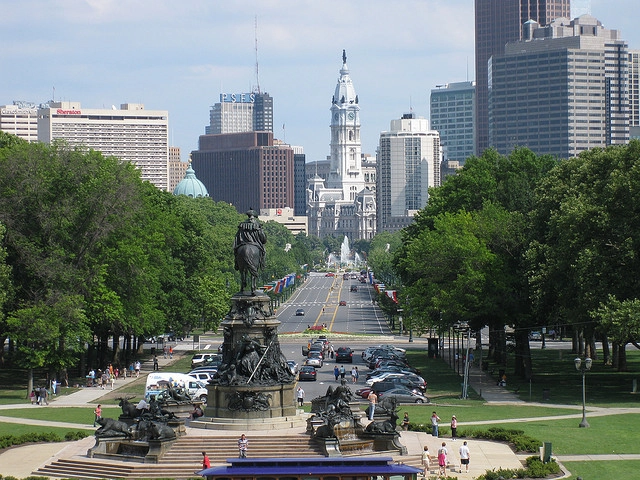
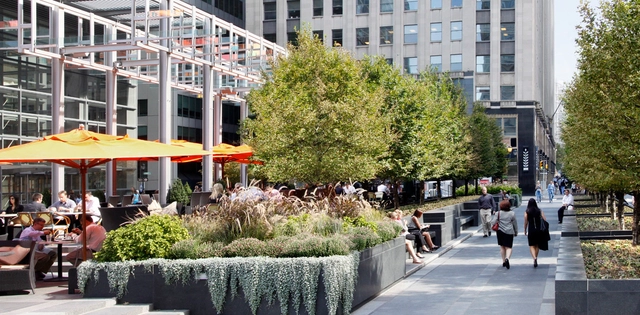
In this article in the Wall Street Journal, a number of key players discuss the ongoing work to transform "the most elegant urban boulevard in the US", Philadelphia's Benjamin Franklin Parkway. The parkway has been on a long journey from boulevard to highway, and thanks to a new plan entitled "More Park, Less Way", it could be on its way back, with a variety of plans to change the Parkway into a vibrant, more densely populated series of spaces with more amenities for local residents. You can read the full article here.
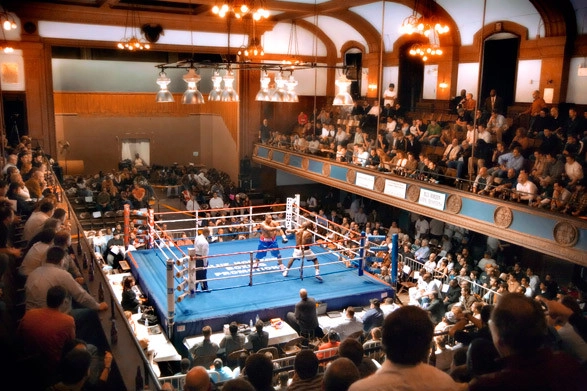
A stirring piece by the Philadelphia Inquirer Architecture Critic, Inga Saffron, calls for the preservation—both inside and out—of architecture under threat by “warp-speed gentrification.” Saffron uses as her examples two traditionally black, historic event halls, the Royal Theater and the Blue Horizon, that are “now controlled by developers who would gut their innards and insert soulless structures behind the thin veneer of their facades, a parking garage in the case of the Blue Horizon. That would leave the public with the equivalent of a cardboard cutout of the once-glamorous venues, perfect for photo-ops but lacking in architectural flesh and blood.” The article is a spirited call to preserve not just facades, but also the inner life of architecture: what, according to Saffron, makes a building vibrant and preservation-worthy in the first place.
The bursting of the housing bubble wreaked havoc on cities across the United States causing widespread blight in once-thriving community economies. Foreclosed, abandoned and condemned homes continue to pockmark neighborhoods and communities, adding to the vacant lots of populous but affected cities like Philadelphia. The Mayor's Office of Philadelphiaapproximates that there are nearly 40,000 vacant lots throughout the city of brotherly love, about 74% of which are privately owned, making them virtually inaccessible to rehabilitation. But the city has a strong drive to amend these conditions. With organizations like DesignPhiladelphia's "Not a Vacant Lot"and the city's Redevelopment Authority, some of this land is being put to good use.
Just last month, University of Pennsylvania’s School of Design announced their lecture series for Spring 2012. All lectures are held at 6PM in Meyerson Hall and free and open to the public unless otherwise noted with continuing education credits available. The series began on January 17th and concludes on April 28th. More information on the upcoming events after the break.
Vacant land is a looming problem for many cities, especially when it remains undeveloped for years or is transformed into garbage dumps and parking lots. But when designers begin to notice these voids within the activity of a city they are able to unlock the inherent potential in the land. That is precisely what “Not a Vacant Lot”, as part of DesignPhiladephia, did this October. Philadelphia’s 40,000 vacant lots are both a challenge and an opportunity for young designers, artists and architects to tranform these under-utilized spaces into experiences within the fabric of the urban environment. The focal point of the design intervention was at the University of the Arts lot on 313 S. Broad Street, just a few blocks from Philadelphia’s center. It featured a reinterpreted map of Philadelphia by PennDesign students and Marianne Bernstein’sPlay House, an 8′x8′ aluminum cube which, in its simplicity, could unlock the potential of this particular lot. But this engagement of vacant land was just one such intervention in a series artist installations throughout Philadelphia. Another such intervention, GroundPaper, was designed by two collaborating artists, Mike Ski and KT Butterfield. The site of their choosing was along the banks of the Delaware River in Fishtown, a neighborhood of Philadelphia.
Read on to see what artists can accomplish with no budget, a vacant lot and an inspired idea.
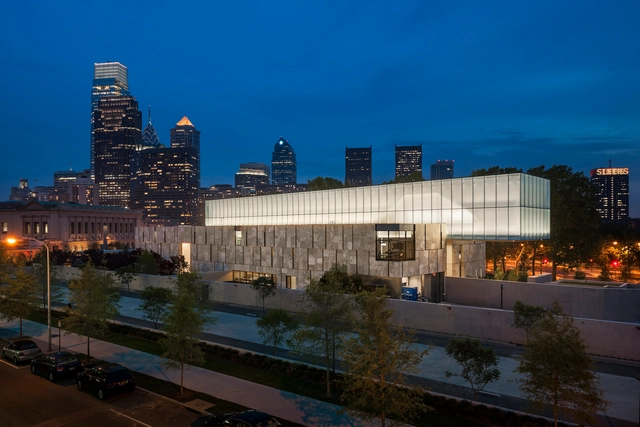
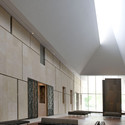
The last chance to see the Barnes Foundation’s artwork in its original setting has passed. It is now being prepared for the move to its new home in downtown Philadelphia. Architects Tod Williams and Billie Tsien designed the new building for the Barnes Foundation with respect for its strong history and as a reflective addition of the foundation’s mission. The building is scheduled for completion in late 2011. More after the break.
The OLIN team’s award-winning submission to the Living City Design Competition responded to ambitious standards of sustainable development within the historically rich yet socially and ecologically underserved neighborhoods of Brewerytown and North Central in Philadelphia. Working closely with architects and urban planners Digsau and Interface Studio, OLIN explored how sustainable design can be implemented within an existing urban framework by utilizing local resources, community engagement, and respect for the vernacular culture and architecture.
https://www.archdaily.com/159540/patchwork-living-city-design-competition-olinChristopher Henry
A conceptual proposal for the retrofit of an old grain silo in Center City Philadelphia, Interface Studio Architects aims to integrate an existing, vacant structure into an urban, mixed-use project. Additionally, it raises interesting questions about old building reuse and innovative tactics for sustainability. More images and architects’ description after the break.