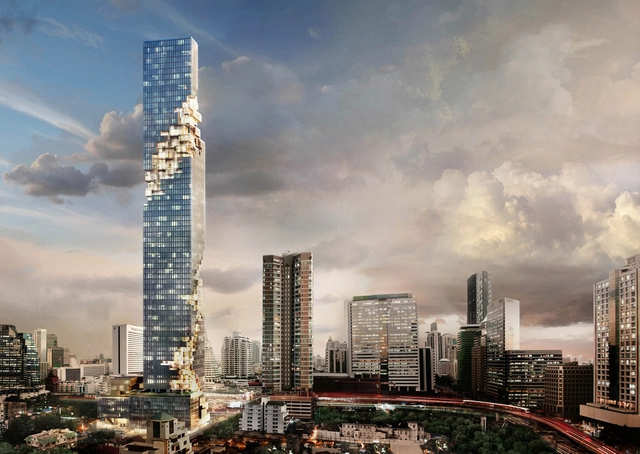
Hong Kong- and Beijing-based Büro Ole Scheeren is expanding with the opening of two new offices in Berlin and Bangkok. As its founder, German architect Ole Scheeren says, the expansion will extend the practice's range of work with projects in Europe and North America. "Büro Ole Scheeren’s Berlin studio will act as a European base for work across the western hemisphere, while Büro Ole Scheeren in Bangkok, together with its subsidiary HLS, is charged with the further design development and construction supervision of the MahaNakhon tower, soon to be completed as Thailand’s tallest skyscraper," says the practice.
Participating in the What Can Design Do conference in Amsterdam, Ole Scheeren took time, along with several other creators, to discuss the impact of the working environment. Playfully dubbed, “Pod Sessions,” each talk takes place in De Vorm’s contemporary Pod chair, the PET plastic improving acoustics and signature Dutch felt providing comfort. In his Pod Session, Ole Scheeren, founder of Buro OS and lead designer on the CCTV Building in China, talks about the nature of a transitional workplace, the importance of collaboration, offices as a creative tool and the necessity of having a personal presence in a project. Having participated in projects across the world, Scheeren frequently moves to the site of his latest projects, as was the case with the CCTV Building.
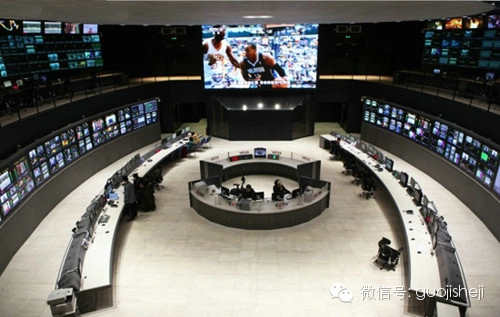
Since the building's construction concluded in 2012, images of OMA's CCTV Headquarters have permeated the media. But inside views of this mutant skyscraper -- characterized by a soaring 72 meter cantilever -- have remained rare. Until now, that is. Images originally published by International Design and shared on WeChat by 广电独家 reveal the interior of OMA's CCTV Headquarters, including Emmy-winning set designer Jim Fenhagen's news studios.
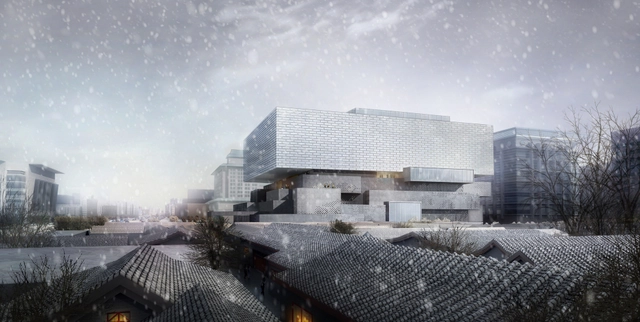
The Guardian Art Center features none of the dramatic cantilevers and futuristic formal experimentation of Büro Ole Scheeren's other works. Instead the "hybrid art space" - located in the heart of Beijing, just a stone's throw from the Forbidden City - references the scale and materiality of the adjacent traditional buildings. The lower floors, containing an auction house and a museum with a 1,700 square meter exhibition-events space, comprise an aggregation of small "pixelated" blocks, clad in stone with a pattern of perforations derived from a 700-year-old Chinese landscape painting. Though the upper portion of the building, containing a 120-room hotel and a restaurant, is larger in scale, it is broken down by a facade of oversized glass "bricks," again a reference to the materials of the hutong next door and a "humble and non-elitist symbol in Chinese culture," according to the press release.
To find out more about this intriguing building, we spoke to Ole Scheeren, who assured us that in spite of its appearance, the Guardian Art Center is just as radical as his previous works. Read on after the break for the full interview.
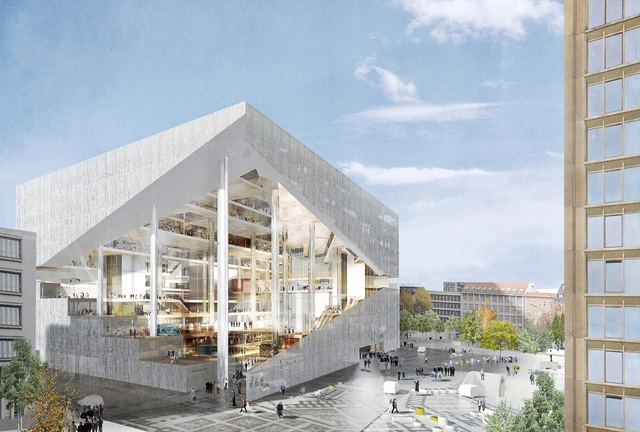
For the recent Axel Springer SE Media Campus in Berlin, OMA's proposal (shown) is up against designs by two of OMA's past employees.. Image Courtesy of Axel Springer SE
It is difficult to even imagine an architectural practice more influential than OMA. Not only has Koolhaas' practice completed high-profile buildings worldwide, but it has also been the incubator for some of the world's most famous architects, with many striking out alone after a period working under Rem. This article in the Wall Street Journal profiles some of the latest crop of "graduates", including Bjarke Ingels and Ole Scheeren, who have founded their own practices in the last decade and are now acting as some of OMA's biggest competitors. You can read the full article here.