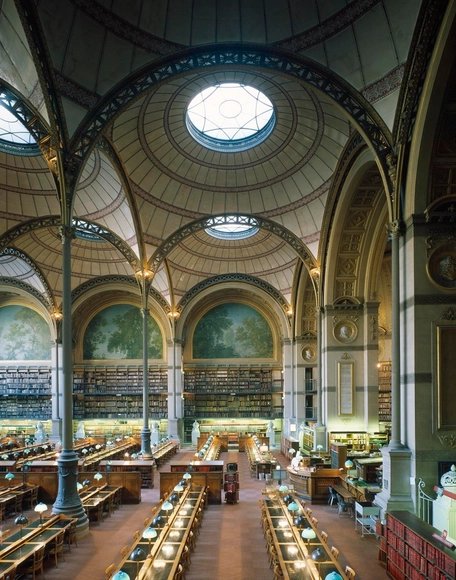
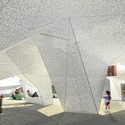
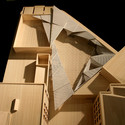
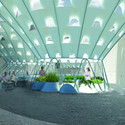
MoMA's upcoming exhibitionHenri Labrouste: Structure Brought to Light celebrates the impact of this 19th century architect on space, materials, luminosity and on great places of assembly. The exhibition will run from March 10th to June 24th, 2013 and will be the first solo exhibition of Labrouste's work in the United States.
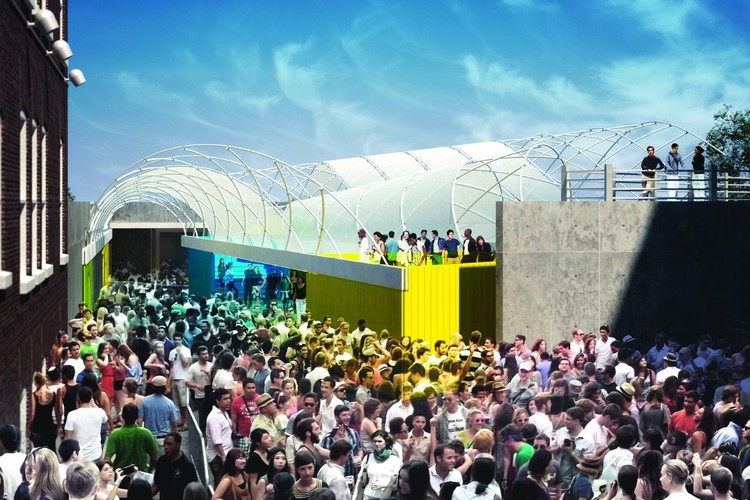
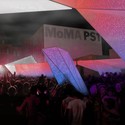
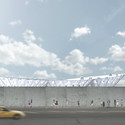
The Museum of Modern Art and MoMA PS1 has selected CODA’s (Caroline O’Donnell, Ithaca, NY) large-scale, self-supporting Party Wall, made from leftover shreds of skateboard material, as winner of the 2013 Young Architects Program (YAP). Drawn from five finalists, the porous skin of CODA’s temporary urban landscape will shade visitors of the Warm Up Summer Music series with its reclaimed woven screen, while providing water in refreshing cooling stations and seating with its detachable wooden skin on the lower half of the linear structure.
The MAXXI Museum in Rome has announced the five young designers who will compete for the opportunity to design and build a space for live summer events in the large courtyard of the MoMA PS1 in NY, the MAXXI Plaza in Rome, and - for the first time - at Turkey's Istanbul Modern.
Each of the finalist's projects will also be displayed as exhibitions at the four institutions participating in the Young Architects Program (YAP): the MAXXI, the MoMA PS1, Constructo (a Chilean cultural institution), and Istanbul Modern.
The five finalists have until January 2013 to submit their proposals. The chosen project will be constructed and inaugurated in June.
More information of the five finalists, after the break...
The Museum of Modern Art in NYC is launching an exhibit called Tokyo 1955–1970: A New Avant-Garde, that investigates the transformation of Tokyo from a war-torn nation into an international center for arts, culture and commerce. The exhibition will run from November 18 through February 25, 2012 and includes over 200 works of various media including painting, sculpture, photography, architecture, drawings, graphic design, video and documentary film.
The Museum of Modern Art, Columbia University and The Frank Lloyd Wright Foundation have announced that the vast archives of American architect Frank Lloyd Wright (1867-1959) have been jointly acquired by the University and the Museum and will become part of their permanent collections. The archive, which includes some 23,000 architectural drawings, 44,000 historical photographs, large-scale models, manuscripts, extensive correspondence and other documents, has remained in storage at Wright’s former headquarters – Taliesin (Spring Green, WI) and Taliesin West (Scottsdale, AZ) – since his death. Moving the archives to New York will maximize the visibility and research value of the collection for generations of scholars, students and the public.
“The Frank Lloyd Wright Foundation takes seriously its responsibility to serve the public good by ensuring the best possible conservation, accessibility, and impact of one of the most important and meaningful archives in the world,” said Sean Malone, CEO of the Frank Lloyd Wright Foundation. “Given the individual strengths, resources and abilities of the Foundation, MoMA and Columbia, it became clear that this collaborative stewardship is far and away the best way to guarantee the deepest impact, the highest level of conservation and the best public access.”
Continue after the break for more images and an informative video.
Urban Movement Design, winner of the 2012 Young Architects Program (YAP) MAXXI in Rome, has reinvented the MAXXI experience by engaging the mind and body with their interactive, summer installation. UNIRE/UNITE responds to the current public health crisis by offering an alternative solution to traditional urban furniture that choreographs exercise and play back into our daily lives. As our world struggles in crisis, Urban Movement Design believes it is imperative that we rethink the way we live and change the disabling, sedentary lifestyles that are currently promoted by our built environment.
The New York and Rome-based practice has merged the two disciplines of architecture and movement therapies in an effort to integrate health back into design and promote a greater sense of community. This project is a reflection of their philosophy. Continue after the break to learn more.
Urban Movement Design: “All of nature acts according to the law of interconnectedness, but humankind has moved away from this natural law and into an unnatural state of self-interest and isolation.”
Yesterday afternoon, inside the playground of MoMA PS 1, we met Wendy - HWKN’s temporary summer installation for the 2012 Young Architects Program. As an experiment in pushing the boundaries of what architecture can do in an urban environment, Wendy certainly makes an impression. Her blue spiky arms shoot passed the confines of PS 1′s courtyard walls, immediately attracting the attention and piquing the curiosity of those meandering along Jackson Street. Conceptualized as a storm, Wendy intends to challenge the public’s notion of what architecture should be, as the structure’s ecological function will actually clean the air. ”Wendy does not play the typical architecture game of ecological apology – instead she is pro-active,” explained HWKN.
ArchDaily announced the winning proposal for the Young Architects Program (YAP) MAXXI 2012 in late February. In order to bring you full coverage of the annual competition, we are featuring the other four creative designs that competed against UNIRE/UNITE. NAMI, which means “wave” in Japanese, is a project that reflects contemporaneity, aims to send a message about the importance of harmony, and to create a bridge between people and cultures. This proposal, designed by VeryVery Architecture Office, is very simple and essential: an airy space provided with shadow, movable sitting benches, and a space that can accommodate different types of events and activities. Imbued with an experimental spirit and a strong attention to sustainability, NAMI offers a chance to express the social and cultural values requested by the Young Architecture Program.
ArchDaily announced the winning proposal for the 2012 MoMA PS1 Young Architects Program (YAP) in February. In order to bring you full coverage of the annual competition, we are featuring the other four creative designs that competed against HWKN’s Wendy.Cameron Wu(Cambridge, MA) proposed Coney Inland, an architectural strategy which formally unifies and spatially modulates the challenging MoMA PS1 courtyard site. A series of developable surfaces (cones and cylinders) and their base structures normalize the contingencies of scale and shape of the three courtyard spaces, while their legible transformations register the idiosyncratic nature of the overall site geometry.
For generations of New Yorkers, Coney Island has served as the quintessential local retreat from the city. Unfettered access to sky, land, and sea makes it a clear contrast to the urban metropolis, drawing crowds in search of spatial and social release. Through the architectural translation of qualities inherent to this ocean-side precedent, Coney Inland imports the culture of casual beach leisure into the courtyard at MoMA PS1.
The program promoting and supporting young architecture organized by MAXXI Architettura together with MoMA/MoMA PS1 in New York and CONSTRUCTO of Santiago in Chile has announced UNIRE/UNITE by Urban Movement Design as winner of the 2012 Young Architects Program (YAP) MAXXI in Rome. Following MAXXI’s first successful summer installation named WHATAMI by stARTT, Urban Movement Design now has the opportunity to reinvent the MAXXI piazza with an interactive installation featuring a long and sinuous band of wood and grass that encourages a playful bond between the building and its users. This proposal was selected over four other shortlisted contestants who where chosen by an Italian jury.
Both UNIRE/UNITE by Urban Movement Design and WENDY by HWKN (HollwichKushner) will be inaugurated in the MAXXI piazza and the courtyard at MoMA PSI in June 2012, along with an exhibit showcasing the fifteen design proposals from the finalists.
Continue reading for more information on this years MAXXI winner, UNIRE/UNITE.
ArchDaily announced the winning proposal for the 2012 MoMA PS1 Young Architects Program (YAP) earlier this month. In order to bring you full coverage of the annual competition, we are featuring the other four creative designs that competed against HWKN’s Wendy. Ibañez Kim Studio (Mariana Ibañez and Simon Kim) proposed a Mechanical Garden that enjoyed a unique partnership with artists and engineers in Philadelphia.
ArchDaily announced the winning proposal for the 2012 MoMA PS1 Young Architects Program (YAP) earlier this month. In order to bring you full coverage of the annual competition, we are featuring the other four creative designs that competed against HWKN’s Wendy. Virtual Water, a collaborative design brought to you by UrbanLab, endrestudio and Method Design, formally manifests what is hidden in plain sight: RAIN. The project reveals and plays with thousands of gallons of summertime rainwater that would otherwise be discarded from the PS1 courtyard.
Virtual Water refers to water hidden in everyday products. A pair of jeans, for example, has a 3000 gallon Virtual Water footprint because 3000 gallons of water are consumed in the various steps of its production chain (growing the cotton, dyeing the fabric, etc).
Last September, we attended MoMA’s PS 1 Open Studio event to catch a glimpse of the collaborative projects of five multidisciplinary teams focusing on how to re-think, re-organize and re-energize the concept of an American suburb in the wake of the foreclosure crisis. When we visited, the teams were in the final stages of their designs and preparing to send their visions to the Museum of Modern Art for the exhibition “Foreclosed: Rehousing the American Dream. One of the team’s we talked with was WORK Architecture Company about their Nature-City proposal, an extension of the suburb whichhas been designed in an abstracted way to serve as a plug in model to create cities elsewhere.
Starting today, through July 30, New York’s Museum of Modern Art (MoMA) will be running an exhibit featuring the proposals of five interdisciplinary studios that were asked to re-think and re-invent the future of housing in the midst of the foreclosure crisis that remains a threat to many Americans and their homes. Over the Summer of 2011, WORKac, MOS Architects, Visible Weather, Zago Architecture and Studio Gang Architects selected five “megaregions” across the country on which to speculate the form that housing could take: physically, socially and economically. Late this summer, ArchDaily has provided coverage while the work was in progress. Opening today, the results of those speculative efforts will be presented at the MoMA as part of an exhibit called Foreclosed: Rehousing the American Dream. The Open Studios exercise was organized by Barry Bergdoll, MoMA’s Philip Johnson Chief Curator of Architecture and Design, with Reinhold Martin, Director of Columbia University’s Temple Hoyne Buell Center for the Study of American Architecture.
Read on for more on the proposals and details about the exhibit.
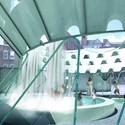
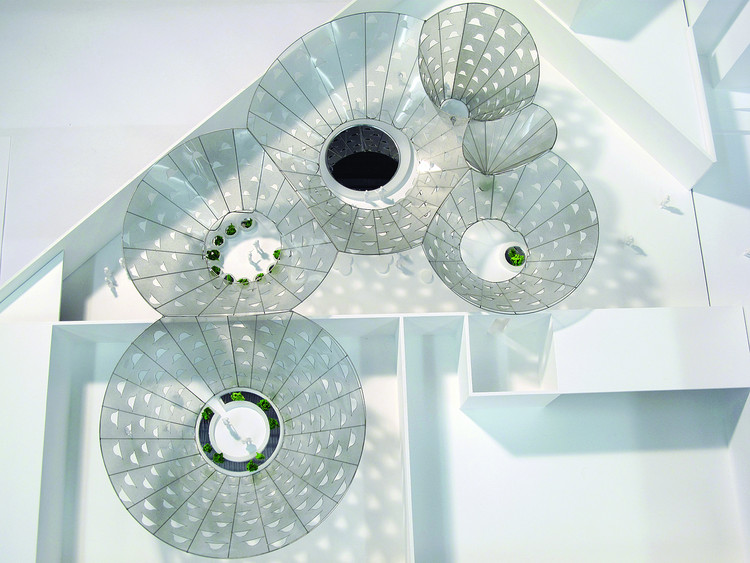
The Water Cathedral is a large, horizontal urban nave for public use. The structure is made up of numerous slender, vertical components, which hang or rise like stalactites and stalagmites in a cave, varying in height and concentration. The project incorporates water dripping at different pulses and speeds from these hanging elements, fed by a hydraulic irrigation network. When filled with small amounts of water, the stalactite components act as interfaces out of which water droplets gradually flow and cool visitors below. The stalagmites topography provides elements of shade, along with plants and water that collect under the Water Cathedral’s canopy.
Earlier we brought to you WORKac‘s preliminary scheme for the transformation of Salem-Keizer, Oregon. We would now like to present the final scheme presented by Amale Andraos and Dan Wood. The project integrates elements of the city and nature across an existing 200 acre big box retail site. WORKac is one of five interdisciplinary teams participating in “MoMA’s Foreclosed: Rehousing the American Dream.” Each team is challenged to re-imagine struggling American cities and suburbs, seeing the current economic crisis as an opportunity to evolve.
Jeanne Gang presents Studio Gang’s vision for the transformation of Cicero, Illinois, a 1920’s suburb that suffered greatly from the foreclosure crisis. Studio Gang is one of five interdisciplinary teams participating in “MoMA’s Foreclosed: Rehousing the American Dream.” Each team is challenged to re-imagine struggling American cities and suburbs, seeing the current economic crisis as an opportunity to evolve.
The space of sound created by Carlito Carvalhosa’s Sum of Days on exhibit at MoMA until November 14, 2011 is a sublime environment of billowing white fabric and the white noise of the atrium reflected upon itself. The psuedo-boundaries established by the translucent material that hang from the ceiling create a confined space of light and ambient sound – fleeting and ephemeral. Upon entering the exhibit, you pass an array of speakers affixed to the wall. They are emitting a low hum – the sound of voices and echoes that are distant, yet recognizable. It is unclear at first from where these sounds are originating, but behind the fabric bodies are drifting in and out of view. The curtains, which are constantly swaying, direct you in an ellipse to the center of the space where a single microphone hangs, picking up the noise within the exhibit and sending them to the dozens of speakers that hang at intervals inside the curtains, along the walls of the exhibit, and up through the galleries at the mezzanine levels that overlook the atrium.