

-
Architects: Provencher_Roy
- Area: 59000 ft²
- Year: 2011
-
Manufacturers: Vermont Quarries




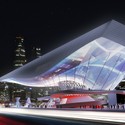
Serie Architects has been awarded first prize by the competition Technical Committee for the Wuxi Xishan Civic Centre in China. Serie saw off strong competition from a high-powered international shortlist which included NihonSekkei, GMP Architekten, AS Architecture-Studio, and Arte Charpentier.
The scheme is oriented around a large public plaza which is intended to form the centre of public life and expression within the Civic Centre. This unadorned open space hosts public gatherings and events, government displays and temporary exhibitions. The importance of symmetry within the composition of the plan is expressed in the strong axial relationship to the main entrance. More images and architects’ description after the break.

Jeju is an island formed by volcanic activities and celebration of its distinctive geological features was one of the main objectives of the brief. The design started from answering the brief which explicitly requested that the scheme to symbolise the volcanic landscape of Jeju consists of caves and mounds. poly.m.ur viewed these two geological feature in terms of their morphological forma-tions – one as constructive space (volcanic mounds) and the other one as subtractive space (volcanic caves), and were repre-sented in the formation of the massing of our scheme.
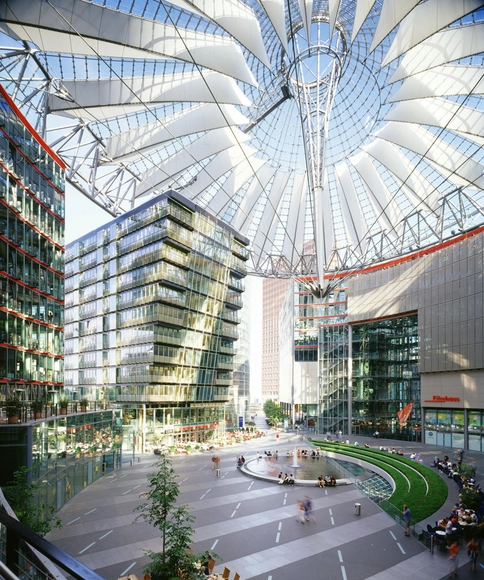

A wall is a binary condition: in/out, old/new, here/there. Blurry Wall, a proposal for a culture complex in Nanjing, China is a project that confuses these distinctions through conflicting bodily sensations. The intention of team members, Yaohua Wang, Scott Chung, Qing Cao, and Lennard Ong, is to tune the architecture into an instrument that channels the different urban energies flowing through it, blurring the boundaries between them. More images and project description after the break.

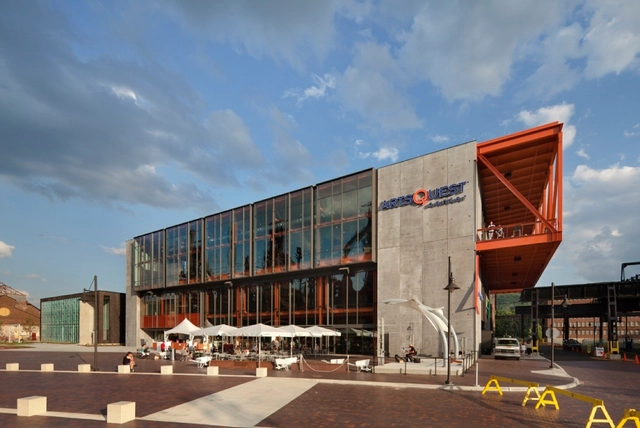

Australian architects and designers Studio 505 are currently completing a series of iconic projects in a new cultural precinct in Victoria’s ‘sister state’ Jiangsu Province in China.
Located in Wujin in the Changzhou precinct, the 3.5 hectare Lotus Park has been designed to be occupied throughout the year with festivals and functions throughout the day and night. The design establishes a clear and active programme of functions and includes the W Gallery, a new museum of contemporary art and many new entertainment and restaurant venues. The themes of environmental sustainability, education, recreation and community focused arts programmes are key to the establishment and success of the park programme. More images and architects’ description after the break.