This 26,800 sqf home, designed by Shubin+Donaldson Architects, not only merges with its remarkable environment, but virtually disappears. Except for a few deft lines and angles – such as the ordered rows of the surrounding vineyard – there is very little perceivable ‘built’ presence. The entrance is marked by a single low wall, delicately cut into the land while sheltering a stairway that immediately begins the descent into the home.
Project description, images, and drawings after the break. Architect: Shubin+Donaldson Architects Location: Los Angeles, California, USA Partners in Charge: Russell Shubin and Robin Donaldson Project Designer: Bradford Kelley Project Area: 26,800 sqf Project Year: In development Renderings: Mike Amaya
https://www.archdaily.com/117610/linda-flora-residence-shubindonaldson-architectsChristopher Henry
“Material beyond Materials: A Composite Tectonics Conference on Advanced Materials and Digital Manufacturing” combines progressive presentations in the fields of architecture, the arts, engineering and materials research. The conference participants will present and discuss their most innovative ideas, projects and positions concerning materials, technology and the impact on the architecture and construction disciplines and professions.
Between February 14th and April 14th the Architecture and Design Museum of Los Angeles will be exhibiting work from several designers that challenge the ubiquitous approach to environmentally conscious architecture and the normative application of technology to achieve sustainability. SOUPERgreen is a collection of five architectural propositions that explore technology as a means to promote the engagement between architecture and environment.
More on this exhibition and the proposals after the break.
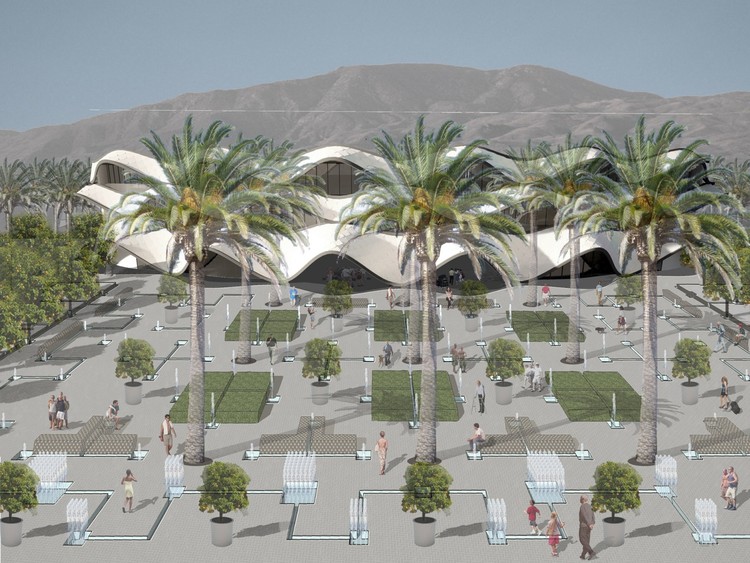
Headed for Palm Springs, California, BOOM Community is a new master-planned community costing $250 million and will provide an exciting new design for the desert that surrounds it. Collaborating to create this pedestrian friendly, neighborhood development are ten architecture firms, including Diller Scofidio + Renfro of New York. Envisioned for the gay community BOOM aims to provide an urban lifestyle promoting healthy living. Included within the masterplan: a boutique hotel, gym and spa, BOOM health and wellness center, and entertainment complex.
A+D, The Architecture and Design Museum of Los Angeles, presents Souper Green, an exhibition of new architectural work that offers a compelling alternative to the conventional idea of “being green” starting February 12th from 6pm-9pm to April 14th.
Highlighting the fact that technology is a key factor in the environmental crisis—to some a main cause, to others the best answer—this work questions the corresponding ways “green technology” is normally cast as a form of penance, and asked to “solve the problem” (as in “please-make-it-go-away-I-don’t-want-to-hear-about-it”). Instead, these five projects promote an attitude that looks at technology as a uniquely human means of expression, through which the “natural”—in its broadest sense—can be engaged and made more visible. More event description after the break.
The Architecture City Guide series heads to the West Coast this week. Los Angeles area is huge and it was nearly impossible to narrow down 12 buildings for this weeks list. Here’s what we suggest visiting if you are in LA, but we want to know what additional buildings you think we should add to our list! Visit the comment section and provide your can’t miss buildings in LA.
The Los Angeles design collaborative, SPORTS, has sent us their most recent project, a gallery installation in Hollywood, California. A description of the project and additional images are after the break.
Today, the design for the Broad Museum has been released. Situated adjacent to Frank Gehry’s Walt Disney Concert Hall and Arata Isozaki’s Museum of Contemporary Art, the museum has become a key part of the Grand Avenue redevelopment project that has been losing steam.
Taking inspiration from the behavior and volume of an idealized cloud, Dan Goods, Nik Hafermaas, and Aaron Koblin created eCloud an interactive sculpture for the San Jose International Airport. The dynamic liquid crystal scultpure hangs from the ceiling displaying weather data from the National Oceanic and Atmospheric Administration. eCloud is constructed from polycarbonate tiles appearing as transparent and opaque depending on the pattern which is in constant motion transforming every 20 seconds.
This week we are featuring San Francisco for our Architecture City Guide series. Thank you to all of our readers for adding their can’t miss buildings last week. We hope to see your comments below this week too.
Follow the break for our San Francisco list and a corresponding map!
“How Wine Became Modern: Design + Wine 1976 to Now” is a brand new exhibit at the San Francisco Modern Museum of Art. Co-created and designed by Diller Scofidio + Renfro, the exhibit was organized by Henry Urbach, SFMOMA’s Helen Hilton Raiser Curator of Architecture and Design. Bringing attention to the wine industry and its integration with the latest artists, designers and architects the exhibit will be on display at SFMOMA until April. A main part of the exhibit is featuring the architectural spaces that house the wine making process, tastings, museums, etc. Some big name architects who have developed designs for cutting-edge wineries include: Zaha Hadid, Frank Gehry, Norman Foster, Herzog and de Meuron, Renzo Piano and Alvaro Siza.
If you’re in the Los Angeles area, the Architecture + Design Museum is launching its latest exhibition – a retrospective honoring Stephen Kanner. Kanner, in addition to being the founder and president of the A+D, was also a third generation architect and principal of Kanner Architects. Some of his most notable projects include PUMA retail stores worldwide, in addition to his contributions to his native LA environment. The exhibit, which will run from November 4th through January 16th, will display sketches and models of his work. As Sam Lubell reported for the AN Blog, “Many will be surprised by the depth of Kanner’s talents—he could sketch almost any building or neighborhood with exact precision, his cartoons were artful and hilarious, and he excelled at painting, model-making, and even carpet design— or even the breadth of his architecture, so this show is a must-see.” The museum is set to establish a Stephen Kanner Memorial Fundto ensure the future of the museum. A+D explained, “Kanner envisioned a museum dedicated to progressive architecture and design, celebrating not only the design breakthroughs of the city but also the accomplishments of the national and international design scenes.”
The American Institute of Architects Los Angeles (AIA|Los Angeles) is pleased to announce a call for entries for the 2010 Arch Is competition. Only in its sophomore year, Arch Is is the newest addition to the AIA|Los Angeles’s growing roster of programs.
Trained as a landscape architect, W. Garett Carlsonhas designed a 1700 sf residence entitled the Joshua Tree Boulder House. Situated on 2.5 acres in Joshua Tree, California, the residence is intended to seem as though it is emerging from the ground. This conceptual idea stems from the site’s proximity to the Joshua Tree National Park which contains some of the most fascinating boulder shapes in the world, according to Carlson.
More images and more about the residence after the break.
Using 4,000 paper cups and 15,000 staples, APHIoIDEA’s newest installation is gracefully suspended from the ceiling, creating a new spatial experience in previously un-utilized storefronts. The architectural installation is part of PHANTOM GALLERIES, an organization that places temporary installations in vacant storefront windows throughout LA to instantly form a new public art gallery.
A video, more images/diagrams and more about the installation after the break.
The work of Los Angeles-based artist Megan Geckler lies somewhere between art and design, with architectural installations that are assembled from thousands of strands of multicolored flagging tape, a plastic ribbon typically utilized by surveyors to demarcate space on construction sites.