1. ArchDaily
  2. Autodesk

Autodesk: The Latest Architecture and News

Design Intelligence and Workflow Continuity: Autodesk Advances Forma and Revit Integration

 | Sponsored Content

Design teams are not short on tools; they're short on continuity. Project data remains fragmented across files, and decisions often lose context as work moves from planning to design to construction. As a result, teams spend valuable time reconnecting information instead of advancing projects.

This points to the need for workflows that preserve design intent and carry knowledge forward across each stage of the process. Within this framework, the idea of "design and make intelligence" can be understood as a shift toward continuity, where data, decisions, and lessons from planning, design, construction, and operations remain embedded in the project rather than stopping at handover. In this context, AI and automation operate with greater relevance, building on accumulated information instead of isolated inputs.


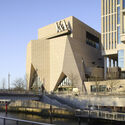
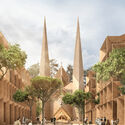
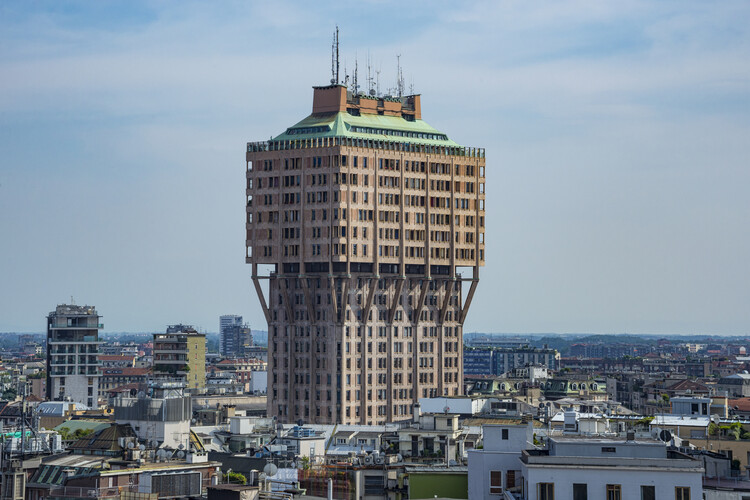
Milan Design Week 2026 and Níall McLaughlin Architects’ Cathedral Precinct in Sydney: This Week’s Review

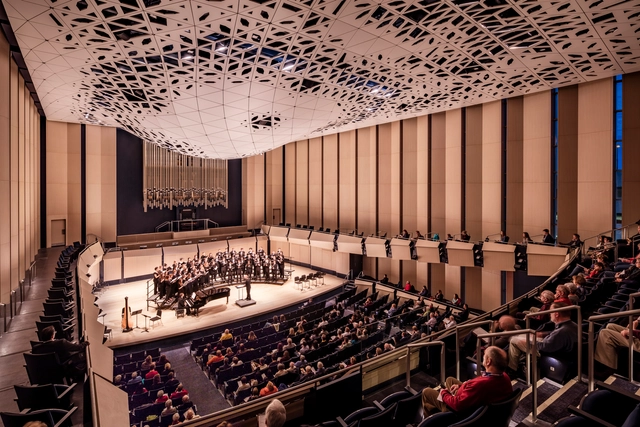
As major cultural events, institutional transformations, and new architectural commissions unfold across different geographies, this week's discourse highlights how architecture operates at the intersection of public life, creativity, and long-term adaptation. With Milan Design Week 2026 foregrounding process, experimentation, and citywide participation, the projects and initiatives emerging this week point to a broader shift toward openness, accessibility, and experiential engagement across disciplines and urban contexts. Ongoing investments in cultural infrastructure, from new museums to large-scale renovations and competition-winning proposals, further underscore how institutions continue to recalibrate their spatial and social roles in response to evolving environmental, technological, and cultural demands.

Milan Design Week 2026 and Níall McLaughlin Architects’ Cathedral Precinct in Sydney: This Week’s Review - Imagen 1 de 4Milan Design Week 2026 and Níall McLaughlin Architects’ Cathedral Precinct in Sydney: This Week’s Review - Imagen 2 de 4Milan Design Week 2026 and Níall McLaughlin Architects’ Cathedral Precinct in Sydney: This Week’s Review - Imagen 3 de 4Milan Design Week 2026 and Níall McLaughlin Architects’ Cathedral Precinct in Sydney: This Week’s Review - Imagen 4 de 4Milan Design Week 2026 and Níall McLaughlin Architects’ Cathedral Precinct in Sydney: This Week’s Review - More Images+ 5

How Architects Add AI to Their Digital Toolbox

 | Sponsored Content

At the turn of the century, architects embraced 3D parametric modeling through building information modeling (BIM), and in the last 10 years connected BIM to the cloud to improve coordination and productivity. But BIM struggles to unify data and workflows across the entire plan, design, build and operate lifecycle. Integrating AI—along with granular data and automation—will empower the next generation of architects with a more connected and outcome-based approach to design, enabling them to focus on outcomes like building performance or sustainability from the very beginning of a project. 

What is the Future Role of Architects in the Age of AI and Data?

 | Sponsored Content

The complexity of our world is constantly increasing, and with it, the pressure and demands placed upon our built environment. Architects are faced with a monumental task: to translate society’s ever-changing needs into tangible, effective and sustainable solutions. Pressing issues such as the climate crisis, rapid urbanization, population density and housing shortages call for a new architecture –one that isn’t afraid to question the traditional way of working and is prepared to take on the challenge. Today the industry must adapt, evolve and innovate to cope with these challenges. The availability of data is changing the game, and as technology continues to advance, it will open new ways of thinking, creating and engaging with the built environment.

In this article, we delve into the effects of the digital transformation, how it is reshaping the industry and the questions it raises about the future role of architects. 

Spacemaker Proposes AI-Powered Generative Design to Create More Sustainable Spaces and Cities

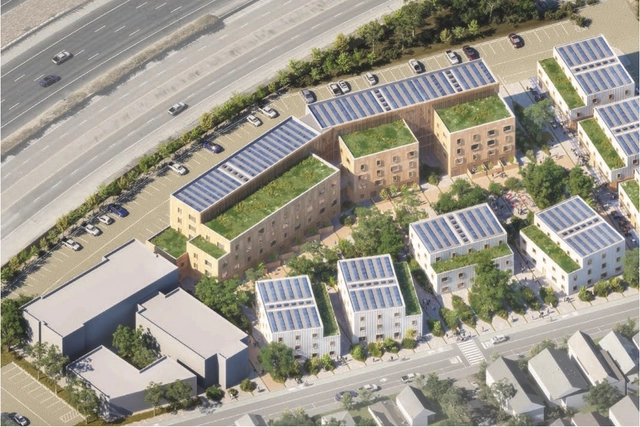
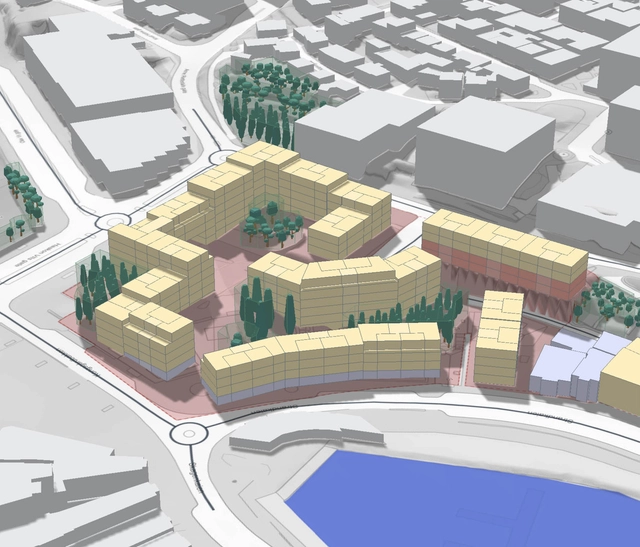
Autodesk has just acquired Spacemaker, a platform that “gives architects and developers the automation superpower to test design concepts in minutes” and explore the best urban design options. Targeting architects, urban designers, and real estate developers, the cloud-based AI-powered generative design helps professionals taking better early-stage design decisions.

Spacemaker Proposes AI-Powered Generative Design to Create More Sustainable Spaces and Cities - Image 1 of 4Spacemaker Proposes AI-Powered Generative Design to Create More Sustainable Spaces and Cities - Image 2 of 4Spacemaker Proposes AI-Powered Generative Design to Create More Sustainable Spaces and Cities - Image 3 of 4Spacemaker Proposes AI-Powered Generative Design to Create More Sustainable Spaces and Cities - Image 4 of 4Spacemaker Proposes AI-Powered Generative Design to Create More Sustainable Spaces and Cities - More Images+ 8

SOM Designs Stereoform Slab Pavilion for 2019 Chicago Architecture Biennial

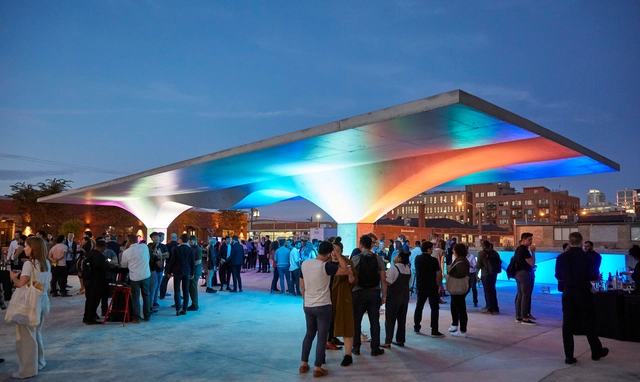
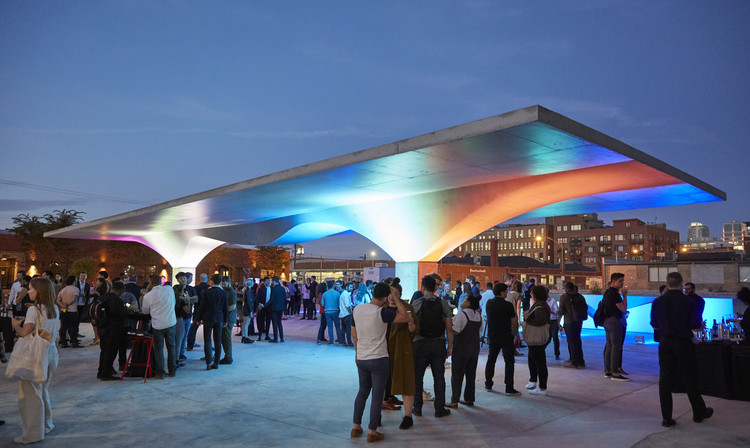
Architecture practice Skidmore, Owings & Merrill (SOM) have designed a concrete pavilion for the 2019 Chicago Architecture Biennial. Today, the practice is unveiling the work of its interdisciplinary practice with Stereoform Slab, a to-scale prototype of a future building system made using advanced robotic fabrication techniques. The project is simultaneously an activation and an exhibition that illustrates a design method that reduces the carbon footprint of concrete construction.

SOM Designs Stereoform Slab Pavilion for 2019 Chicago Architecture Biennial - Image 1 of 4SOM Designs Stereoform Slab Pavilion for 2019 Chicago Architecture Biennial - Image 2 of 4SOM Designs Stereoform Slab Pavilion for 2019 Chicago Architecture Biennial - Image 3 of 4SOM Designs Stereoform Slab Pavilion for 2019 Chicago Architecture Biennial - Image 4 of 4SOM Designs Stereoform Slab Pavilion for 2019 Chicago Architecture Biennial - More Images+ 3

How Modular Construction Could Offer a Lasting Solution in the Affordable Housing Crisis

Subscriber Access | 

This article was originally published in Autodesk's Redshift publication as "How Building Modular Homes can Help Fill the Affordable Housing Gap."

“Modular” isn’t a construction product; it’s a construction process. This is according to Tom Hardiman, executive director of the Modular Building Institute (MBI), whose members include more than 350 companies involved in the manufacturing and distribution of modular buildings, including multifamily homes.

Mind the Gap: Minimizing Data Loss Between GIS and BIM

Subscriber Access | 

An unfortunate fact of the AEC (architecture, engineering, and construction) industry is that, between every stage of the process—from planning and design to construction and operations—critical data is lost.

The reality is, when you move data between phases of, say, the usable lifecycle of a bridge, you end up shuttling that data back and forth between software systems that recognize only their own data sets. The minute you translate that data, you reduce its richness and value. When a project stakeholder needs data from an earlier phase of the process, planners, designers, and engineers often have to manually re-create that information, resulting in unnecessary rework. 

How to Bring Construction into the Future

Subscriber Access | 

This article was originally published by Autodesk's Redshift publication as "The 4 Forces That Will Take on Concrete and Make Construction Smart."

When it comes to building a bridge, what prevents it from having the most enduring and sustainable life span? What is its worst enemy? The answer is, simply, the bridge itself—its own weight.

Built with today’s construction processes, bridges and buildings are so overly massed with energy and material that they’re inherently unsustainable. While concrete is quite literally one of the foundations of modern construction, it’s not the best building material. It’s sensitive to pollution. It cracks, stains, and collapses in reaction to rain and carbon dioxide. It’s a dead weight: Take San Francisco’s sinking, leaning Millennium Tower as an example.

Modern, smart construction can and will do better. A convergent set of technologies will soon radically change how the construction industry builds and what it builds with.

This 3D Printer, Designed Specifically for Architects, Is Surprisingly Easy to Use

Have you ever spent hours calibrating the nozzle of a 3D printer or preparing a print-ready file – only to find that the model has failed because of a missed zero-thickness wall? With this in mind, the Platonics Arka 3D printer currently being developed in Helsinki, Finland—has one simple goal: to remove all unnecessary set-up and technical processes by means of intelligent automation and, as a result, almost entirely eliminate the wasted time that architects and designers spend calibrating printers, or working up print-ready files.

This 3D Printer, Designed Specifically for Architects, Is Surprisingly Easy to Use - Image 1 of 4This 3D Printer, Designed Specifically for Architects, Is Surprisingly Easy to Use - Image 2 of 4This 3D Printer, Designed Specifically for Architects, Is Surprisingly Easy to Use - Image 3 of 4This 3D Printer, Designed Specifically for Architects, Is Surprisingly Easy to Use - Image 4 of 4This 3D Printer, Designed Specifically for Architects, Is Surprisingly Easy to Use - More Images+ 4

"X-Ray Vision" Headset Allows Architects to See Under the Surface of Construction Sites

This article was originally published on Autodesk's Redshift publication as "Augmented Reality in Construction Lets You See Through Walls."

Imagine you’re part of a crew constructing a new office building: Midway through the process, you’re on-site, inspecting the installation of HVAC systems. You put on a funny-looking construction helmet and step out of the service elevator. As you look up, there’s a drop ceiling being installed, but you want to know what’s going on behind it.

Through the visor on your helmet, you pull up the Building Information Model (BIM), which is instantly projected across your field of vision. There are heating ducts, water pipes, and electrical boxes, moving and shifting with your point of view as you walk along the corridors. Peel back layers of the model to see the building’s steel structure, insulation, and material finishes. It’s like having comic book-style X-ray vision—and soon, it could be a reality on a construction site near you.

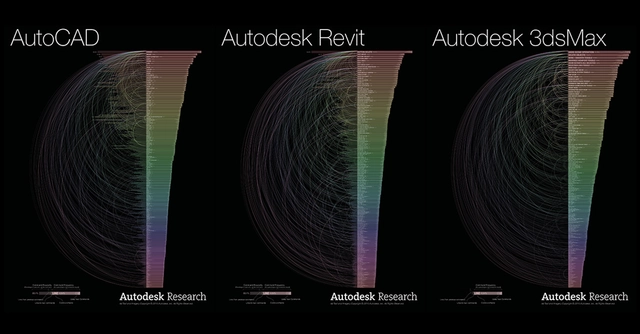
Visualizations of the Most Used AutoCAD, Revit, and 3dsMax Commands

The 'Customer Involvement Program' of Autodesk's research department has, over the years, compiled a database of over 60 million individual commands created by anonymized users. Each reveals shortcut paths and thought flows among its customer base. The team have visualized the product usage (here described as the Command Usage Arc project) by ordering known and new commands from the most-frequently-used to the least-frequently. Revealed as a sequence of infographics, the results demonstrate how people work – and how they often deviate from prescribed usage.

Autodesk's Generative Design Pavilion Plays with Properties and Fabrication Processes in Stone and Fabric

At Autodesk's 2016 conference in Las Vegas, a team from Autodesk's BUILD Space led by principal research engineer Andrew Payne collaborated with manufacturer Quarra Stone, engineers Simpson Gumpertz and Heger, and University of Michigan assistant professor Sean Ahlquist to unveil its new Generative Design Pavilion. The project is an exploration of materiality, with stalagmite stone forms that rise up from geometric floor panels to meet fabric that stretches down from a canopy above. The junction of textile and stone aims to emphasize the distinct behaviors of the two materials.

Autodesk's Generative Design Pavilion Plays with Properties and Fabrication Processes in Stone and Fabric - Image 1 of 4Autodesk's Generative Design Pavilion Plays with Properties and Fabrication Processes in Stone and Fabric - Image 2 of 4Autodesk's Generative Design Pavilion Plays with Properties and Fabrication Processes in Stone and Fabric - Image 3 of 4Autodesk's Generative Design Pavilion Plays with Properties and Fabrication Processes in Stone and Fabric - Image 4 of 4Autodesk's Generative Design Pavilion Plays with Properties and Fabrication Processes in Stone and Fabric - More Images+ 15

The Ultimate Guide to Revit Shortcuts

Subscriber Access | 

This article was originally published on ArchSmarter.

For all the work you do in Revit, there’s a keyboard shortcut that can help you do it faster.

Here’s a roundup featuring some of my favorite Revit keyboard shortcuts to create and organize your model. Keep reading to learn how to create your own shortcuts.

This shortcut cheat sheet is also available in a convenient pdf form; simply sign up here to download it.

12 Top Apps for Architects on the Construction Site

We have previously published the best apps for architects, many of which try to boost creativity and productivity for project design. Now, we’ve put together a series of helpful apps for the development and management of construction projects. From digital measuring tools to instant software-generated reports of work progress, we hope this new construction technology will be most useful to you.

6 Ways BIM Can Make Your Architecture Firm More Competitive

Subscriber Access | 

Starting an architecture firm may sprout from one’s love for and interest in the discipline, but running a competitive business requires more than just a tendency to enjoy the work. BIM could be the edge a firm needs in order to stand out from the crowd. There are many ways a firm can make use of BIM to become more profitable on their projects and successful in winning those projects in the first place; read on to find out more about six of them.

Not Ready for BIM? Here are 5 Reasons You May Be Wrong

Subscriber Access | 

Committing your firm to BIM may seem daunting, especially with the time and cost investments that come with adopting new sets of software and a new workflow. There are hidden parallels however, between BIM and other processes within a firm, and therefore these changes to a new way of working may not be as demanding as they first seem. Here are five ways you may already be halfway to BIM.