1. ArchDaily
  2. Architecture News

Architecture News: The Latest Architecture and News

Venice Biennale 2012: Common Ground/Different Worlds / Noero Architects

Subscriber Access | 

As a contribution to the 13th Venice Architecture Biennale, Noero Architects showcase two powerful works of art in their exhibition Common Ground / Different Worlds to reveal that architects, and artists alike, work to reinterpret, reinvent and transform preexisting ideas and forms. However, Jo Noero, Principle of Noero Architects, believes that the “difference between good and bad work lies in an understanding of that which is shared and common and the ability to transform these ideas into forms and spaces which are both useful and satisfying within the community in which the work is located.”

Noero spent six months hand drawing a 1:100 plan of the historic shack settlement in Port Elizabeth, known as the Red Location District, as a protest against contemporary architecture’s abandonment of the plan, which Noero describes as the common ground for all architects. Featured alongside the 9m-long drawing is the artwork Keiskamma Guernica, a tapestry made by fifty women from the Hamburg Women’s Co-operative from the Eastern Cape that reinterprets Picasso’s Guernica to illustrate their anger towards AIDS/HIV’s impact on South Africa. The featured film above, titled “Red Location Precinct”, supplements the exhibition by revealing the surrounding context of the district and taking viewers inside the Museum of Struggle, the digital library, an archive and an art gallery that are all part of a complex, designed by Noero Architects, that honors the settlement’s turbulent past and provides surrounding community with opportunities for education, employment, and artistic expression. Continue after the break to learn more.

Venice Biennale 2012: Common Ground/Different Worlds / Noero Architects - Image 22 of 4
Keiskamma After Geurnica | 7.8×3.5m Tapestry | Mixed Media | Various Hand Stitched Textiles | The Keiskamma Trust | Hamburg Women’s Co-operative

Venice Biennale 2012: Meeting Lines / Ateliers Jean Nouvel + Habiter Autrement (Mia Hägg)

Subscriber Access | 
Venice Biennale 2012: Meeting Lines / Ateliers Jean Nouvel + Habiter Autrement (Mia Hägg) - Image 4 of 4
© Nico Saieh

Jean Nouvel and Mia Hägg presented “Meetings Lines” at the Venice Biennale. For ‘Common Ground’ they decided to show their finalist project for the Slussen Masterplan competition, an ambitious urban design project that seeks to replace much of the degenerated water and transportation infrastructure in the heart of Stockholm. The project proposes three different public spaces, designed as living links for the city, inspired by infrastructure such as the Rialto Bridge in Venice.

More about the exhibit after the break.

Venice Biennale 2012: Copycat, Empathy and Envy as Form Makers / Cino Zucchi Architetti

Subscriber Access | 
Venice Biennale 2012: Copycat, Empathy and Envy as Form Makers / Cino Zucchi Architetti - Image 2 of 4
© Nico Saieh

The International Jury of the 13th Venice Architecture Biennale has awarded Cino Zucchi Architetti (CZA) a special mention for their installation, Copycat. Empathy and Envy as Form Makers. Their contribution is based on the notion that “we are all a bit copycats”, understanding that cultures are propagated by following “infectious” processes that combine imitation and innovation. CZA presents a collection of “almost-alike” objects and images with the idea that “similarity” rather than “originality” is where people find common ground.

Venice Biennale 2012: Inhabitable Models / Eric Parry Architects, Haworth Tompkins, Lynch Architects

Subscriber Access | 
Venice Biennale 2012: Inhabitable Models / Eric Parry Architects, Haworth Tompkins, Lynch Architects - Image 4 of 4
© Nico Saieh

Inhabitable Models presents the work of three practices -Eric Parry Architects, Haworth Tompkins, Lynch Architects- who find their common ground in an engagement with London, as a city of found fragments. Perhaps uniquely among world cities London exists as a series of largely unplanned, independent, layered fragments which nonetheless come together for a host of legal, political, and economic practicalities. In responding to this conception of London, each practice seeks to resist the temptation of “hallmark” architecture in favor of one which is contextually sensitive and rigorously place-specific. Indeed, the practices’ appreciation of the fragmentary and unplanned applies both to the London that they find, as well as to the London they leave behind.

Gehry’s donation to SCI-Arc endows annual thesis prize

Subscriber Access | 
Gehry’s donation to SCI-Arc endows annual thesis prize - Featured Image
© Melissa Majchrzak

SCI-Arc Trustee Frank Gehry and his wife, Berta, have donated $100,000 to the Southern California Institute of Architecture (SCI-Arc). The noteworthy contribution will go towards the establishment of the Gehry Prize, which will be annually awarded to the best thesis projects selected by critics and jurors at the Graduate Thesis Weekend hosted in September. The first Gehry Prize will be awarded at the 2012 graduation ceremony on September 9th.

President of Madrid Puts Foot In Mouth, Offends Architects Everywhere

Subscriber Access | 
President of Madrid Puts Foot In Mouth, Offends Architects Everywhere - Image 1 of 4
Photo via La Paseata.

Politicians caught on camera say the darndest things. Like – if you’re Esperanza Aguirre, President of Madrid – that architects “should be killed.”

The Politician was unknowingly recorded while speaking with the Mayor of Valdemaqueda, a municipality of Madrid, about their town hall. The building, known as Casa Consistorial de Valdemaqueda (1998), designed by Paredes Pedrosa, was an award-winner at the Spanish Biennale of 1999. Their conversation (translated by yours truly) went as follows:

Mayor: The town hall? Oh, that thing. Well, it’s gotten prizes, president. Architecture prizes.

Esperanza Aguirre: That’s the only positive thing that’s come from the Crisis, that that’s all over. I have never seen anything uglier.

Mayor: You don’t like it?

Esperanza Aguirre: How could I like it, hidden at the end of a plaza like this!

Mayor: Well, because they’re the architects of the Community.

Esperanza Aguirre: Well, they should be killed.

Mayor: They’ve gotten awards.

Esperanza Aguirre: Mario, it’s so stupid (addressing a person next to her). Do you know why we should have the death penalty? I dislike architects because their crimes last longer than their own own lives. They die and leave us with this.

Find out what Ms. Aguirre has had to say for herself since, and take a peek at the original video footage after the break …

Himmelhagen / Snøhetta

Subscriber Access | 
Himmelhagen / Snøhetta - Featured Image

Norwegian-based architecture firm, Snøhetta, has just been announced the winner for the Ordrupgaard competition to design an underground extension to the existing museum in Denmark. In addition to the necessary gallery space to hold the Ordrupgaard’s expanding French collection, Snøhetta’s proposal creates a new solution for landscape and building integration. By adapting existing buildings, and adding landscape elements, the proposal maintains the existing entrance to the building, designed by Zaha Hadid, and creates a circulation new route which the public comfortably flow through as they visit the different exhibition halls. Hadid’s building was originally conceived as a continuous flow of spaces between building, galleries, and gardens, so Snøhetta’s newest addition will build upon such a foundation.

Venice Biennale 2012: Public Works, Architecture by Civil Servants / OMA

Subscriber Access | 
Venice Biennale 2012: Public Works, Architecture by Civil Servants / OMA - Image 11 of 4
© Nico Saieh

“Forty years ago the public cause proved a powerful source of inspiration. Given the numbers of architects that chose to serve it, one might even speak of a common ground. In the age of the ‘starchitect’, the idea of suspending the pursuit of a private practice in favor of a shared ideology seems remote and untenable. In the context of the 2012 Venice Architecture Biennale, this exhibition hopes to provide a small contribution towards finding that common ground once more…” – OMA Partner Reinier de Graaf, August 2012

Throughout Europe in the late 1960s and early 1970s, large public works departments employed architects to design a multitude of public buildings in an effort to serve the public cause. Reinier de Graaf describes this “heyday of public architecture” as “a short-lived, fragile period of naïve optimism – before the brutal rule of the market economy became the common denominator.”

Venice Biennale 2012: Revisit - Customizing Tourism / Cyprus Pavilion

Subscriber Access | 
Venice Biennale 2012: Revisit - Customizing Tourism / Cyprus Pavilion - Image 5 of 4
© Nico Saieh

In a time of rapid physical and digital connections the global phenomenon of tourism becomes more and more of a common activity. Tourism brings people from all over the world on a common ground giving them the opportunity to interact with a locality, places, and people. However, the conventional tourist entertainment character and the lack of local interaction alienate the notion of the common ground in most tourist destinations. Resorts, theme-parks, international hotel chains, global market icons, and city guides turned tourism into a travelling monopoly with global rules that are applicable everywhere. Common ground is at stake!

The pavilion was curated by Charis Christodoulou and Spyros Th. Spyrou.

Venice Biennale 2012: Shifting Grounds (Beyond National Architecture) / Ireland Pavilion

Subscriber Access | 
Venice Biennale 2012: Shifting Grounds (Beyond National Architecture) / Ireland Pavilion - Image 3 of 4
© Nico Saieh

The Irish Pavilion, designed by heneghan peng architects with the support of Arup, and curated by John McLaughlin, charts a position for Irish architecture in a global culture where the modes of production of architecture are radically altered. Ireland has developed a national culture of architecture derived from local place as a material construct. They now have to evolve our understanding in the light of the globalized nature of economic processes and architectural production which is largely dependent on internationally networked flows of products and data. They have just begun to represent this situation to themselves and others. How should a global architecture be grounded culturally and philosophically? How does it position itself outside of shared national reference points?

Al Bahar Towers Responsive Facade / Aedas

Subscriber Access | 

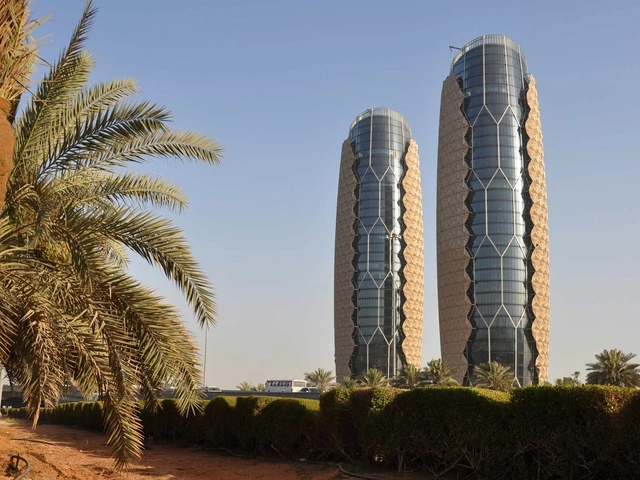
A quick glimpse at the upcoming weather for Abu Dhabi will show a week of intense sunshine, temperatures steadily above 100 degrees Fahrenheit with 0% chance of rain. In such extreme weather conditions, even architects listing environmental design as their top priority are up against a tough battle. Never mind that the sand can compromise the structural integrity of the building, the intense heat and glare can render a comfortable indoor environment relatively impossible if not properly addressed. For Abu Dhabi’s newest pair of towers, Aedas Architects have designed a responsive facade which takes cultural cues from the “mashrabiya”, a traditional Islamic lattice shading device.

More about the towers’ shading system after the break.

Frank Lloyd Wright Archives relocate to New York

Subscriber Access | 
Frank Lloyd Wright Archives relocate to New York - Image 5 of 4
Frank Lloyd Wright by JOHN AMARANTIDES, 1955. ”The Frank Lloyd Wright Foundation Archives (The Museum of Modern Art | Avery Architectural & Fine Arts Library, Columbia University, New York)”

The Museum of Modern Art, Columbia University and The Frank Lloyd Wright Foundation have announced that the vast archives of American architect Frank Lloyd Wright (1867-1959) have been jointly acquired by the University and the Museum and will become part of their permanent collections. The archive, which includes some 23,000 architectural drawings, 44,000 historical photographs, large-scale models, manuscripts, extensive correspondence and other documents, has remained in storage at Wright’s former headquarters – Taliesin (Spring Green, WI) and Taliesin West (Scottsdale, AZ) – since his death. Moving the archives to New York will maximize the visibility and research value of the collection for generations of scholars, students and the public.

“The Frank Lloyd Wright Foundation takes seriously its responsibility to serve the public good by ensuring the best possible conservation, accessibility, and impact of one of the most important and meaningful archives in the world,” said Sean Malone, CEO of the Frank Lloyd Wright Foundation. “Given the individual strengths, resources and abilities of the Foundation, MoMA and Columbia, it became clear that this collaborative stewardship is far and away the best way to guarantee the deepest impact, the highest level of conservation and the best public access.”

Continue after the break for more images and an informative video. 

Venice Biennale 2012: Elbphilharmonie / Herzog & de Meuron

Subscriber Access | 
Venice Biennale 2012: Elbphilharmonie / Herzog & de Meuron - Image 7 of 4
© Nico Saieh

Herzog & de Meuron’s exhibition at the Biennale is focused on the architecture of a symbolic project, with a complex history: The Elbphilharmonie, a concert hall on top of a former industry in Hamburg, which also includes a 250 room five-star hotel, and 47 apartments. The project, in a very advanced state, remains halted since last year due to legal issues with the contractor.

In the exhibition, the history of the project is documented with three-dimensional representations of the complex building services; camera shots panning through the construction site; and large-scale models, whose spatial and physical presence represent what the architects wished and still wish to foreground: architecture.

Michael Graves: In Defense of Drawing

Subscriber Access | 
Michael Graves: In Defense of Drawing - Featured Image
© Michael Graves, Denver Central Library

In his Op-Ed for The New York Times, called “Architecture and the Lost Art of Drawing,” American architecture legend Michael Graves laments the loss of drawing in our computer-dependent age. While Graves realizes the usefulness of computer technology to present a final product, he maintains that the act of sketching (particularly those first, fleeting “referential sketches”) is vital to the process of design:

LEGO® Architecture Landmark Series: Villa Savoye

Subscriber Access | 
LEGO® Architecture Landmark Series: Villa Savoye - Image 1 of 4
LEGO® Architecture Series: Villa Savoye

LEGO® has just announced the newest classic building to join the collection of renowned architectural replicas in their Architecture series, the Villa Savoye, designed by Le Corbusier. Capturing the essence of the modernist villa, the small scale replica also makes sure to touch on Corbusier’s well-known ‘five points’. One of the most easily recognizable and renowned examples of the International style, the LEGO version will be available September 1 at a suggested price of $69.99.

Lying on the outskirts of Paris, France, Villa Savoye was designed as a private country house in 1931 and quickly became one of the most influential buildings and cemented Le Corbusier’s reputation as one of the most important architects of the 20th century. More images after the break.

Venice Biennale 2012: The Piranesi Variations / Peter Eisenman

Subscriber Access | 
Venice Biennale 2012: The Piranesi Variations / Peter Eisenman - Image 14 of 4
Field of Dreams / Ohio State University Knowlton School of Architecture © Nico Saieh

Inspired by the 13th International Architecture Exhibition‘s theme Common Ground, Peter Eisenman has formed a team to revisit, examine and reimagine Giovanni Battista Piranesi’s 1762 folio collection of etchings, Campo Marzio dell’antica Roma. Derived from years of fieldwork spent measuring the remains of ancient Roman buildings, these six etchings depict Piranesi’s fantastical vision of what ancient Rome might have looked like and represent a landmark in the shift from a traditionalist, antiquarian view of history to the scientific, archaeological view.

Eisenman’s team consists of Eisenman Architects, students from Yale University, Jeffrey Kipnis with his colleagues and students of the Ohio State University, and Belgian architecture practice, Dogma. Each group has contributed a response to Piranesi’s work through models and drawings that stimulate discourse on contemporary architecture. In particular, they explore architecture’s relationship to the ground and the political, social, and philosophical consequences that develop from that relationship.

Venice Biennale 2012: The Piranesi Variations / Peter Eisenman - Image 15 of 4
The Project of Campo Marzio / Yale University School of Architecture © Nico Saieh

Described as “precise, specific, yet impossible”, Piranesi’s images have been a source of speculation, inspiration, research and contention for architects, urban designers and scholars since their publication 250 years ago. Continue after the break to learn more.

Venice Biennale 2012: Arum / Zaha Hadid

Subscriber Access | 
Venice Biennale 2012: Arum / Zaha Hadid - Image 19 of 4
© Nico Saieh

With their early work inspired by Russian Suprematism, Zaha Hadid Architects’ pays homage to the historical lineages of collective research that has led to the major works of today’s contemporary architecture at the 2012 Venice Biennale with the installation ‘Arum’. The pleated metal structure is derived from the work of German architect Frei Otto, who paved the way for material-structural form-finding processes. This installation is a response to David Chipperfield’s belief that the theme of ‘Common Ground’ is meant to “reassert the existence of an architectural culture, made up not just of singular talents but a rich continuity of diverse ideas united in a common history.”

Venice Biennale 2012: Arum / Zaha Hadid - Image 6 of 4
© Nico Saieh

Beautifully crafted, the installation at the Corderie of the Arsenale also includes models and explorations of ZHA, related to the work of Frei Otto, Felix Candela, Heinz Isler. In this aspect the firm has able to expose visitors to the inspiration and research from modern architects that can be found on ZHA’s contemporary works. We saw Patrik Schumacher before the Biennale’s preview on top of every detail, leading to an impecable result.

Videos, photos and more from the architects after the break:

Venice Biennale 2012: Originaire / China Pavilion

Subscriber Access | 
Venice Biennale 2012: Originaire / China Pavilion - Image 3 of 4
"Sequence" by Shao Weiping © Nico Saieh

From the curator Fang Zhenning:

“Originaire” is a word created to combine the meanings of “original” and “initial”. In the Chinese language, the character for “source” is specifically in the context of the water source. As such, we invoke the idea of “originaire” to seek the origin of memory and a mental image of the original world.

Venice Biennale 2012: Originaire / China Pavilion - Image 1 of 4
© Nico Saieh

Five architects, artists, and designers were asked to create five installations from different perspectives to represent different interpretations of the meaning of “originaire”.

In alliance with Architonic
Check the latest Architecture NewsCheck the latest Architecture NewsCheck the latest Architecture News

Check the latest Architecture News