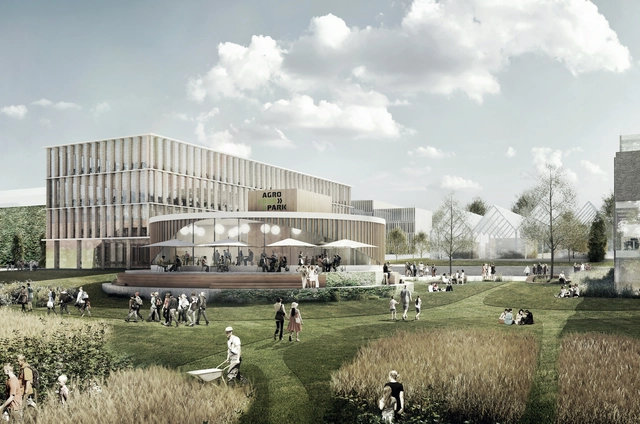
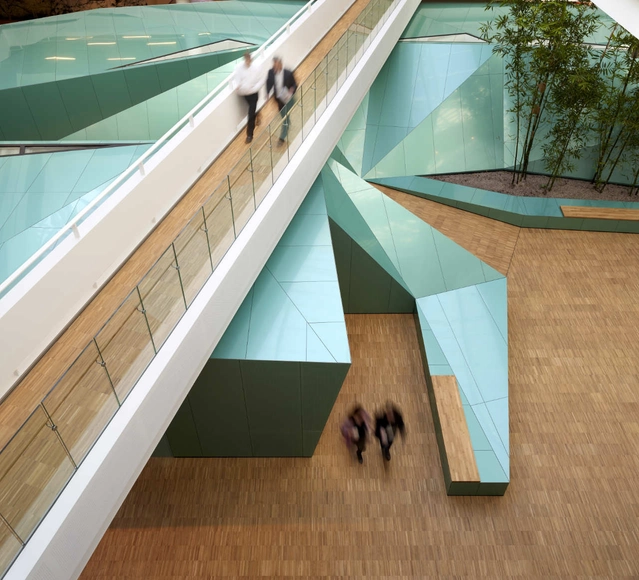
William McDonough + Partners and GXN together with 3XN Architects, BCVA and Urland have teamed up to develop a master plan for the Agro Food Park (AFP), a hub for agricultural innovation near Aarhus, Denmark. Aiming to serve as a benchmark for future global food industry development, the project will combine urban density with agricultural test fields in a collaboration of academic and commercial business.
Over the next 30 years, the current AFP—which was opened in 2009 and spans 44,000 square meters with nearly 1,000 employees—will expand by an additional 280,000 square meters.
We are privileged to have been chosen by GXN to collaborate on what will become an entrepreneurial ecosystem for addressing the future of food and plant resources, said William McDonough, founder of William McDonough + Partners and co-author of the text, Cradle to Cradle: Remaking the Way We Make Things.
The impacts of architecture on the quality of human life are often debated, and in the 21st century, projects are under greater scrutiny than ever for the experiences they provide for people. Buildings all over the world must address a specific context, responding to the cultural framework of their users.
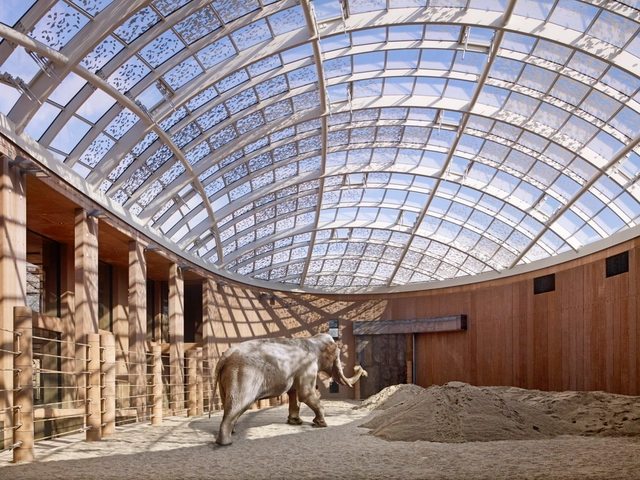
In light of this, we’ve gathered 8 projects that have a different sort of user -- projects designed not just for people, but also for animals. Ranging from zoo buildings to aquariums, stables and shelters, these projects have the unique challenge of balancing a human and animal experience. See them all after the break.
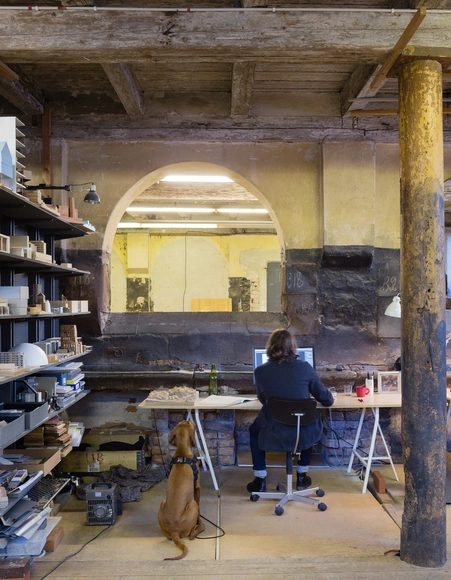
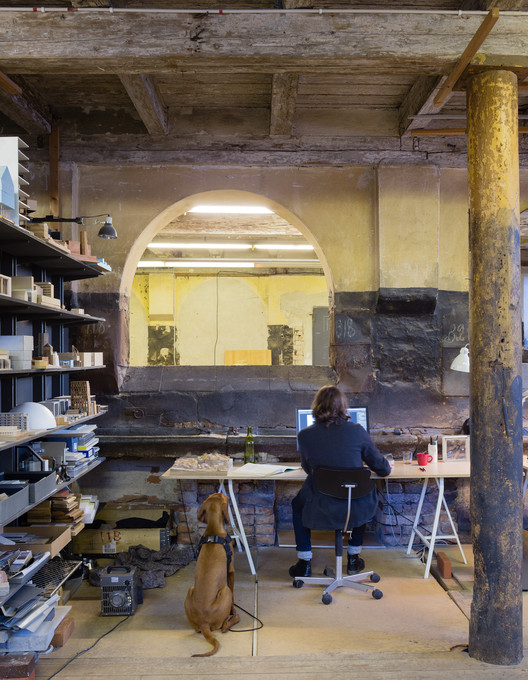
Architectural photographer Marc Goodwinhas recently completed "the ultra-marathon of photoshoots:" twenty-eight architectural offices in twenty-eight days, spread across four capital cities – Oslo, Stockholm, Copenhagen, and Helsinki. His aim was to understand what sort of spaces architects in the Nordic countries operate in, and how they differ between each respective country. From former boathouses to stables and coal deposits, Goodwin has captured some of the most unique working environments the profession has to offer.
New York City's Van Alen Institute have announced four new members—Haptic Architects, Mecanoo, Studio Libeskind, and Trahan Architects—to their International Council, a platform for exchange among leading architects, designers, developers, and planners. Furthermore, Jing Liu (SO –IL), Kim Herforth Nielsen (3XN), and Raymond Quinn (Arup) have joined its board of trustees to help guide the organisation's cross-disciplinary research, provocative public programs, and design competitions.
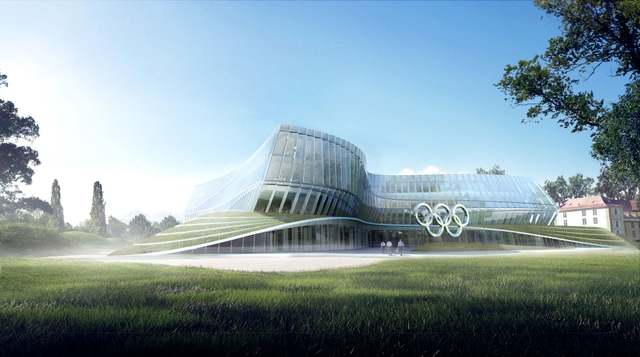
3XN and the International Olympic Committee (IOC) have released images of a new headquarters planned for a 24,000-square-meter site on banks of Lake Geneva in the Swiss city of Lausanne. Adjacent to the historic Château de Vidy, which has been the “iconic home” of the IOC, 3XN’s design is intended to respect both the château’s legacy and park setting, while making the transition from park to building as “soft” as possible.
The influx of students in Aarhus, Denmark is causing the city to rapidly expand. In response to the growing need for affordable housing close to the local university, 3XN teamed up with developer Jens Richard Pedersen to design a residential high-rise near the institution. The future tower has been dubbed La Tour as an ode to the building that currently occupies the site, Hotel La Tour.
Newly released renders and model photographs depict the tower as a sweeping semi-circular form that rises in steps. The gradual elevation of the building will start at the street, defining the transition from the surrounding small-scale buildings to the urban high-rise typology. For more information and images, read on after the break.
In honor of World Photo Day (August 19th) ArchDaily wanted to thank the photographers who bring to life the projects that we publish every day. So we asked architects to weigh in on the work of some of our most-appreciated architecture photographers. Here, Kim Herforth Nielsen of 3XNwrites on behalf of Adam Mørk.
https://www.archdaily.com/538789/world-photo-day-adam-mork-by-kim-herforth-nielsen-of-3xnAD Editorial Team
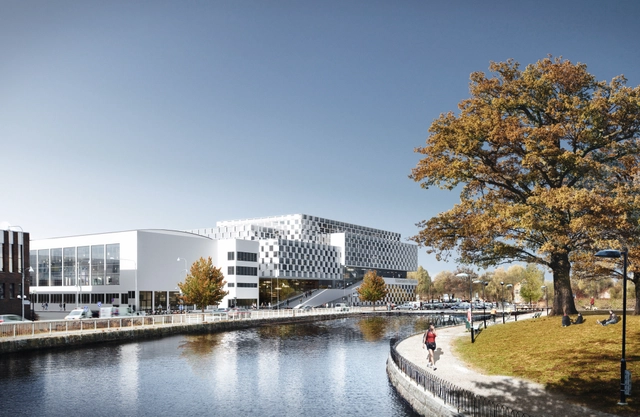
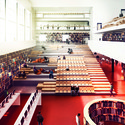
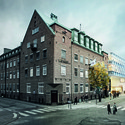
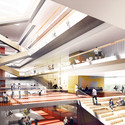
3XN has won an architectural competition -- beating out Wingårdh, Arkitema Dot, Christensen & Co, Juul/Frost, and White -- to design a new educational building for Mälardalen University in Eskilstuna (southwest of Stockholm, Sweden). The project not only includes a new 18,250 square meter building, but also the renovation of a listed Modernist Public Bath Paul Hedquist. The new campus is planned to be ready in 2018. Read the architect's description of the winning project, after the break.
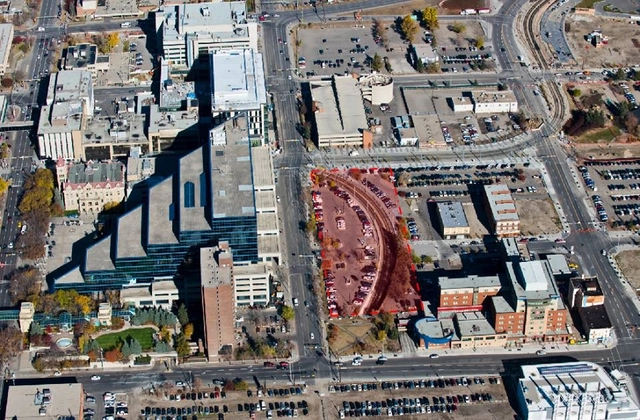
Four shortlisted teams have been asked to design proposals for a new central library in the Canadian city of Calgary. Selected from 38 submissions, the competing teams of local and international architects will harness the power of platemaking to envision a 280,000 square-foot “landmark” for the East Village Calgary.
What do we know about designing for individuals with autism? Those concerned with sensory issues are split on some issues. Some say we should limit daylight and exterior views, keep ceiling heights low and spatial volumes small, use restrained details, subdued colors, and reduce acoustical levels. Others advocate for high ceiling heights, large spatial volumes, and high levels of daylight with plenty of views to the outside. Still others disagree with catering to sensory needs altogether. They point out that individuals with autism struggle generalizing skills, and designing sensory heavens can do more harm than good. Thus they argue for autism classrooms, schools, and homes that mimic all the colors, sounds, lighting, and spatial volumes of “neuro-typical” environments. So who is right?
https://www.archdaily.com/177293/designing-for-autism-lightingChristopher N. Henry
This week, with the help of our readers, our Architecture City Guide is headed to Amsterdam. With its numerous canals, Renaissance architecture, and bike friendly culture, it is hard not to fall in love with Amsterdam. Also, if you love modern or contemporary architecture one could hardly argue against making this city the first stop on a tour of Europe. Our list of 24 buildings hardly does justice to this amazing city, but it will certainly give those less familiar with the city a starting point. We will be adding to our list in the near future, as we didn’t come close to incorporating all our readers’ suggestions. In the meantime add more of your favorites to the comment section below.
The new Headquarters will be one of Sweden’s most modern and innovative office buildings – focusing on transparency, Scandinavian simplicity and dynamic social environments. Behind the project is the Danish Architect 3XN in collaboration with Humlegården Fastigheter, representing the property owner Länsförsäkringar Liv.
More images and complete press release after the break.
MIND YOUR BEHAVIOUR invites you into 3XNs universe and gives a glimpse into the thoughts, visions and processes forming the basis of 3XNs architecture focusing on behaviour. The exhibit challenges the concept of behaviour by providing a direct and physical meeting with 4 meter high abstract building sections as well as inviting the viewer to reflect on how architecture shapes our behaviour. The exhibit displays 28 projects from the last five years of 3XNs work.
A few weeks ago, we featured a competition won by 3XN to transform the former freight train halls in Aarhus, Denmark into a new and dynamic cultural center. After the break, several more images and diagrams about this new cultural hub for scenography, visual arts and literature.
And now, they won the competition for the Frederiksberg Courthouse in Denmark, an extension to a neo-classical building. The new building follows the line of the neighborhood’s architecture, reinterpreted in a contemporary style, following the horizontal lines, materials and roof.
From the public square right next to the building, the heavy volume looks lighter as the opening in the corner give a sense of cantilevering.
More images and the architect’s description after the break:
3XN architects’ proposal for the Danish pavilion for the Shanghai expo 2010 uses their national flag to create a dynamic spatial environment. ”An exhibition window is an invitation that says: Welcome inside a little piece of Denmark. And in 2010, in the age of globalisation, it is important to add: Welcome to a Denmark that is part of the world,” stated the architects.
3XN just shared with us their winning entry for the Randers Museum of Art, a “sculpture sitting in a sculpture garden” according to the architects, a sinuous building both open to both the town and the landscape. The red-tile façade of the exterior becomes the roof, and similarly on the inside, the floor becomes a wall, and then the wall a ceiling.
From the architects:
https://www.archdaily.com/14961/3xn-wins-architecture-competition-for-the-randers-museum-of-artAmber P