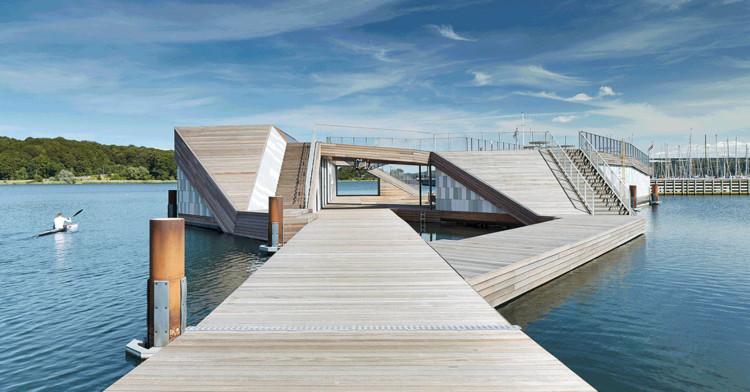
Building above water means doing away with a part of construction that is quite literally the basis of most of our built environment: the foundation. In a world dominated by water, currents, and shifting levels are variables that simply cannot be ignored, which is why the most emblematic feature these projects share is their adaptability.
Instead of robust, deep bases – such as piles or caissons – designed to anchor architecture into the earth, floating structures frequently employ solutions like concrete pontoons or plastic drums to prevent the building from sinking. These are typically paired with anchoring systems to "fix" the structures, even if only temporarily, to a specific location.
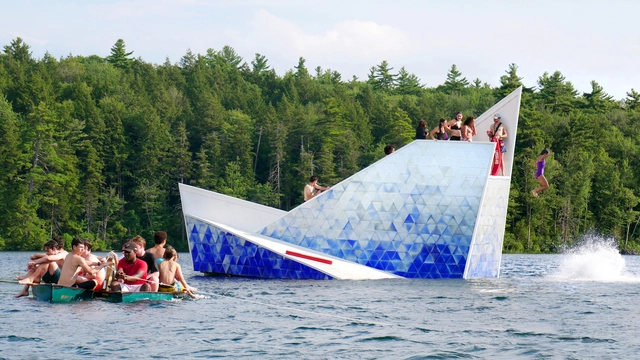
Plataforma de Mergulho ICEBERG / Bulot+Collins. Image Cortesia de Bulot+Collins
The aquatic environment has always fascinated dreamers and researchers. Around 1960, in the midst of the fierce space race of the Cold War, French explorer Jacques Cousteau developed equipment such as the Aqualung to unravel the depths of the sea, which remained as unexplored as outer space itself. He even stated that in 10 years we could occupy the seabed as “aquanauts” or “oceanautas,” where it would be possible to spend long periods extracting mineral resources and even growing food. Sixty years later, the seabed is still reserved for few, and mankind has been more concerned with plastic in the oceans and rising sea levels than colonizing the ocean floor. But being close to a body of water continues to attract most people. Whether out of interest or in response to risks of flooding and over-population, some have turned to utopian proposals and floating architecture, examples of which have been featured in the ArchDaily project archive. But what are the fundamental differences between building houses on land versus on water, and how do these buildings remain on the surface rather than sinking?
Coastal cities have always been a point of attraction for residents, tourists, and businesses. Alongside the aesthetic features, their proximity to the sea has made these cities a focal point for maritime transportation with the construction of ports, as well as hotspots for recreational and aquacultural activities. However, the past decades saw these particular regions threatened with a shortened lifespan; rising water levels, floods, and recurring cyclones, along with other natural disasters, have endangered coastal communities, putting their population, ecosystem, and built environment at risk.