Sylvain Deleu

BROWSE ALL FROM THIS PHOTOGRAPHER HERE

A Look Back at the 9 Japanese Architects Honored with the Pritzker Prize

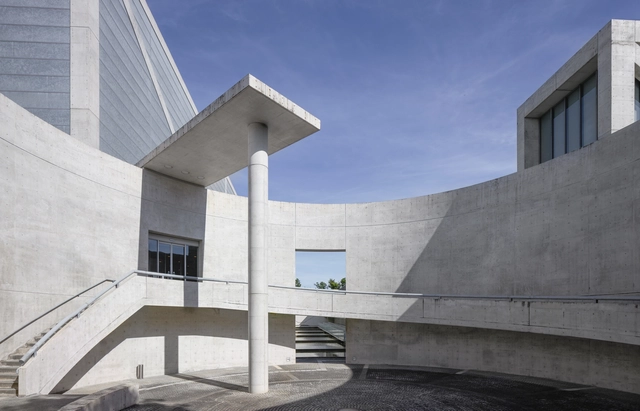
Last week, Japanese architect and social advocate Riken Yamamoto was announced as the 2024 Pritzker Architecture Prize Laureate, becoming the 9th Japanese architect honored with the profession's most prestigious award. Throughout the 45-year history of the Pritzker Prize, Japan stands out as the nation with the highest number of laureates. While geography is not a criterion in the selection of the laureates, Japanese architecture consistently impresses with its interplay of light and shadow, the careful composition of spaces, soft transitions between interior and exterior, and attention to detail and materiality. An ingrained culture of building also celebrates diverse designs and encourages global dialogue and the exchange of ideas and best practices. Read on to rediscover the 9 Japanese Pritzker laureates and glimpse into their body of work.

A Look Back at the 9 Japanese Architects Honored with the Pritzker Prize - More Images+ 6

Spotlight: Toyo Ito

As one of the leading architects of Japan's increasingly highly-regarded architecture culture, 2013 Pritzker Laureate Toyo Ito (born June 1, 1941) has defined his career by combining elements of minimalism with an embrace of technology, in a way that merges both traditional and contemporary elements of Japanese culture.

Spotlight: Toyo Ito - Image 1 of 4Spotlight: Toyo Ito - Image 10 of 4Spotlight: Toyo Ito - Image 9 of 4Spotlight: Toyo Ito - Image 7 of 4Spotlight: Toyo Ito - More Images+ 7

Life after Serpentine: Second Lives of Architecture's Famed Pavilions

If the surest sign of summer in London is the appearance of a new pavilion in front of the Serpentine Gallery, then it’s perhaps fair to say that summer is over once the pavilion is taken down. The installations have gained prominence since its inaugural edition in 2000, acting as a kind of exclusive honor and indication of talent for those chosen to present; celebrated names from the past names include Zaha Hadid, Rem Koolhaas, and Olafur Eliasson.

Life after Serpentine: Second Lives of Architecture's Famed Pavilions - More Images+ 15

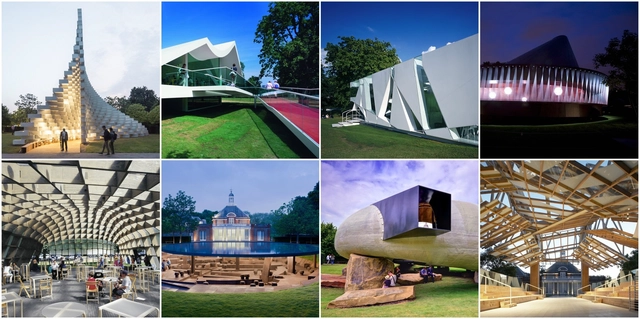
Round-Up: The Serpentine Pavilion Through the Years

Lasting for close to two decades now, the annual Serpentine Gallery Pavilion Exhibition has become one of the most anticipated architectural events in London and for the global architecture community. Each of the previous eighteen pavilions have been thought-provoking, leaving an indelible mark and strong message to the architectural community. And even though each of the past pavilions are removed from the site after their short summer stints to occupy far-flung private estates, they continue to be shared through photographs, and in architectural lectures. With the launch of the 18th Pavilion, we take a look back at all the previous pavilions and their significance to the architecturally-minded public.

Round-Up: The Serpentine Pavilion Through the Years - More Images+ 33

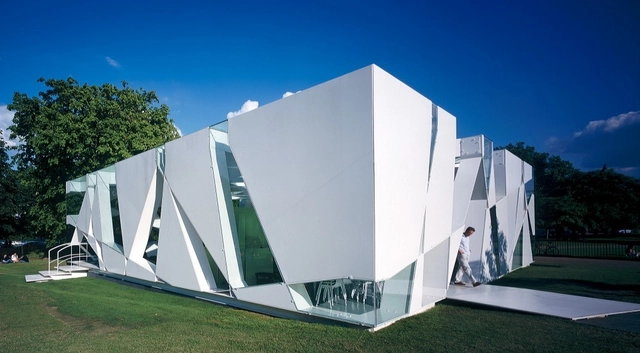
Serpentine Gallery Pavilion 2002 / Cecil Balmond + Arup + Toyo Ito & Associates, Architects

Serpentine Gallery Pavilion 2002 / Cecil Balmond + Arup + Toyo Ito & Associates, Architects - Pavilion
© Sylvain Deleu
City of Westminster, United Kingdom

Toyo Ito, recipient of the Pritzker Prize 2013, along with Cecil Balmond and Arup were in charge of the design of the Serpentine Gallery Pavilion back in 2002. What appeared to be an extremely complex random pattern was in fact derived from an algorithm of a cube that expanded as it rotated. The intersecting lines formed different triangles and trapezoids, whose transparency and translucency gave a sense of infinitely repeated motion.

You can see more images of the Serpentine Gallery Pavilion 2002 after the break. And don't forget to check ArchDaily's exclusive coverage of the 2013 Pritzker Prize.

The Life and Work of Toyo Ito, 2013 Pritzker Laureate

Subscriber Access | 

Until his third year of high school, Toyo Ito's passion was not architecture, but baseball. 

Fortunately for us all (and almost assuredly for the Pritzker laureate himself), he soon switched career paths.

Born in Seoul in 1941, Ito moved to Japan at the tender age of two. From the age of 12 (when his father died) to the time he went to University, Ito was part of the family business: making miso (bean paste). However, upon attending The University of Tokyo from 1965-1969, architecture became his life work. 

Read more on the life and work of Toyo Ito, the 2013 Pritzker Laureate, after the break...

The Life and Work of Toyo Ito, 2013 Pritzker Laureate  - More Images+ 3