Architecture is constantly changing and adapting to new needs, which are linked to social, economic, technological, political, and demographic changes. In this sense, the aging population is one of the most outstanding changes of the 21st century: The increase in life expectancy and the decrease in fertility rates mean that the older population is increasingly numerous. How can architecture help to provide a better quality of life, promote the autonomy, dignity, and well-being of the elderly?
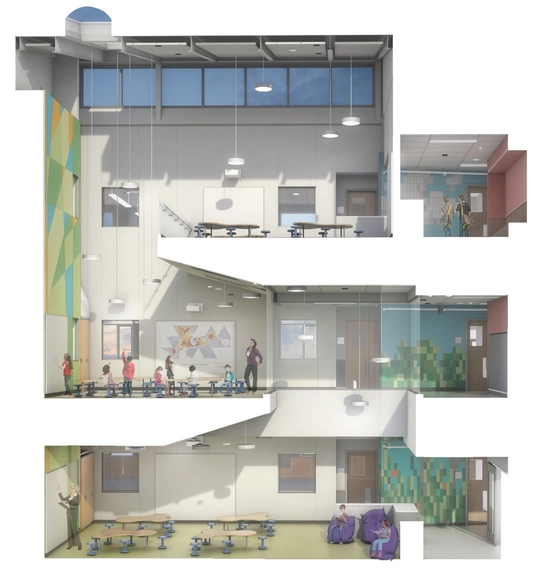
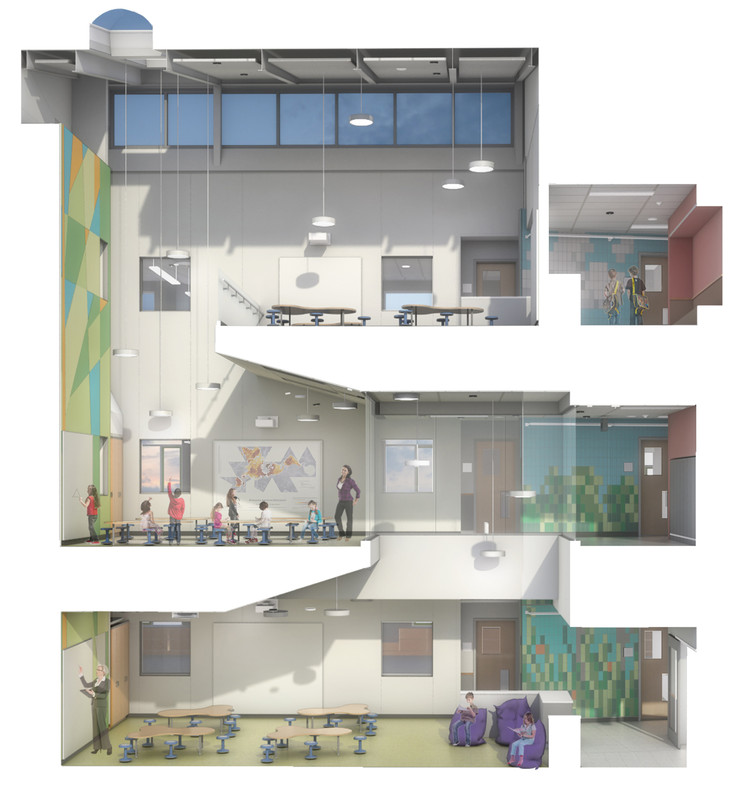
Woodland Elementary School / HMFH Architects. Image Cortesia de HMFH Architects
It is a student's right to be educated in a safe, healthy, and even aesthetically appealing environment, especially young students for whom these factors are even more important. For example, it has been shown that when the ergonomics of chairs are inadequate, they can greatly affect levels of concentration and the development of skills such as calligraphy. At the same time, the effectiveness of traditional teaching methods is increasingly being questioned and the quality of alternative methodologies increasingly being considered. In other articles, we discussed in more detail the design of Montessori schools and the atmosphere of Waldorf interiors.
Today, we will cover the importance of choosing furniture and address some aspects to consider when organizing them in classroom design for the schools of the future.
Manufacturers: Atlas Schindler, Albizzati, Antonietti, Beyler, Curti, +12De Stefano, EIMI, Earthworks, Floorcolor, Hunsinger, Mirolo Pere et Fils, Negro Pere et Fils, Petracca, Pole bâtiment, STTS Tennis et sols, Soprema, Zanelec-12
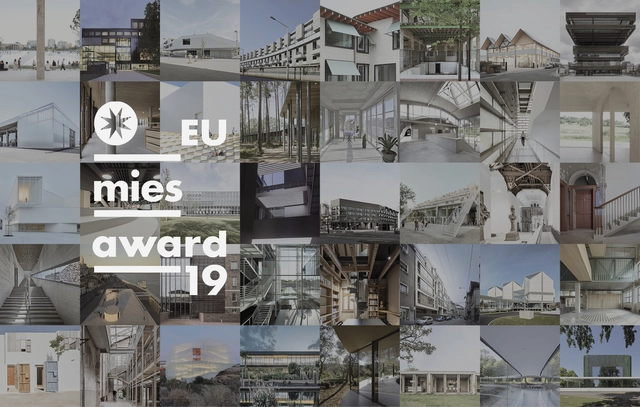
The European Commission and the Mies van der Rohe Foundation have announced the 40shortlisted works that will compete for the 2019 European Union Prize for Contemporary Architecture – Mies van der Rohe Award. The Prize, for which ArchDaily is a media partner, has seen a jury distill 383 nominated works into a 40-project-strong shortlist, celebrating the trends and opportunities in adaptive reuse, housing, and culture across Europe.
https://www.archdaily.com/909537/shortlisted-projects-announced-for-the-eu-mies-award-2019Niall Patrick Walsh
When the world undergoes major changes (be it social, economic, technological, or political), the world of architecture needs to adapt alongside. Changes in government policy, for example, can bring about new opportunities for design to thrive, such as the influx of high-quality social housing currently being designed throughout London. Technological advances are easier to notice, but societal changes have just as much impact upon the architecture industry and the buildings we design.
The shortlist for the 2018 Architectural Photography Awards have been revealed, bringing together 20 atmospheric images of the built environment. Categories this year ranged from a “portfolio of an individual building to a single abstract: with a professional camera or on a mobile phone.”
The 2018 edition saw a record number of entries, with photographs from 47 countries, including the UK (28%), USA (20%), Germany (6%), and China (5%). The 20 photographs were selected from four categories: exteriors, interiors, sense of place, and buildings in use.
https://www.archdaily.com/903008/shortlist-for-the-2018-architectural-photography-awards-revealedNiall Patrick Walsh
Wine production is an industry that combines robust economic activity with an extensive cultural legacy. Although there are several programs related to the wine sector, we commonly find spaces dedicated to the process of fermenting grapes into wine. However, there are a variety of duties grouped around wine production that play an important role in boosting the industry, such as tasting rooms, education centers, sales rooms, or broadcast. Below, a selection of 27 inspiring projects of wine architecture.
The 2017 Pritzker Prize was a surprise to many, awarded to the three founders of RCR Arquitectes, a modest Spanish firm located in the small town of Olot in Catalonia. Many people and critics shared their astonishment at the prize being awarded to three individuals for the first time since the Pritzker Prize began in 1979, including the third female winner, and at the relatively low profile of RCR Arquitectes before March 1st.
Whether this surprise was pleasant or shocking differs from critic to critic, but there nevertheless seems to be a consensus on the jury’s decision to venture further into politics and away from their traditional interest in celebrity architects. As clearly stated in the jury’s citation: “In this day and age, there is an important question that people all over the world are asking, and it is not just about architecture; it is about law, politics, and government as well.” Are they steering the prize in the right, or wrong, direction?


















.jpg?1488583403&format=webp&width=230&height=230&crop=true)


![Media Library [Third-Place] in Thionville / Dominique Coulon & associés - Library](https://snoopy.archdaily.com/images/archdaily/media/images/5894/ff7f/e58e/ce6e/c700/06cc/slideshow/32_THIONVILLE_Coulon_Ass.-Thionville42408_©Eugeni_Pons-web.jpg?1486159736&format=webp&width=640&height=580)


![Media Library [Third-Place] in Thionville / Dominique Coulon & associés - More Images](https://images.adsttc.com/media/images/5894/ff7f/e58e/ce6e/c700/06cc/newsletter/32_THIONVILLE_Coulon_Ass.-Thionville42408_©Eugeni_Pons-web.jpg?1486159736)