1. ArchDaily
  2. Urbanism

Urbanism: The Latest Architecture and News

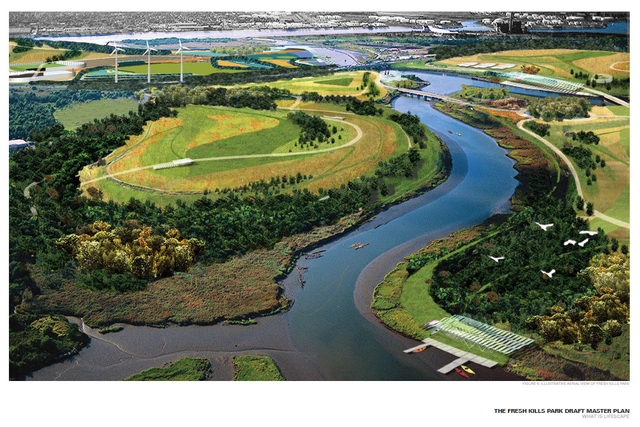
Landfill Reclaimation: Fresh Kills Park Develops as a Natural Coastal Buffer and Parkland for Staten Island

Every natural disaster has an "aftershock" in which we realize the fragility of our planet and the vulnerability of what we have built and created. We realize the threat to our lifestyles and the flaws in our design choices. The response to Hurricane Sandy in October 2012 was no different than the response to every other hurricane, earthquake, tornado , tsunami or monsoon that has wrought devastation in different parts of the world. We recognize our impact on the climate and promise to address how our development has caused severe disruptions in the planet's self-regulating processes. We acknowledge how outdated our systems of design have become in light of these damaging weather patterns and promise to change the way we design cities, coastlines and parks. We gradually learn from our mistakes and attempt to redress them with smarter choices for more sustainable and resilient design. Most importantly, we realize that we must learn from how natural processes self-regulate and apply these conditions to the way in which we design and build our urban spaces.

Since Hurricane Sandy, early considerations of environmentalists, planners and designers have entered the colloquiol vocabulary of politicians in addressing the issues of the United States' North Atlantic Coast. There are many issues that need to be tackled in regards to environmental development and urban design. One of the most prominent forces of Hurricane Sandy was the storm surge that pushed an enormous amount of ocean salt water far inland, flooding whole neighborhoods in New Jersey, submerging most of Manhattan's southern half, destroying coastal homes along Long Island, and the Rockaways and sweeping away parts of Staten Island. Yet, despite the tremendous damage, there was a lot that we learned from the areas that resisted the hurricane's forces and within those areas are the applications that we must address for the rehabilitation and future development of these vulnerable conditions. Ironically, one of the answers lies within Fresh Kills - Staten Island's out-of-commission landfill - the largest landfill in the United States until it was shutdown in 2001. Find out how after the break.

Fresh Kills Landfill was opened in 1947 along the western coast of Staten Island as a temporary solution for New York City's waste just in time to accommodate an exponential rise in consumption in the post-World War II United States. Three years later, and the landfill continued to operate until it became the principal landfill for New York City, collecting the solid waste from all five boroughs in the "age of disposability". It is no wonder then, that the temporary solution swiftly became a 50-year one.
MIT’s Center for Advanced Urbanism Collaborates with AIA to Bring Research Solutions for Healthy Urban Futures

American Institute of Architects (AIA) and Massachusetts Institute of Technology’s (MIT) Center for Advanced Urbanism have announced a research collaboration to support AIA efforts through the Clinton Global Initiative (CGI), Decade of Design, a measure focused on improving the health of urban communities. As the global population continues to shift toward urban environments, urban conditions of the past century have become too outdated to address the increase in population and pollution. In order to advance the state of city liveability, professionals in the design and planning fields must reconsider how urban environments need to be designed to work optimally in regards to social, economic and health challenges. MIT's collaboration with the profession-based organization of the AIA allows the research of the school to reach the professional world for application and development.

Subscriber Access

Smart Solution for Compact Living: Tiny Apartments, High Design

How can a small 420 square foot apartment transform into eight comfortable rooms?  It takes smart design solutions that incorporates modulation and interior planning that conforms to everyday needs in an increasingly competitive environment of living space.  Founder of Treehugger.com, Graham Hill takes the viewer on a tour of his "Life Edited" apartment that provides a sustainable living solution to compact apartments in urban environments like New York City.  This apartment provides all the amenities necessary with some additional effort of converting rooms to fit everyday needs.  Interested in seeing this apartment transform into a living room, bedroom, kitchen, dining room and guest room? Join us after the break to find out.

Subscriber Access

Pacific Standard Time Presents: Modern Architecture in L.A.

Pacific Standard Time Presents: Modern Architecture in L.A.  - Featured Image
Outside In: The Architecture of Smith and Williams; Wayne Williams (1919–2007) and Whitney Smith (1911–2002), Smith and Williams Community Facilities Planners office (South Pasadena, Calif.), 1958; Photograph by Jocelyn Gibbs, 2012

The Getty Trust is partnering with Pacific Standard Time to present 11 individual exhibitions throughout LA's museums that will explore the history and heritage of the city's modern architecture and its influential designers. As musician, photographer and architectural blogger Moby boasts that "LA has the most diverse architecture of any city on the planet". Pacific Standard Time Presents: Modern Architecture in LA will explore this diversity that covers post World War II architecture through today through specific points of view ranging in architectural style, influence and decade. The exhibitions, which will run from April through July 2013, are a follow-up to last year's Pacific Standard Time: Art in LA, 1945-1980. The focus of the exhibitions will range in scale and cover the monumental and everyday architectural moments that make LA unique. Exhibitions will present iconic modernist homes and cultural landmarks as well as coffee shops, car washes, and the freeways in addition to the un-built architectural fantasies of modernism and post-modernism.

Pacific Standard Time Presents: Modern Architecture in L.A.  - Image 1 of 4Pacific Standard Time Presents: Modern Architecture in L.A.  - Image 2 of 4Pacific Standard Time Presents: Modern Architecture in L.A.  - Image 3 of 4Pacific Standard Time Presents: Modern Architecture in L.A.  - Image 4 of 4Pacific Standard Time Presents: Modern Architecture in L.A.  - More Images+ 7

Follow us after the break for the eleven exhibitions that will be part of PST's event.

Subscriber Access

MAS Context #16: Production

MAS Context #16: Production - Featured Image
MAS Context #16: Production; Cover by David Sieren

The new issue of MAS Context, a quarterly publication released by MAS Studio takes on the daunting issue of production and consumption impacting cities through the lens of a handful companies operating out of Chicago. Production and consumption have a negative connotation in today's atmosphere of sustainability and conservation but architecture is fundamentally a celebration of the craft of inventing, designing and making. MAS Studio, in collaboration with Chicago-based collective The Post Family, looks critically at the social, environmental, and political implications of consumer culture while celebrating the excellence of production.

Subscriber Access

Slum Rehabilitation Promise to Mumbai's 20 Million

Slum Rehabilitation Promise to Mumbai's 20 Million - Image 3 of 4
Aerial View of Mumbai; Courtesy of Flickr User Cactus Bones; Licensed via Creative Commons

Slums, shanty-towns, favelas - they are all products of an exploding migration from rural to urban areas. Over the last half century, people living in or near metropolises has risen in proportion to the global population. Migrations from rural areas to urban areas have grown exponentially as cities have developed into hubs of economic activity and job growth promising new opportunities for social mobility and education. Yet, with all these perceptions holding fast, many people who choose to migrate find themselves in the difficult circumstances of integrating into an environment without the proper resources to accommodate the growing population. Cities, for example, like Mumbai, India's largest city and 11th on the list as of 2012 with a population of an estimated 20.5 million. According to a New York Times article from 2011, about 60% of that number live in the makeshift dwellings that now occupy lucrative land for Mumbai's developers.

More to come after the break.

Our Ideal City? Seen through the eyes of the Pacific West Coast.

Our Ideal City? Seen through the eyes of the Pacific West Coast. - Featured Image
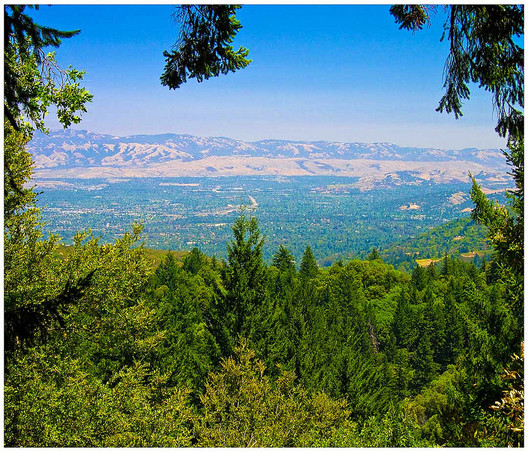
View of Silicon Valley via Flickr user Shootyoureyeout. Used under Creative Commons

As most New Yorkers know, people are willing to shell out a hefty sum to live in a place where work and play are right around the corner from each other. But as the article by Ken Layne in The Awl points out, the west coast is a somewhat different place. UNLIKE New York City, which is crowded with restaurants, bars, and entertainment, as well as offices, design firms and businesses; Silicon Valley, which caters to programmers and tech companies that hire at $100k a year, offers few of the amenities that a nearby town like San Francisco does. So, Layne concludes, residents are willing to spend hours of their day making their way into the fortressed office parks of Silicon Valley, flanked by parking lots and boulevards, just to have a cultural reprieve to call home.

Subscriber Access

Britain's Built Legacy: From "Carbuncles" to the Cutting-Edge

Britain's Built Legacy: From "Carbuncles" to the Cutting-Edge - Image 5 of 4
Photo of Queen Elizabeth II's Jubilee Celebrations. Photo © LEON NEAL/AFP/GettyImages

‘What is proposed is like a monstrous carbuncle on the face of a much loved and elegant friend.”

It’s easy to see why British Architects get their hackles raised when it comes to Prince Charles. The oft-quoted gem above, said in reference to a proposed extension to the National Gallery in 1984, is one of hundreds of such Architectural criticisms Prince Charles has made over the years. Which wouldn’t matter of course, if, like any average Architectural layman’s opinions, his words didn’t have much weight.

His do. They’ve resulted in the intervention, squelching, and/or redesign of at least 5 major plans over the last twenty years. But let’s not write off Charles just yet.

With the Queen’s Jubilee ceremoniously having finished yesterday, the conversation analyzing her legacy has begun. And while London’s towering, cutting-edge high rises (a la Norman Foster, Richard Rogers, and Zaha Hadid), will be the shining examples of Elizabeth’s reign – I’d like to suggest something, and raise a few hackles, myself…

Curious for more? Keep reading about Prince Charles’ unlikely influence on Architecture, after the break…