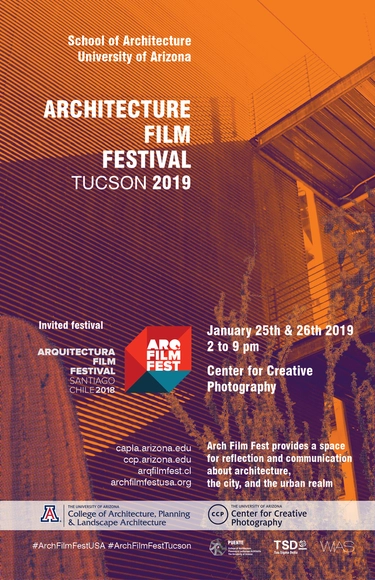
School of Architecture of the University of Arizona presents “Architecture Film Festival Tucson 2019” in conjunction with invited festival ArqFilmFest Santiago Chile 2018.
Film has the power to bring people together – or tear them apart, spur conversation, and transform ideas. It is in anticipation of this that the School of Architecture of the University of Arizona College of Architecture, Planning and Landscape Architecture presents “Architecture Film Festival Tucson 2019” in conjunction with invited festival Arquitectura Film Festival SANTIAGO 2018. Held at the Center for Creative Photography at the UA’s main campus, a festival of selected award-winning films shown in previous festivals held in Santiago, London, Venice, Lisbon, and Buenos Aires will take place over two days, January 25-26. Ranging in genre from documentary to experimental and hailing from some eleven countries, most of these films have never before been aired in the U.S.
In its 10th edition, MEDS Workshop is going to take place this year in Greece, on Spetses Island with its theme “MEMNISO,” which in ancient Greek means “to remember.” The idea of the workshop is to bring traditional professionals together with contemporary crafts and design by exploring new capabilities and learning techniques from local expert craftsmen. The goal of the workshop is to not only learn from local artisans but also exchange knowledge and share skills.
The role of architecture is to create strong and sustainable identities for cities and their communities. With well-conceived design, we can help things run more fluidly, improve people’s well-being, and make life more enjoyable. Every project is a unique expression of the ethos of its users, climate, and context. A built environment can be seen as a point of departure: it is where the architecture starts to communicate, the point from where it starts to interact with the public and its users. Followed by a talk with Jette Hopp of SNØHETTA.
The Appio Spagnolo Association announces the Contest of Ideas for the creation of design objects aiming at the promotion of the wine industry together with the handcrafted furniture industry, and encouraging the positive combination of these two important productive fields.
Description via Amazon. From Fallow is a curated collection of 100 ideas for abandoned property. Through drawing and text each idea is elaborated and each entry serves both as documentation and speculation. The intention, here, is to think differently about pre-existing conditions and to be particular about them. I offer examples of different spatial characteristics around abandonment in North American legacy cities. The variations are mesmerizingly complicated and varied. A vacant lot is never one thing. Terrains have different scales, elevations, adjacencies, uses, climates and cultures. And just as no one territory is the same, so no one idea is sufficient. The goal, in considering these disparate ideas, is not to imagine any singular solution but to understand the many possibilities. Ideas can be tested, substituted and combined.
Social design is design for society and with society. As social innovation and on the basis of dialogue and participation, social design strives for a new networking of the individual, civil society, government, and the economy. Social design is thus a response to a global growth economy and its consequences for humans and the environment: The means of production and resources are becoming scarcer, setting off discussions about the need to redesign social systems and living and working environments. Architects and designers have always played a vital role in shaping this social culture.
Videos
30 thumbs from the Murcutt Master Class - Architecture Foundation Australia
Commenced in 2001, this annual event has been attended by architects and academics from over 80 nations. The Glenn Murcutt Master Class is a two-week residential studio program held in Australia. Week one is held at ‘Riversdale’, the Arthur and Yvonne Boyd Education Centre, a magnificent rural retreat south of Sydney - an award-winning building designed by Murcutt in 1999 and described by Thomas J. Pritzker as a ‘Masterwork’. Glenn personally leads the Master Class, stays at ‘Riversdale’ with the participants and leads the program. Other tutors on the Master Class include seminal Australian architect and educator Richard Leplastrier, award winning and internationally published architect Peter Stutchbury, leading academic and practitioner Professor Brit Andresen, and Master Class Convener Lindsay Johnston, former Dean of Architecture, University of Newcastle, Australia. Week two of the 2018 Master Class will be held again in Sydney. The Master Class is open to practising architects, academics, postgraduates and some senior architecture students. There are only 32 places available.
The Award for Architectural Heritage Intervention AADIPA’s 4th call, addressed to professionals related to interventions in architectural heritage –architects, historians, archaeologists ...–, opens its online registration on Monday, December 17, 2018 and will remain open until April 5, 2019. Any completed work, carried out or published in the European geographical area during the period between January 1, 2012 and December 31, 2018, and which meets the requirements of the 4 categories of the award can be entered:
Category A: Intervention in built heritage All architectural, permanent or ephemeral interventions in architectural properties of heritage interest. Category B: Exterior spaces All interventions in the historic
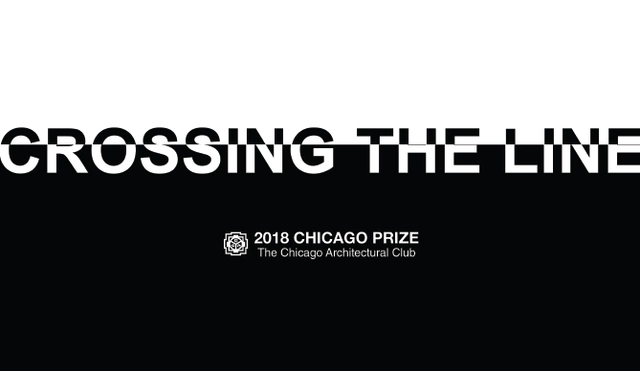
The Chicago Architectural Club (CAC) is pleased to announce the 2018/19 Chicago Prize Competition: Crossing the Line. A call for entries for the 2018/19 Chicago Prize is taking place as of November 30th, 2018 with the announcement of the winning entries on February 28th, 2019.
The crossing of an imaginary line 100 years ago resulted in the death of an African-American teenager named Eugene Williams, inciting the Chicago Race Riot of 1919. This chain of events demonstrates the power of lines – conceptual and physical – in shaping places and lives. Whether material or immaterial, the lines of Chicago both
The State Committee on Urban Planning and Architecture of the Republic of Azerbaijan (Committee) invites the bidders to an open tender for development of the General Plan for Baku city based on the order No. 256 of the President of the Azerbaijan Republic “About the measures on Development of the General plan for Baku city” dated June 27, 2018.
The Tallinn Architecture Biennale 2019, which Opening Week takes place from September 11-15 2019 announces Open Call for International Architecture Schools‘ Exhibition ‘‘Terribly Beautiful‘‘ that is part of TAB 2019 Main Programme and targets current students, practicing architects and everyone else who has ever studied in architecture school.
TAB 2019 Architecture Schools' Exhibition is curated by three young Estonian architects: Merilin Kaup, Margus Tammik and Ulla Alla. Curators are expecting projects that hide a sinuous process and tell a story in which they can see author’s state of mind, personality and value systems.
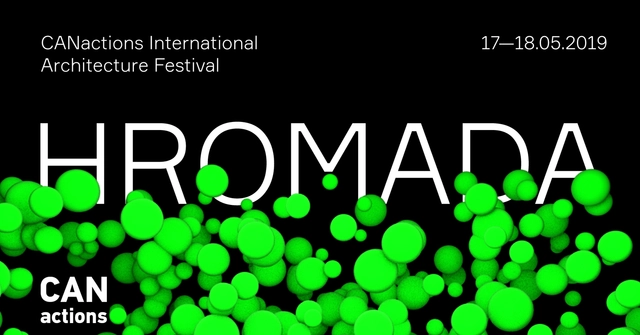
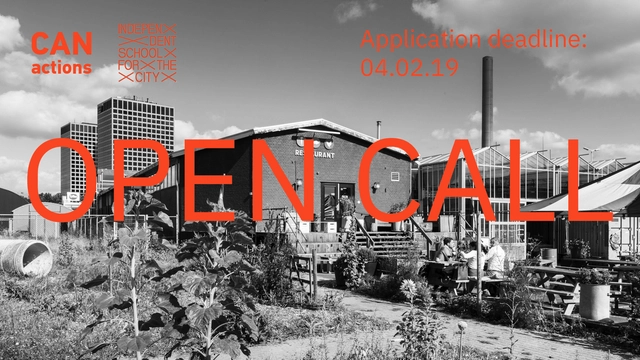
CANactions is an educational platform, aimed to enhance the creation of places and communities where people love to live and work. CANactions integrates the most relevant world experience in the sphere of architecture and urbanism to educate and inspire responsibility active change makers. CANactions is a member of Future Architecture Platform.
This year, the 12th CANactions International Architecture Festival will be focused on an exploration of a notion of "Hromada" — Ukrainian name for the Community.
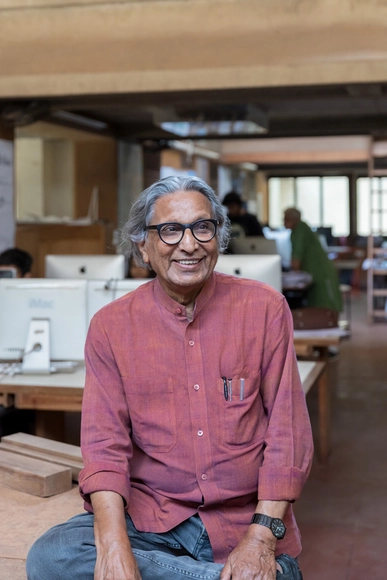
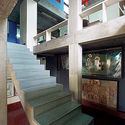
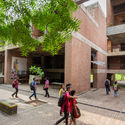
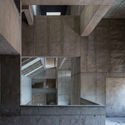
With the exhibition »Balkrishna Doshi: Architecture for the People« (30 March to 8 September 2019), Vitra Design Museum presents the first international retrospective about the 2018 Pritzker Prize laureate Balkrishna Doshi outside of Asia.
The renowned architect and urban planner is one of the few pioneers of modern architecture in his home country and the first Indian architect to receive the prestigious award. During over 60 years of practice, Doshi has realized a wide range of projects, adopting principles of modern architecture and adapting them to local culture, traditions, resources, and nature. The exhibition will present numerous significant projects
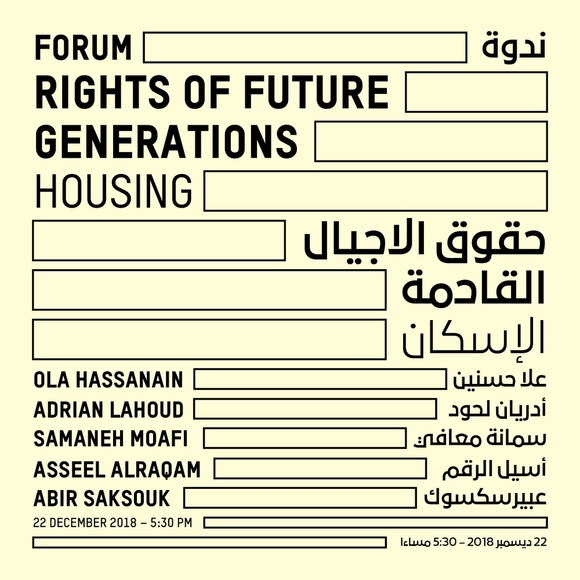
Using Sharjah as its primary field of research, the inaugural edition of Sharjah Architecture Triennial invites members of an emerging generation of architects, urban designers, planners, scholars and artists from across Middle East, North and East Africa, and South and Southeast Asia and their diaspora to respond to the unique challenges and opportunities faced by our generation.
Through the theme of Rights of Future Generations, curator Adrian Lahoud seeks to question how inheritance, legacy, and the state of the environment are passed from one generation to the next, how present decisions have long-term intergenerational consequences and how other expressions of
The state of things is very serious. The water is rising, the ice is melting, the forests are on fire, and the land is sinking. Every day is a new catastrophe, we’re rushing toward a precipice, we’re out of time, we’re out of luck, we screwed the pooch, dropped the ball, botched the delivery, broke the system, went hurtling down the road of good intention…In design, we’ve been trained to respond with solutions. Throughout history mischief-makers have plagued the over-powerful, puncturing the smug assumptions of Fat Cats, Big Cheeses, and High Muck-a-Mucks. From Coyote to Anansi to Shakespeare’s fools, the