Herzog & de Meuron's ten-storey extension to London's Tate Modern, which officially opens to the public this week, is the latest in a series of ambitious building projects pursued by the internally renowned gallery of contemporary art. Sitting above The Tanks, the world's first dedicated galleries for live art and film installations, the building's pyramidical form provides 60% more exhibition space for the institution. Two days before its doors welcome art-lovers from around the world, photographer Laurian Ghinitoiu has captured a collection of unique views on this highly anticipated addition to London's skyline.
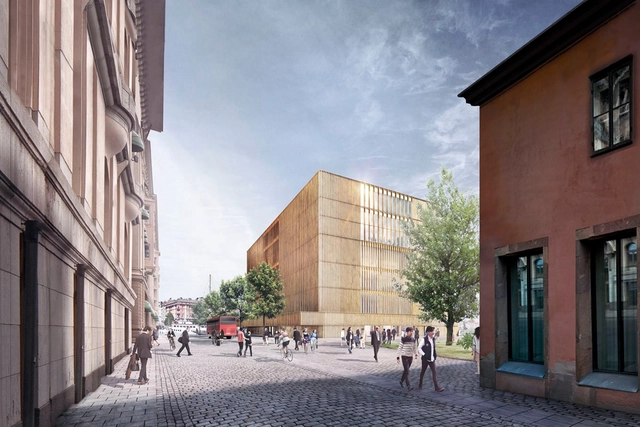
Earlier this monthThe Guardian reported that the King of Sweden, Carl XVI Gustav, has denounced David Chipperfield's designs for Stockholm's new Nobel Center (Nobelhuset) in the Dagens Nyheter(DN), a national Swedish newspaper, as both too volumetrically large and badly sited. The practice's initial proposal, which was lauded by the awarding jury for its “lightness and openness,” is a glass and stone structure which attempts to “convey dignity” and embody the ideals of the Nobel Prize.
Montréal’s CCA (Canadian Centre for Architecture), the international museum and research center which was founded by Phyllis Lambert in 1979 and is currently directed by Mirko Zardini, has launched a new iteration of its website. The organisation’s new online presence has been conceived as an active editorial project which aims for more than dissemination of information alone; rather, it will take positions and—being organised around several themes such as “The Planet is the Client,” “Origins of the Digital” and “Technology Sometimes Falls Short”—will reflect the CCA’s ongoing research interests.
This interview with Zardini has been conducted by Steffen Boddeker (currently Director of Communications at Columbia University Graduate School of Architecture, Planning and Preservation – GSAPP), who has worked with the CCA as a communications and online consultant overseeing its web presence since 2006.
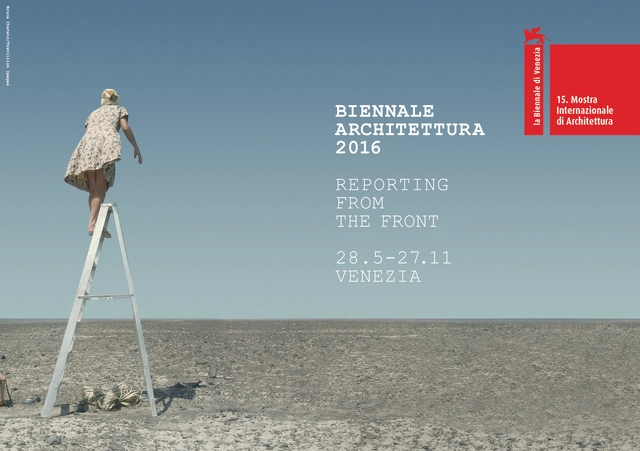
"Scrutinizing the horizon and looking for a new perspective" is what Alejandro Aravena has encouraged in the 2016 Venice Biennale, Reporting From the Front. "[He] has staged one of the most socially charged Biennales," Gillian Dobias reports, by "exploring the different ways that design can add value." In this, the first of two film reportages from the Biennale, Monocle talks to Aravena about his hopes for stimulating the debate on improving quality of life in the built environment, and tour the Central Pavilion and the Arsenale to uncover what's on show.
A little over a month since Rotterdam-based practice MVRDV announced a new temporary urban structure—a 180-step staircase, 29 meters tall and 57 meters long—for the heart of city of Rotterdam, the project has been officially opened. Those who ascend the staircase will find a temporary observation deck looking over Rotterdam Centraal, a rooftop bar, and the temporary reopening of the Kriterion cinema that was last active in the 1960s.
The Dutch Structuralist architect Aldo van Eyck left his mark in Amsterdam – not only in the form of buildings but also, perhaps surprisingly, in the form of urban playgrounds. Over the course of his career he created a network of more than 700 playgrounds throughout the capital. Today, only a handful of these remain intact. A special publication, compiled by Denisa Kollarova and Anna van Lingen, revisits the seventeen remaining Van Eyck playgrounds in Amsterdam’s city centre. The following extract from the book seeks to introduce the project, and describe its urgency.
We live in an era in which there are not many carefully constructed playgrounds. We don’t like what we see. Have we—city decision makers, architects, designers, parents, friends —forgotten to be critical?
The Board of Directors of La Biennale di Venezia, upon recommendation from Alejandro Aravena, have announced the jury for the forthcoming Venice Biennale who will award the Golden Lion for Best National Participation, the Golden Lion for Best Participant in the International Exhibition Reporting From the Front, and the Silver Lion for a Promising Young Participant in the International ExhibitionReporting From the Front. They will also have the opportunity to award one special mention to National Participations and two special mentions to the participants in the International Exhibition.
The Board of Directors of La Biennale di Venezia, upon recommendation from Alejandro Aravena, have announced the Brazilian Pritzker Prize-winning architect Paulo Mendes da Rocha as the recipient of the Golden Lion for Lifetime Achievement of the 15th International Architecture Exhibition, Reporting From the Front. Citing the "timelessness" of his work "both physically and stylistically" as "the most striking attribute of his architecture," the board have also stated that "this astonishing consistency may be the consequence of his ideological integrity and structural genius."
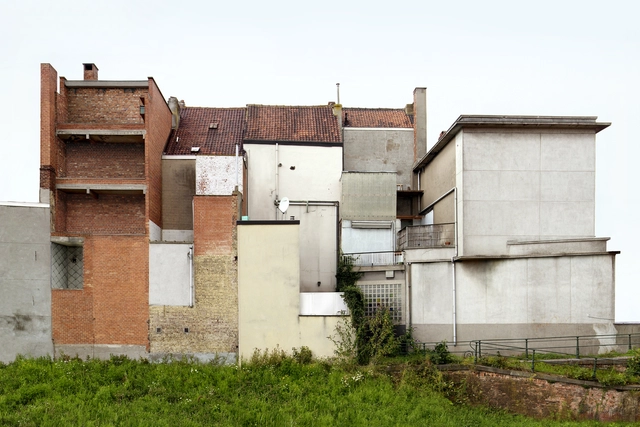
A practice of architects, an interior architecture firm, and an architectural photographer will together be presenting the Belgian contribution to the 2016 Venice Biennale. Architecten de vylder vinck taillieu, interdoorzon interieurarchitecten and Filip Dujardin—self-styled as the Bravoure (Bravura) team—will explore "what craftsmanship can mean during a period of economic scarcity" as, according to the curatorial team, "dealing with scarcity demands a high level of precision."
European Expressionism in architecture has, until now, suffered from neglect. Following a successful campaign for the first volume in a planned seven-part series which focused on Berlin, a new version of the Fragments of Metropolis series—which covers with the Rhein-Ruhr region of Europe—will document 155 buildings from Bochum, Bottrop, Dortmund, Duisburg to Düsseldorf, Cologne, Münster and Oberhausen. This latest volume is currently being crowdfunded.
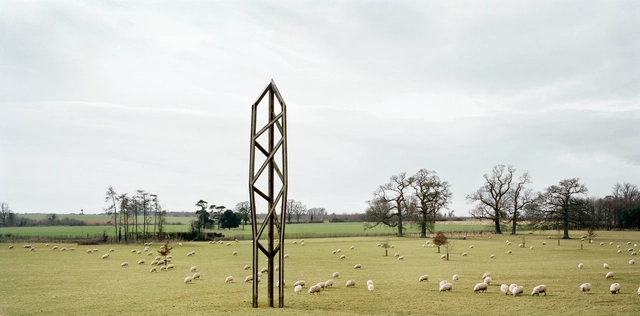
Two sculptures—Obelisk by Alison and Peter Smithson and Columns by Álvaro Siza Vieira—have been re-erected in Shatwell, a "semi-derelict agricultural complex" located in rural England. The instatement of the monuments form a part of an evolving programme of installations which Drawing Matter, an organisation founded by Niall Hobhouse "that champions the process of architecture through collecting, archiving and commissioning," will use to explore the relationship between architecture, sculpture and landscape.
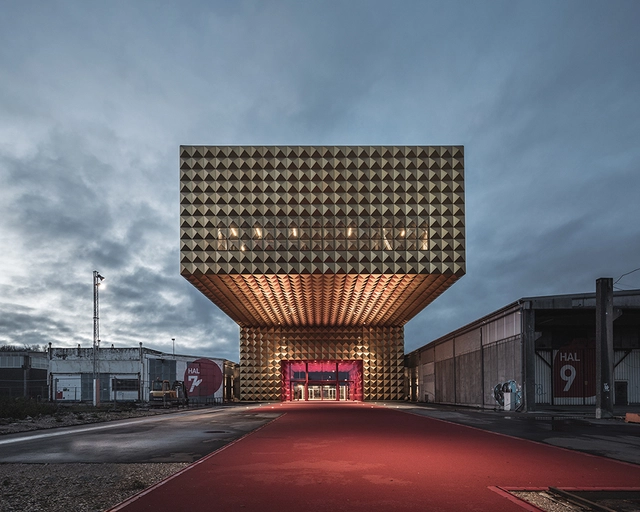
A new museum dedicated to rock, pop and youth culture will open today in the Danish city of Roskilde. Designed collaboratively by Dutch-based practice MVRDV and Copenhagen-based COBERagnarock, as it is to be known, has been described by its designers as "oozing rock’n’roll attitude, with its golden exterior and velvety red interior." The museum is part of ROCKmagneten, a masterplan for the site of a former concrete factory which COBE and MVRDV won together in 2011. The area has since been designated as a creative and cultural neighborhood and the museum, which is now at the heart of this transformation, is set to be open to the public all year round.
Concrete Loveis a film about the Böhm family. Shot at their residence in Cologne, Germany, and on location at their projects—both completed and under construction—around the world, the film's Swiss director, Maurizius Staerkle-Drux, spent two years in close quarters recording scenes and conversations that offer a profound insight into the world of Pritzker Prize-winning architect Gottfried Böhm, the late Elisabeth Böhm, and their three sons.
Read on to be in with a chance of winning a copy of the film.
The After Belonging Agency, the curatorial team behind the 2016 Oslo Architecture Triennale (OAT), have revealed sixteen speakers who will present at the event's central conference at the Oslo Opera House this coming September. Atelier Bow-Wow, Snøhetta alongside a number of other academics, practitioners and decision-makers will come together to "address architecture’s relation to current pressing questions such as refugeeism, migration and homelessness, new mediated forms of domesticity and foreignness, environmental displacements, tourism, and the technologies and economies of sharing."
In celebration of Earth Day, we invited Benjamin Grant—founder of the Daily Overview—to select the five "overviews" which he considers to be among the most inspiring that his platform has shared. The image above, taken on Christmas Eve in 1968 by astronauts of NASA's Apollo 8 mission is, according to Grant, "believed by many to be the first "overview" of our planet, captured by astronaut Bill Anders." This photograph dramatically pulled into focus the simultaneous magnificence, intricacy, and terrifying fragility of the planet we inhabit. Since that moment the advent, acceleration, and accessibility of satellite imagery has made one thing abundantly clear: that humankind has had a considerable effect on Earth, for better or for worse.
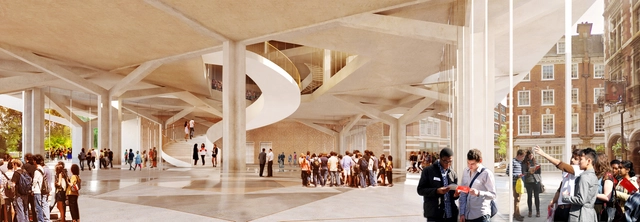
Dublin-based Grafton Architects, who last year were awarded the Jane Drew Prize, have seen off competition from the likes of Herzog & de Meuron and David Chipperfield Architects to win the contest to design the London School of Economics’ (LSE) £100 million ($144 million) Paul Marshall Building. The new center will house the academic departments of Accounting, Finance and Management and research centres, including the Marshall Institute, with teaching facilities as well as new multipurpose sports and arts facilities. Grafton Architects are reportedly "absolutely delighted to be given this opportunity to build in this unique location in Lincoln's Inn Fields, across from the wonderful Sir John Soane’s Museum, for a visionary client such as LSE."
In an interview with the Council on Tall Buildings and Urban Habitat (CTBUH), Bjarke Ingels reflects on the design of skyscrapers, noting how "sculpture is fine, but if its arbitrary it's not as interesting." Architects, Ingels argues, have the problem of "skilled incompetence:" the notion that they "already know the answer before [they've] even heard the question." This prevents them "from questioning the question, or having the question rephrased, or elaborating on the question, or even listening for the question – because [they] already know the answer."
Following the death of Zaha Hadid on March 31st of this year Section D, Monocle 24's weekly review of design, architecture and craft, hones in on the role of women in architecture and design. They discuss why, despite an almost 50:50 gender split in undergraduate architecture courses, women are still grossly underrepresented at senior levels within the profession by featuring conversations with two leading female architects, Angela Brady OBE and Amanda Levete. The episode also looks back over the lives of some of architecture's overlooked heroines.


.jpg?1465998369&format=webp&width=640&height=580)
.jpg?1465998696 "© Laurian Ghinitoiu")
.jpg?1465998420 "© Laurian Ghinitoiu")
.jpg?1465998587 "© Laurian Ghinitoiu")
.jpg?1465998579 "© Laurian Ghinitoiu")
.jpg?1465998369)

.jpg?1463424218&format=webp&width=640&height=580)

_Morley_von_Sternberg_reduced.jpg?1485964869&format=webp&width=640&height=580)