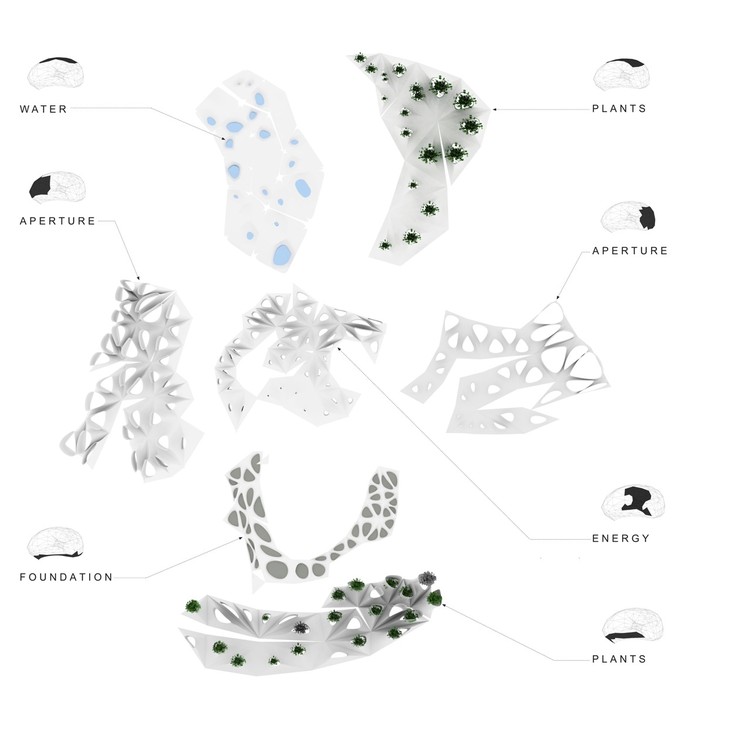
New Orleans’ Lower 9th Ward represents a rather new phenomenon in American urbanism; physical tabula rasa paired with a metaphysical fabric of emotion, history, and tragedy that is no less significant than the physical emptiness. That emptiness has boldy been broken by the Make It Right foundation. Regardless of one’s opinion of their planning or design practices, the context that MIR has created in the 9th Ward has it’s own richness that is redefining the neighborhood’s physical presence while ensuring the continuity of the metaphysical through resident outreach. It is this new context that should now be respected and preserved. Unwittingly, MIR has sparked and nurtured the NOLA movement, defined by contemporary material, formal, and tectonic gestures with a thoughtful respect for regional typologies. This proposal by GOATstudio, for the DesignByMany challenge which ArchDaily sponsored, is the next entry in the soon to be expanding catalogue of NOLA. More images and description after the break.
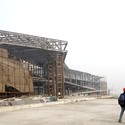
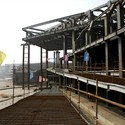
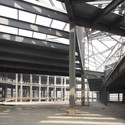
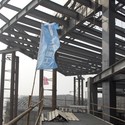
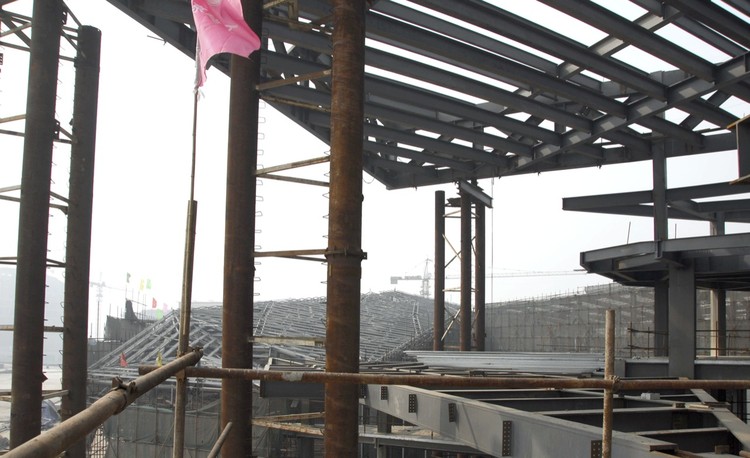
Preston Scott Cohen‘s winning competition proposal for the Taiyuan Museum of Art is currently under construction. A cluster of buildings unified by continuous and discontinuous promenades both inside and outside. The building responds to the urban parkscape in which it is set; visitors are encouraged to pass through the building while not entering into the museum itself. An exterior ramp threading through the building connects the heterogeneous hardscapes, lawns and sculpture gardens. The integration of building and landscape registers multiple scales of territory ranging from the enormity of the adjacent Fen River to the intimacy of the museum’s own particular spatial episodes.
Architects: Preston Scott Cohen Location: Taiyuan, China Client: Taiyuan City Government Project Team: Preston Scott Cohen (architectural design); Amit Nemlich (planning); Collin Gardner, Hao Ruan, Joshua Dannenberg (design assistants, modeling, renderings); Yair Keshet(model) Project Consultants: Architecture Design and Research Institute of South East University Project Area: 32,500 sqm Project Year: 2007-2010
Architecture for Humanity’s Kimisagra Football for Hope Center in Kigali, Rwanda has broken ground. This video by Killian Doherty and music by Sophie Nzayisenga features the site location, renderings, and most importantly the communities excitement for the new center.
We are slowly getting closer to 50,000 photos on our Flickr Pool, so if you want to see a lot of amazing architecture photography, go ahead. Remember you can submit your own photo here, and don’t forget to follow us through Twitter and our Facebook Fan Page to find many more features.
The photo above was taken by thomaslewandovski in Glauburg, Germany. Check the other four after the break.
Focus! Focus! Focus! Why are you reading this! You should not be reading this now! Get back to work! You are being unproductive! You are DISTRACTED!
Architecture in an office environment often functions like the opposite of how it was in studio. For one, offices are businesses so there is a need for oversight, management, evaluation, assessment, leadership, discrete task assignments, meetings…the list goes on. Notice that all of these elements to running a firm somehow come down to time management and staffing issues. Leaders have to keep an eye on junior staff, not to be annoying and stand over their shoulders micro-managing them, but to stay aware of what everyone is doing and where the different aspects of complex projects stand. Of course, this also relates to project budgets.
Located in the heart of downtown Austin, this project is a renovation and expansion of an existing contemporary art space. LTL was commissioned to design 21,000 sqf of new program within the building envelope, including an entry lounge, a video/projects room, a large open gallery, multipurpose room, two artists’ studios, additional art preparation areas, and an roof deck.
The original Municipal Theatre of Corfu designed by C. Pergolessi at the end of the 19th century and destroyed by German bombers during the Second World War. In its place a modern building was erected in the 1960’s which unfortunately did not meet the aesthetic and functional expectations of the citizens of Corfu. This proposal, brought to ArchDaily by Zerefos Tessas Architects is for the Renovation and Extension of the Municipal Theater of Corfu, Greece to provide a more appropriate architectural identity through the building.
The J‐House uses a historically standard New Orleans housing lot: 30×150 feet. The original site for the J‐House is located in a designated flood zone as is common with many housing sites throughout the Southern Louisiana region. Recent FEMA studies have concluded that a vast range of New Orleans housing sites are currently 9‐feet under sea level. The original site for the J‐House is no different.
Architect: AEDS | Ammar Eloueini Digit-all Studio Location: 918 Upperline Street, New Orleans, Louisiana, USA Project Team: Ammar Eloueini, Jana Masset, David Merlin, Dan Kautz, Jamie Lookabaugh, Surawat Hanthawichai Architect of Record: Wisznia A+D Sturctural Engineer: Buro Happold New York, Craft Engineering Studio New York Photographs: Courtesy of AEDS
https://www.archdaily.com/138398/in-progress-the-j%25e2%2580%2590house-aedsChristopher Henry
Architects Aleksandar Kekovic, Marjan Petrovic, Bojan Stojanovic, Milan Stevanovic, and Srdjan Sakan, shared with us their proposal for the Beton Hala Waterfront Center Competition in Belgrade, Serbia. More images and architect’s description after the break.
The Södra Tennis Hal, designed by Deve Architects questions how wood construction can be utilized to create the ultimate competitive tennis environment in Växjö, Sweden for efficiency, light, air quality and flexibility.
When we came across the work of Michael Hansmeyer, we were struck by the complexity and the seemingly delicacy of his work. Educated as an architect and computer programmer, Hansmeyer intends to create a new kind of architectural expression using the mathematics of algorithms. “On the one hand, their computational power can address processes with a scale and complexity that precludes a manual approach. On the other hand, algorithms can generate endless permutations of a scheme. A slight tweaking of either the input or the process leads to an instant adaptation of output. When combined with an evaluative function, they can be used to recursively optimize output on both a functional and aesthetic level,” explained Hansmeyer. His Subdivision project features geometrically intricate surfaces that create an artistically articulated variety of columns. The 2.7 meter high columns are fabricated as a layered model with sheets 1mm thick.
Steven Holl Architects were approved last week by the board of visitors’ finance committee to design a $19.3 million gallery at Virginia Commonwealth University (VCU) in Richmond, Virginia.
An existing surface parking lot on the east side of VCU’s campus will be transformed into the 32,000 sqf arts institute. This will provide an opportunity to create a distinctive entrance into the campus from Broad and Belvidere streets. The program for the new gallery includes space for traveling exhibits and student exhibits, archival study area, offices, and an auditorium.
Points of View (POV) is a Herman Miller series sharing architects’ perspective on design. Directed by Hello Design, POV provides five different California architects’ step by step process from approach and design development to materials choices. Architects include Leo Marmol and Ron Radziner of Marmol Radziner, Kim Coleman of Cigolle X Coleman, James Meyer of LeanArch, Jim Jennings of Jennings Architecture, and John Friedman of JFAK Architects.
By integrating solar power systems in the roof or façades of buildings in an architecturally and technically sophisticated manner, architects can increase the awareness of both builders and the public regarding the possibilities for combining buildings with solar technology, and thus help renewable energies become more widespread. To increase acceptance and to foster awareness of this topic, the Bavarian Association for the Promotion of Solar Energy (SeV Bayern) is organising the competition “Building-Integrated Solar Technology2011”.
This proposal comes from Zechner and Zechner’s winners entry for the Reißeck Top Terminal Competition, a new mountain restaurant at 2250 meters above sea level in the Austrian Alps. In addition, the building with include a top terminal for the Reißeck incline railway, along with information and display areas.
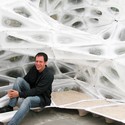
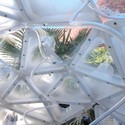
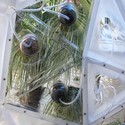
Every year, the AIA stages a competition for an intervention that brings to life the historic city of New Orleans. This year the institute selected a scheme by Gernot Riether that proposed a series of glowing spherical enclosures sited within the hidden courtyards of the city’s distinctive French Quarter. They would be illuminated in the evening, dramatically modulating the host environment and bringing attention to these romantic, mysterious and usually private spaces, typically located deep in the block, away from the street.
Developed by the german architects stadiumconcept for the FIFA World Cup 2022 the Floating OffShore Stadium represents an extraordinary and ambitious concept. The Floating OffShore Stadium is a swimming construction that can be relocated to seaside venues across the oceans. More images and complete architect’s description after the break.
South Florida based Nichols Brosch Wurst Wolfe and Associates was recently awarded third place in the Miami Water Box competition for their roaming proposal. Additional images of their project in addition to a full description can be viewed after the break.
Amsterdam based project development corporation NIC started sale of the MVRDV designed Alphabet building. In Amsterdam small and mid-size creative companies have trouble finding suitable office space. The Alphabet building communicates through a clear exterior design which reveals on the East façade the house number and at the main façade the extension for each company, a letter of the alphabet. The interior is highly flexible and completed with a rough and pure finishing. The 3200m2 creative industry building will be completed in 2012 according to high energy efficiency standards.
Is architecture employment improving? According to C. J. Hughes recent article some firms need for design services has increased providing an opportunity to hire employees. That being said the employment opportunities are still minimal some firms hiring only one or two employees while others are able to hire in the double digits. Many principals are tentative about the future and are therefore proceeding cautiously not to over hire employees.
Miami University graduate students, Brian Albrecht and Kristopher Kunkel, and their faculty adivsor, Mary Rogero, recently sent us their submission for the AIAS School of Tomorrow 2010 Competition. They chose to design for the Phillis Wheatley Elementary School that we recently featured on our site. Their proposed design seeks to accomplish two vital aspects of sustainability and design: the preservation of an iconic Modern structure that embodies the period in which it was built, and secondly adapts that structure to suit present day needs for an area with unique problems and a unique culture.
https://www.archdaily.com/137857/proposed-renovation-to-the-phillis-wheatley-elementary-school-for-the-aias-competition-for-schools-of-tomorrow-brian-albrecht-kristopher-kunkel-and-mary-rogeroChristopher Henry
Five great kindergartens for our seventh selection of previously featured projects. Check them all after the break.
Kindergarten Kekec / Arhitektura Jure Kotnik Kindergarten Kekec is an extension of a typical Slovene prefab kindergarten from the 1980s. Situated in one of Ljubljana’s residential areas, Kekec answers the growing demand for kindergartens. This comes as a result of Ljubljana having witnessed considerable population growth as well as legislative changes and a planned increase in building density inside the highway ring surrounding the city (read more…)
At an international symposium from 26/05/2011 till 28/05/2011 in Graz, attention turns to the question of how to shape an active role for architecture in the development of “Dense Cities“. The range of questions covers all levels of scale ranging from urban landscape and agglomeration through districts to blocks and individual buildings, covering everything from the development of new building typologies on through actual interventions in the urban setting to analyses of transformations of urban density.
As an all-electric vehicle, the Ecco has no emissions of its own, and can be quickly charged at a standard 240V station. But when used for extended living purposes, even where no electricity is available, its built-in photovoltaic panels and solar sail roof mean that it can cut out the middle man, and charge directly from the sun.