.


.

Federico Soriano Pelaez shared with us their third prize winning proposal for the New Taipei City Museum of Art. Their aim was to design a museum which contains all museums. A museum which is the entirety of all the museums in the world. They collected 100 of the most important museums of art from around the world. It is architecture as a refined abstraction of a historic landscape. It is a recollection of generic fragments from the plans of the museums from around the world which will be inserted into the Taipei City Museum of Art. More images and project description after the break.

Australia-based Andrew Maynard has shared a new type of governmental building with us with a project that is as much a statement about pushing the realm of architecture forward, as it is a reaction to political happenings and the need for change. This adaptable architecture builds upon the irony of a democracy where elected representatives supposedly represent the voice of the people, yet, the occupied governmental spaces are “fortified and spatially manipulated to the benefit of the representative rather than those represented.” By allowing the represented to interact with the spatial qualities of the representatives, Maynard’s mobile and adaptable structure becomes a ” democratic architecture.”
More images and more about the project after the break.

For one night only on October 26th from 7:00-8:30pm, P.E.A.R. (Paper for Emerging Architectural Research) will be performing live for an evening of readings, discussions and performances at The Architecture Foundation in London.

The complexity of a problem that stands before competitors reflects a contrast that exists between rural surroundings and program demands that refer to a high built-up density in an otherwise non-urbanized (built-up) area of the prairie. This project, by MITarh Architecture Studio represents a model for an anticipated urban development of the area in which the competition task has been set. An initial motive for designing was the distinctive texture of the surrounding fields. Their aim is to establish a rational and useful urban matrix adaptable to the existing area using the dimensions and geometry of the new structure, while establishing continuity of the surrounding area. More images and architects’ description after the break.
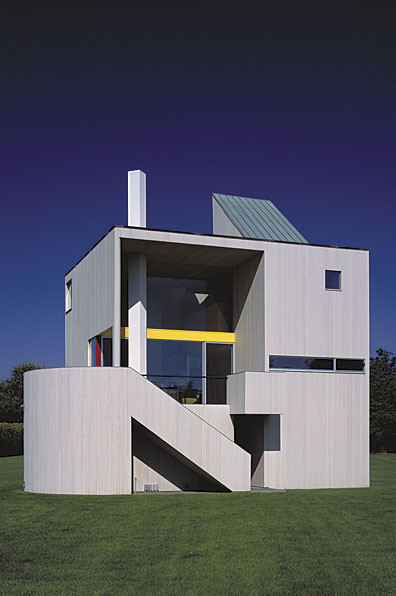
Taking place at the Yale School of Architecture gallery from November 14th-January 27th is the Gwathmey Siegel: Inspiration and Transformation Exhibition which is the first museum exhibition devoted to the work of Gwathmey Siegel and Associates Architects, one of the most influential architecture firms of the modern period. The exhibition is free and open to the public. More information on the event after the break.

The space of sound created by Carlito Carvalhosa’s Sum of Days on exhibit at MoMA until November 14, 2011 is a sublime environment of billowing white fabric and the white noise of the atrium reflected upon itself. The psuedo-boundaries established by the translucent material that hang from the ceiling create a confined space of light and ambient sound – fleeting and ephemeral. Upon entering the exhibit, you pass an array of speakers affixed to the wall. They are emitting a low hum – the sound of voices and echoes that are distant, yet recognizable. It is unclear at first from where these sounds are originating, but behind the fabric bodies are drifting in and out of view. The curtains, which are constantly swaying, direct you in an ellipse to the center of the space where a single microphone hangs, picking up the noise within the exhibit and sending them to the dozens of speakers that hang at intervals inside the curtains, along the walls of the exhibit, and up through the galleries at the mezzanine levels that overlook the atrium.

Two nice houses, two big scale projects and the latest update on Herzog and de Meuron’s Elbe Philarmonic Hall. Check them all after the break.
BU Landmark Complex / Architects 49 The Bangkok University Landmark Complex is initiated on the necessities that are to reorganize the frontal area of the campus and to create an outstanding approach for the campus’s entrance. In addition to the mentioned requirements, the School of Business Management also required some supplementary facilities, for example, classrooms, seminar rooms, lecturers’ office, lecture halls. Then, the new complex is emerged from the particular architectural form evoking the symbol of the university, a diamond (read more…)

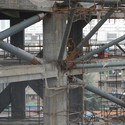
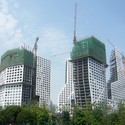
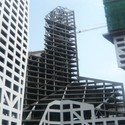
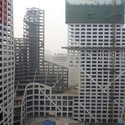
Construction of Steven Holl Architects’ Sliced Porosity Block is making progress in Chengdu, China. The large hybrid complex topped out at a 123 meters in September and is scheduled for completion in 2012. The five towers house offices, serviced apartments, retail, a hotel, cafes, and restaurants. The 105,000 square foot site will stimulate a micro-urbanism and offer generous amounts of public open space.
Architects: Steven Holl Architects Location: Chengdu, China Project Area: 310,000 sqm Project Year: In Progress Under Construction Photographs: Steven Holl Architects

PLANT Architecture has recently been recognized with an Honorable Mention in the City of Toronto’s Urban Design Awards. Held every other year, the awards acknowledge the contributions design has on the local milieu. PLANT’s revitalization of the Nathan Phillips Podium Square (part of Toronto’s iconic City Hall by Viljo Revell) introduces a greenscape to the podium previously occupied solely with a vast hardscaped plaza.

Leeser Architecture was recently awarded the second prize in international design competition for the reconstruction and renovation of Moscow’s Polytechnic Museum. The 430,000 sq ft Museum was built in three stages from 1887 to 1907 and has since become an architectural and cultural landmark in Moscow. Their design included covering the courtyards of the existing building with an additional 22,000 sq ft of exhibition space identified as ‘the Cloud.’ The Cloud, comprised of all glass, floats above the proposed active courtyard spaces, allowing for visitors to experience the feeling of walking on air. When occupying the Cloud visitors are granted unprecedented views over the city of Moscow establishing the Museum as a cultural destination. More images and architects’ description after the break.

We’ve been taking you through the two week installations at the BOFFO Building Fashion event, and this week marks the third installation by Patrik Ervell + Graham Hudson. It is quite remarkable to see the transformation that takes place at 57 Walker Street every few days (remember how last time, the fashion and architecture pair Irene Neuwirth + Marc Fornes / TheVeryMany resulted in a crazy atmosphere of organic metallic forms dancing across the room?). Now, visitors will experience a space with crumbling walls, rubble, scaffold and re-bar designed by Hudson in response to the Ervell’s design brand of innovative materials and unconventional application throughout his collections. “Overall, the environment that has been created where destruction —the decay and the beautiful—are transformed into art and design, both literally and figuratively,” explained BOFFO.
More about the designers and the installation after the break.

As the winning entry for a competition to design an arts and cultural square at Lake Sanyon in Daqing, China, the project by Chi Wai Chan examines the relationships between the elements of the water, the sky and the earth. A waterfront promenade that ensues the formal attributes and fluidity of the water, a 1,394 m long canopy with LED display that transpires the form of the clouds and a ground condition of self-similar marine lifeform that establishes the view corridors to the lake; these three design elements serve as the organizing apparatus for the design of the square. More images and project description after the break.
Between 1989 and 2003, Liberia was ravaged by two civil wars. The fighting killed 300,000 – young and old alike. Currently, Liberia is 162nd in the Human Development Index and is still recovering from the devastation. The Bamboo School Project in Fendell on the outskirts of Monorovia, Liberia, led by Brazilian architect André Dal’Bó da Costa and film maker Vinícius Zanotti, seeks to establish one of the most important social and architectural programs for future development: education.
Follow us after the break for more.

We are sharing with you an interview of british architect Jonathan Sergison of Sergison Bates architects conducted by Hugo Oliveir, as seen in Jornal Arquitectos. Sergison, prior to the founding of his firm in 1996 with partner Stephen Bates, gained professional experience working for David Chipperfield and Tony Fretton. Currently he serves as a Professor of Architectural Design at the Accademia di Architettura in Mendrisio, Switzerland.
The complete interview following the break.

Spillman Farmer Architects’ proposal for the Dickinson College Kline Sports Facility takes advantage of the existing features, while striving to introduce more transparency and connectivity as well as making the building’s sustainability evident. The new three-level addition transforms the Kline Center into a dynamic campus gateway, a marquee building with bold daytime and nighttime presence. The addition is placed along the eastern side of the existing building, reaching east to Cherry Street and south to High Street and integrated with the existing topography. More images and architects’ description after the break.

The design for the fire station in Porto Santo, Madeira, Portugal by Luis Banazol arises from the dialectic of reflection, at the same time simple and strong, between the artificiality of the urban and the organic naturalness. As a concept of development, we tried to integrate the building with the involving, creating an element in sober, contemporary yet functional and appropriate to their function. More image and architects’ description after the break.

The project proposal for the first CTBUH international student design competition by Ajmona Hoxha and Elis Vathi aims to redefine the gap created between the two extreme social classes of India as the widening income gap between the rich and the poor over the years has raised fears of a social backlash. Since it is highly noticed that the difference between the rich and the poor is displayed not only in the social life but at a major grade on the physical environment, there is a need for redirecting social organization by creating a new environment. Displacement of the concentrated power of the narrow rich circles to wider masses would be achieved by strong physical means. More images and project description after the break.

The recreational family houses near Bratislava, designed by Chybik + Kristof Associated Architects, offer a possibility of permanent settlement. The project aims to create a residential area of high quality with direct contact with water surface. Furthermore, a considerable number of houses are located in the area of an ancient riparian forest in the riverbed of the Danube. The project’s main motto is to set up a space for a life in contact with nature, a life with a link to the original fauna and flora. More images and architects’ description after the break.

The 3-1 Zone of Government Building in Sejong City is a symbolic gate of the central administration town. The Urban Gate, where nature and citizen are together, and the Urban Plaza, which anybody can freely use, are planned for here. It is designed as a comfortable and cozy resting place shaped after nature. It will be used for various events including festivals and various culture and art activities. In terms of urban scale, the linear shape of existing master plan had been maintained.

Vallo Sadovsky Architects recently sent us their latest book, Urban Interventions. We have featured one of Vallo Sadovsky Architects’ projects before, BA_LIK. That project gets to the heart of what this book is about. Small urban interventions can completely transform and revive a space and city. This book is filled with writings and examples that expand on that idea. “The proposals in these pages are, with few exceptions, practical solutions to real urban problems, most of them having to do with the creation of place or connecting disparate places together, by shifting the perception of the value of a piece of open space or mending a neighborhood from the effects of a multilane freeway. Some of the most inspiring are also the most modest, replacing lost trees with potted plants that provide seating for rest or perhaps a conversation with a neighbor,” writes John Peterson.
Take a look inside after the break.

An increasing trend towards sustainable construction within the building industry has resulted in a steady stream of “green” products into the marketplace. It is not uncommon to see products labeled with numerous claims that are certified by previously unheard of governing bodies. Industry leaders recently gathered in Toronto at Greenbuild to focus on avenues to increase the transparency of such claims made in the marketplace, and develop an integrated information source to reduce confusion and increase reliability.

From December 2nd to February 19th, Flight Assembled Architecture, the first installation to be built by flying machines, will be conceived as an architectural structure at a scale of a 600 m high “vertical village”, the installation addresses radical new ways of thinking and materializing architecture as a physical process of dynamic formation. The exhibition is put on in Orleans, France at the Frac Center by Gramazio & Kohler and Raffaello D’Andrea in collaboration with ETH Zurich. More information on the event after the break.

For those of you that enjoyed our post on the Covington Farmers Market you might enjoy visiting an exhibition that features Jeff Goldberg’s images and the students’ bass wood models of the project at The Virginia Center for Architecture in Richmond, Virginia. The exhibition, ”Design 2011: A Retrospective of Winning Work”, will be held from October 20, 2011 – January 8, 2012.
Additionally, design/buildLAB has been invited to give a lecture to coincide with the exhibit. The lecture, ”Teaching Practice”, will be held at the Richmond Convention Center on Thursday November 3rd from 10:45-12:15. For more information visit: http://www.virginiaarchitecture.org/ae_index.html
More images of the project after the break.
But you can browse the last one: 417