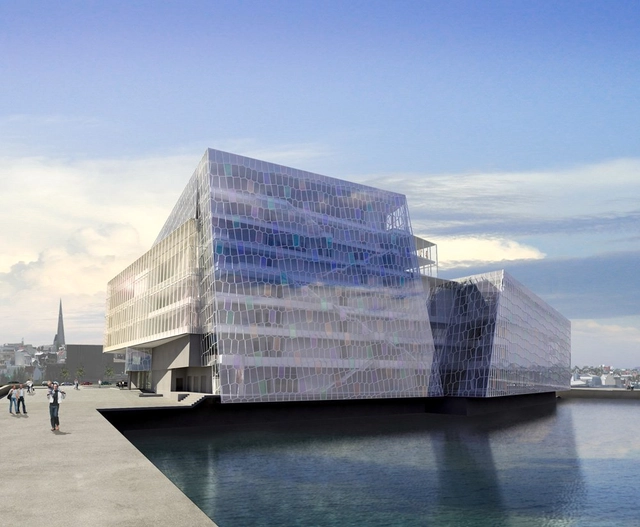
Residents are hopeful that Foreign Office Architects (FOA)’s first museum design (and the firm’s first major US building) will help Cleveland’s urban-revitalization project move forward. Farshid Moussaviof the FOA London has designed a geometric volume that dominates the Uptown area’s site, creating a bold icon for the new Museum of Contemporary Art. Prior to this, the MOCA rented a 23,000 square feet of space on the second floor of the Cleveland Play House complex, but with this 34,000 sqf new home, the museum will be able to showcase a bigger selection and accommodate more visitors.
More images, a cool video, and more about the project after the break.
When we spotted William Leddy’s (the founding principal of Leddy Maytum Stacy Architects in San Francisco) thoughts on Getting Past Green for the Architect’s Newspaper, we completely connected with his words. A few months ago, when we shared Frank Gehry’s comments about LEED, we received an overwhelming number of responses about your opinions of the rating system. Leddy exclaimed, “Let’s get past our paler notions of “green design” and stop fussing over arcane LEED points to get to the real business of fully integrating radical resource- efficiency within our concepts of design excellence. Only then can we whole-heartedly focus the transformative power of design on the greatest challenge of our generation: helping to lead our society to a prosperous, carbon-neutral future. We can afford to do nothing less.”
It is easy to take for granted the things you grow accustomed to, but ever since the initial idea of revitalizing the High Line began sprouting up, New Yorkers have been taking full advantage of the project and loving every second spent strolling, relaxing and gazing at the West Side’s newest addition. The project has truly piqued locals and tourists’ interests as the elevated promenade is enjoyed as much today as it was on opening day over a year ago.
With such success, it is no surprise, as Kate Taylor reported for the New York Times, that the small office of the Friends of the High Line has received countless calls asking how their cities can also enjoy the High Line effect.
Chaired by Paolo Baratta, the Board of the Biennale di Venezia has awarded the Golden Lion for Lifetime Achievement to Rem Koolhaas. The much deserving architect has produced dozens of thought-provoking and inspirational works that constantly push the limits of the current state of architecture. His strength lies in his buildings’ strong conceptual nature that is carried through to ideas about circulation, structure and programmatic organization. ”Rem Koolhaas has expanded the possibilities of architecture. He has focused on the exchanges between people in space. He creates buildings that bring people together and in this way forms ambitious goals for architecture. His influence on the world has come well beyond architecture. People from very diverse fields feel a great freedom from his work,” explained the board.
For the Young Architects Forum Atlanta’s 10UP! National Architectue Competition, participants were challenged to create a temporary installation for Atlanta. The winning 45 ft tower, Periscope, designed by Brandon Clifford and Wes Mcgee of Matter Design Studio, is an “inhabitable installation with iconic implications to advocate bold architecture for the Atlanta community and young designers across the globe.” The designers felt the tower would create a strong marker for the city, “Through vertical expansion via the omission of a vertical restriction, this tower will engage a broader audience, inviting them to the event similar to search lights in the night sky.”
More about the tower, including lots of images and a video, after the break.
If you quickly glance at this first image of Point Supreme Architects’ newest installation, you may being wondering what that blue volume is or even wondering what could happen in that small space. But, if you’re wondering what it is made of, well, that question yields the most interesting answer. The architects teamed with two visual artists, a musician and a performance artist/choreographer to design this installation and performance piece made 100% from blue foam insulation panels!
More information about this installation and more images of the amazing foam work after the break.
Although Peter Zumthor’s success is undisputed in the architecture world, it was interesting he would tackle a residence for Living Architecture as his past works have gracefully unfolded after years of development. For Zumthor’s project, entitled A Secular Retreat, the architect employs his signature strategy of using nature as a source of relaxation. The hill-top retreat is a quiet and passive design, truly taking the backseat to the surroundings. The home is designed to exploit the beauty of its location, capitalizing on views and providing perfect places for reflection. The home, Zumthor’s first project in the UK, is the perfect residence of the Living Architecture projects to visit for some peaceful downtime.
Jeffrey Pongonis’ blog, MSI Design – Beyond the Studio, is chock full of urban issues ranging from new green initiatives to schematic designs for new developments. What attracted our attention was the strategic plan for Columbus Ohio, an initiative to restore Downtown’s vitality by building upon the area’s success from the 2002 Strategic Business Plan for Downtown Columbus.
More about the plan and more images after the break.
A few days ago, we shared C. F. Møller Architects‘ winning entry for the Kristiansund Opera and Culture Center entitled Kulturkvartalet. This project shares its joint first place prize with Oslo based architecture and design office Space Group + London based Brisac Gonzalez. The team of Space Group and Brisac Gonzales have designed a 15, 000 m2 opera and cultural house with a 600-seat auditorium, library, cultural facilities, restaurants and a youth center. ”Our strategy is threefold: a full refurbishment of the building skin, an upgrading of the structure, and an extension of the top floor with roof terrace. The ground floor is conceived as a living room, with spaces for music, newspapers, studying, playing. The café opens graciously to Kongensplass – an urban garden,” explained the team.
More images and more about the winning proposal after the break.
With all the projects we feature, it becomes second nature to envision yourself occupying that space if not only to critique its success, but also to merely imagine what it would be like to live there. But, what if, instead of just daydreaming about living in a certain residence designed by your favorite architect, you could actually spend a week or two in a house designed by Peter Zumthor, or JVA, or even MVRDV? Living Architecture, a new not-for-profit organization, offers the chance to rent houses in different areas of Britain for a vacation starting at £20 per person per night. ”We are dedicated to introducing you to the best of contemporary architecture, as well as to curating unique and enjoyable holidays,” explained the organization.
It’s that time of the year. Architectural Record has published their list of Top 250 architecture firms. The companies are ranked according to revenue for architectural services performed in 2009 in $ millions.
The list is compiled from a survey conducted for Engineering News-Record’s annual Top 500 Design Firms Sourcebook. As last year, number 1 was for AECOM Technology Corporation, an engineer-architect firm from Los Angeles, California.
The firms classify themselves by:
A = Architect AE = Architect-Engineer AP = Architect Planner EA = Engineer-Architect AEC = Architect-Engineer-Contractor
Ozel Office, a practice based in both LA, California and Istanbul, Turkey, has designed a competition proposal for an Opera House for Izmir, a port town off the Aegean Coast. The competition challenged participants to see architecture as a “catalyst” that could potentially help the city re-center itself as a hub of economic activity and source of cultural significance. The collaborative effort within the office, especially led by Guvenc Ozel and Erdim Kumkumoglu, produced a proposal where the ”architecture becomes a catalyst that reinforces the relationship between the old city, the new city, the waterfront and urban culture. In short, our vision is a synergy of spatial, cultural as well as practical and contextual aesthetics.”
More images and more about the project after the break.
New Zealand architect, Tim Stephens, shared his HuntingtonUrban Farm design with us. The farm responds to the lack of support for the sustainable practice of growing and cultivating one’s own food source, an important issue Stephens sees as becoming more prevalent as our population increases. The farm provides convenient access to individualized plots of land where users can produce their own food right in the middle of the town.
Check out this video we found by Yellow Line Pictures and the 2010 MoMA/MoMA PS1 Young Architects Program. We’ve been documenting SO-IL’s Pole Dance quite extensively and we feel that this video is a good addition to our coverage. We hope the film’s fun take on demonstrating how to use the project will make you even more excited to visit the PS1 schoolyard if you find yourself in the New York area. What do you think of the noise making poles? And, how about the fact that the project can be affected by an iPhone app ?
Similar to their identifiable products, the Apple stores require a sleek, almost instantly recognizable, aesthetic. As keepers of the latest technology, the buildings’ minimalist interiors boast a calm and sophisticated demeanor, complimenting, yet not overshadowing, their prized possessions. It may come as a surprise that the leading architects behind the stores are Bohlin Cywinski Jackson (BCJ), a firm that had never designed a retail store before Apple and whose principal, Peter Bohlin, winner of the AIA Gold Medal, ironically doesn’t use email.
Bohlin has awed us in the past, especially with Apple’s second Manhattan retail store located on Fifth Avenue. Turning a tough retail space into a successful masterpiece, the store’s iconic cube, a 32-foot glass structure, marks the store’s entrance and beckons customers down to the retail level which is illuminated with natural light. And now, BCJ has just unveiled their latest Apple store, and the first of its kind in China which seeks to emulate similar design decisions as the Fifth Avenue project.
C.F. Møller Architects just won a shared first prize in the competition for the new Opera and Culture Center in Norway, entitled Kulturkvartalet. This new Opera Center will house the country’s oldest opera in Kristiansund, the capital of the region of Nordmøre. The site proposes an interesting challenge as the new design must integrate two existing buildings with the proposed new urban center, and the most critical component becomes the shared urban space between the old and the new which will ultimately connect the Opera and Culture Center with pedestrian streets and a nearby park.
This past week, we’ve featured several of Jeffrey Durkin’s videos, such as Lindsay Brown’s ideas for the SD Waterfront and Miki Iwasaki’s philosophy on furniture design, architecture and society. This video highlights Jonathan Segal, a San Diego developer and architect, who focuses on urban projects such as high-density residence, mixed use, and live/work units.
A few days ago, we introduced Junya Ishigami’s Kanagawa Institute of Technology Workshop, a lightweight studio space with an interesting interior due to 305 slender columns. Our friend, Brandon Shigeta, shared his photos with us that illustrate Ishigami’s technique of using column distribution as a space generator. Although the slender columns appear randomly distributed, the architects’ seemingly scattered order has created defined zones that subdivide the large studio workspace.
More images and more about the columns after the break.
We have told you in the past about Brad Pitt´s Make It Right Foundation. They have been working with a group of international architects to redevelop the Lower 9th Ward in New Orleans, after hurricane Katrina. The name of the foundation addresses the desire of Pitt, architecture enthusiast, to design these houses the best way and not just as a temporary solution, in a process that also included working not only with these renowned firms, but also very close with the community, with a focus on sustainable development.
Recently, we were invited to see Sir James Dyson’s newest technology in the Pomegranate Gallery. Perhaps the name sounds familiar, and rightly so. The company continually makes innovative products that remain at the top of their market, such as their Dual Cyclone which became the fastest selling vacuum cleaner ever to be made in the UK, or their washing machine with two rotating drums which move in opposite directions, or even their hand dryer which produces an air stream flowing at 400 mph. With a background in industrial design, Dyson’s work combines modern engineering with an aesthetic undertone, all in an effort to achieve energy efficiency. Their creativity comes to life within their Malmesbury headquarters, a long span structure topped with an undulating roof designed by Wilkinson Eyre Architects.
Our friends from Studio One Eleven have just broken ground on Long Beach’s newest urban farm. The design is an extension of the New City School, a charter campus within the Long Beach Unified School District, that will teach children important lessons about the environment and nutrition.”The need to grow locally, provide affordable organic foods, and reconnect people to the land is an issue we are very passionate about at Studio One Eleven. All of our projects…represent our interest in improving the natural and built environment while creating a better community,” explained Michael Bohn, principal of the firm.
More images and more about the urban farm after the break.
Jeffrey Durkin, founder of Breadtruck Films, has documented the ongoing efforts of the architect + developer movement to revitalize San Diego’s urban waterfront. In a city where a tree, let alone a patch of grass, is hard to come by, architect Lindsay Brown has proposed a public park along the edge of the city to break the monotonous hardscape of buildings and highways that dominate the area.
More about the design, including renderings from the architect.