Based on the idea of Mirage, described at the wikipedia as a naturally occurring optical phenomenon in which light rays are bent to produce a displaced image of distant objects or the sky, the team that designed the Croatian Pavilion for the VeniceBiennale decided to create a floating pavilion to present arts and architecture of Croatia at the Venice Biennale.
Following the same principles of a Fata Morgana, which is an unusual and very complex form of Mirage that can be seen in a narrow band right above the horizon, the Floating Pavilion is constructed on an existing barge with dimensions of 10m x 20m x 3m. It is designed by a group of 14 leading Croatian architects, who have made the recent Croatian architecture visible on the global scene. Instead of working in the usual formats of their practices and presenting speculative projects, they decided to work together on a single proposal and to have it constructed and towed toward its final destination in Venice right away. The pavilion structure is the barge’ cargo, welded from 30 tons of Q385 wire mesh in more than 40 layers of varying contours. The cargo presented here maps the process of intense interaction between architects working on the common project, their collaboration with the Croatian maritime industry, and the extraordinary act of architecture it produced. Please follow the pavilion’s maiden voyage across the Adriatic over here
HOK has infused green strategies into Chicago’s Greenway Self-Park facility – a not so typical place to find sustainable ideas. While the 11 story energy efficient parking garage features a naturally ventilated exterior wall, a cistern rain water collection system, a green roof, and electric car plug-in stations, we can’t get over the dozen wind turbines made by Helix Wind that attach to the external structure.
More about the self-park and more images after the break.
The current need for housing in Chile after the earthquake is a unique opportunity to re-think architecture. It has generated an exceptional scenario that demands for new proposals and solutions.
Architecture usually responds to definite problems with specific, unique and unrepeatable responses. Projects are configured as rigid and closed systems that can hardly be replicated with success anywhere else. At the same time, these architectonic solutions are linked with an ‘elite’, they are luxurious commodities that are specific-individual-crafted, normally at a very high cost.
After the break you can see Emilio Marin’s proposal regarding this issue, including diagrams, renders and the complete text description.
Slovenia-based OFIS arhitekti (see their projects here) are looking for a local office around Minsk, Belarus and Sochi, Russia to work with two sports projects (a football stadium and a building for Winter Olympics).
Continuing our coverage of Herzog and de Meuron’s Elbe Philharmonic Hall, we just found some interesting news regarding the construction site. Currently around 80 meters high, the music hall still has a few years of construction left. As huge cranes rise high above the building, Michael Batz, a scenographer, has taken advantage of the cranes and turned an ordinary construction site into a tourist attraction. Usually, people come to see a finished building – yet Batz’s idea of covering the cranes with blue LEDs creates a new kind of attraction.
Check out more images of the blue cranes, and a close up shot of the skin after the break.
Following our recent updates about the Architecture Billings Index, the most recent news from the AIA shows a slight increase for the month of July. The American Institute of Architects reported the July ABI score was 47.9, up from a reading of 46.0 the previous month.
The next world congress of the International Union of Architects will be held in Tokyo, Japan, from 25 to 29 September 2011. The academic program covers research papers and design works, realized or planned, on the overall congress theme: DESIGN 2050. This theme is the opportunity for designers to express and present their visions of architecture and ideal cities and to imagine the tendencies of urban architecture prefiguring the world in 2050.
Robin Pogrebin of The New York Times recently reported that Raj Ahuja, an Indian-born architect who joined Philip Johnson’s firm back in 1971 and became a partner in 1984, will be selling the architect’s archive of sketches. And, this isn’t any ordinary sketchbook. Johnson’s collection includes over 25,000 design sketches, working drawings, renderings and photographs that cover more than 120 projects from 1968 to 1992. After a bankruptcy claim left the work in Ahuja’s possession, he has been waiting to “transfer it to respectful hands” with the hope that a single institution will acquire the entire collection so as not to break up the archive.
The new library, placed centrally at the Dalarna university campus, is organized as a ”spiral of knowledge” (see diagram below). The sloping terrain continues in a ramp through the building. Wrapping itself the ramp creates a spiral-shaped space – the heart of the building for information seeking and easy orientation. This organization of program creates a various learning environment where students can take part in the vibrant life of the library as well as retreat into various study niches. The different sound levels and activities create a diverse and eventful library.
A recent graduate from London’s Bartlett School of Architecture, Richard Hardy has produced a fascinating animation for Nic Clear’s Unit 15 that pushes futuristic architecture to a new level. Using David Foster Wallace’s ‘Infinite Jest’, a novel that questions certain aspects of Americans’ obsessive behavior – in terms of the intense fascination with entertainment, materialism, technology etc – the studio challenged students to analyze the implications of society’s “obsessive/addictive behavior…to develop tactics to cope with the difficulties of creating an architecture in uncertain times.”
Although we’ve featured dozens of projects that incorporate vertical or roof gardens, we just couldn’t stop looking at this beautiful six story tall green wall by architect Jose Maria Chofre that we spotted at Urbanarbolismo. The articulated design, teamed with the variety of foliage, adds a great texture and personality to the building, a new children’s library in eastern Spain.
More images and more about the green wall after the break.
Earlier last week, the City Council of New York City decided to move forward with Rafael Viñoly Architects’ master plan for the New Domino in Brooklyn. While the historic sugar refinery complex, with its familiar yellow signage, has achieved landmark status and will be preserved, the 11.2 acre-site will be outfitted with 2,200 new apartments – 660 of which are affordable housing – and four acres of public park space including a riverfront esplanade along the East River in Brooklyn.
Throughout this decade, we’ve experienced and endured quite a few severe natural disasters. Whether it be earthquakes in Chile or Haiti, a hurricane in New Orleans, or a tsunami in Ao Nang, Thailand, these powerful natural forces illustrate the amazing, yet catastrophic, side of nature. Currently, Pakistan is suffering greatly from floods and mudslides that have resulted from monsoons. As CNN reports, an estimated 1,100 people have already been killed and thousands more are stranded on rooftops trying to escape the rising waters. The monsoons have destroyed twenty five bridges, washed away 58 kilometers of road, and damaged thousands of acres of crops. Plus, weather officials predict more monsoon rains today.
When Chile battled the 8.5 quake, the country greatly benefited from strict building codes. Yet, we know that many countries do not implement the same kinds of construction guidelines nor adequate flood control systems, plus the poverty levels in countries leave the less fortunate even more vulnerable. Jackie Craven’s architecture blog for About.com shows different strategies designed by architects and civil engineers to control flood water in their low-lying countries.
Take a look at some of the solutions. Would any of these solutions work in Pakistan?
New York will be the recipient of another Steven Holl project – a new library at the Queens West Development at Hunters Point. Envisioned as a contemporary “urban forum”, the project will shape public space and create new connections across the Queens West Development, Hunter Points South, and the existing neighborhood of Hunters Point. Steven Holl states, “We are very pleased with this great commission for an addition to the growing community. We envision a building hovering and porous, open to the public park. A luminous form of opportunity for knowledge, standing on its own reflection in the east river.”
We’ve seen tons of glitzy and glamorous renderings that immediately attract our attention. You know the kind we mean – a picturesque snapshot where the weather is absolutely perfect, the sunlight is bursting through the glass facade magnificently, and people are laughing and strolling hand in hand. And, sometimes, the rendering style speaks louder than the actual architecture – convincing clients and jurors, or perhaps misleading them, to invest in the project. Of course, we love seeing the variety of presentation styles and how firms market their work, but we also enjoy seeing construction shots and finished photography to see if the realized project lives up to the idealized renderings.
So, if you had to choose between a pencil, a knife, or a hammer as the only tool you could ever own, which would you choose and why? – John Maeda, the President of the Rhode Island School of Design, and this week’s guest moderator for the Glass House Conversations, asks us. These conversations have a rich history rooted in Johnson’s New Canaan creation. Not only did the Glass House offer an elegant example of Modern Architecture, the residence also played hostess to some of the greatest creative thinkers of the twentieth century. Described as “the longest running salon in America,” the Glass House witnessed dozens of intense conversations about art, architecture and society between Philip Johnson and David Whitney and their invited guests, including Andy Warhol, Frank Stella and Robert A.M. Stern. The conversations, not doubt, spurred debate, yet the meetings were the perfect opportunity to share ideas and philosophies that ultimately impacted our culture.
Check out this great video we spotted over at The Architect’s Newspaper Blog by Urban Omnibus. The video’s subject, Mitch McEwan, speaks about Superfront, a space for architectural experimentation located on Atlantic Avenue in Brooklyn. Throughout the video, McEwan emphasizes that the collaboration between the architect and interdisciplinaries is the way for architecture to break out of its isolated shell and affect the broader public. As McEwan points out, architecture cannot become a contained subject that is purely debated and discussed by architects. After all, in order to create places that suit the public, a vital relationship must be fostered between the designer and the community. McEwan also calls to attention the fact that if we want to expand the influence of the architect, we have to, basically, make our “architecture not just about architecture all the time”. We have to create something real and meaningful; our architecture must speak to the site, the local culture, and most importantly, those who will be occupying the space. What do you think of the video and McEwan’s ideas?
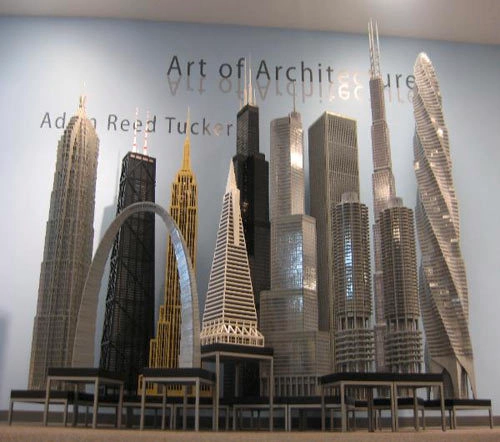
Growing up, LEGO were a staple of most children’s playtime activities to create anything from a house to an entire city for hours at a time. The blocks were so captivating that it seems that even as we outgrow our childhood years, we can never outgrow the toys. Previously, we’ve featured projects that have shown James May’s LEGO addiction…his actual house is built from LEGOs! Yet, May isn’t the only one to still show an interest in the children toys – architect Adam Reed Tuckerhas created 15 large scale buildings from around the world just using the blocks. The buildings are the focal point of the exhibition LEGO® Architecture: Towering Ambition at the National Building Museum in Washington, DC.
Brent Vander Werf’sCompliant Shading Enclosure creates a movable mechanism within the air-gap of a glass enclosure to regulate the amount of sun, shade and shadow permitted in a space. Powered by the energy from the sun, the mechanism passively expands or closes to make the opening the correct size to meet the desired comfort level.
Set for completion this October, NORD Architecture’s Shingle House will be part of the Living Architecture vacation houses, a project aimed to enhance the public’s appreciation of architecture. For their project, the young practice responded to the site’s strong winds and incorporated a modern take on the typical shingle homes that are scattered across the area.
More images and more about the home after the break.
During the post-WWII era, the surge in the housing market often resulted in “faceless” suburban communities that sprang up to relieve the immediate need for housing. The cities maintained their cultural identity and rather than the suburbs infusing their new communities with commercial or cultural entities, the suburbs constantly relied on the city’s proximity for such things. As this old model is highly unsustainable and car dependent, Christoph Vogl from Cheungvogl has studied Long Island’s suburbs, in particular Hempstead, that did not grow as independent communities. He has outlined a master plan of what can be done to give Long Island the social, cultural and economic context it needs.
“Very much representing these observations, the so-thought town centres of Long Island’s communities, placed around the major traffic intersections are not occupied by cultural, commercial and social institutions, as expected from the ratio of communal identity and urban context, but by parking lots. Not some, but hectares of paring lots. Not complaining about the non-existence of urban context and real community, these vacant areas around Long Island’s “Cross roads” offer the unique chance for master planning based reconsideration of the meaning of community,” added Vogl.
Check out the steps of the master plan after the break.
Residents are hopeful that Foreign Office Architects (FOA)’s first museum design (and the firm’s first major US building) will help Cleveland’s urban-revitalization project move forward. Farshid Moussaviof the FOA London has designed a geometric volume that dominates the Uptown area’s site, creating a bold icon for the new Museum of Contemporary Art. Prior to this, the MOCA rented a 23,000 square feet of space on the second floor of the Cleveland Play House complex, but with this 34,000 sqf new home, the museum will be able to showcase a bigger selection and accommodate more visitors.
More images, a cool video, and more about the project after the break.