

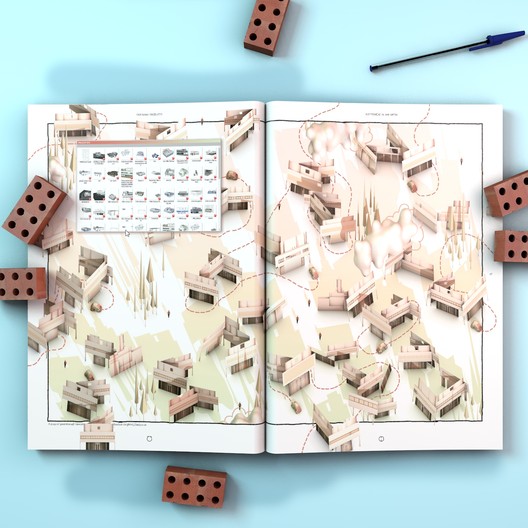
Why do we build? How do we build? Who do we ultimately build for? These have been questions that have dominated the worlds of both practice and pedagogy since the early ages of architecture. On a basic level, those questions can be answered almost reflexively, with a formulaic response. But is it time to look beyond just the simple why, how, and who?
In a world where the physical processes of architecture are becoming increasingly less important and digital processes proliferate through all phases of architectural ideas and documentation, we should perhaps be looking to understand the ways in which architects work, and examine how we can claim the processes—not just the products—of our labors.
Curtis Roth, Associate Professor at the Knowlton School of Architecture, recently published his book Some Dark Products after completing research as a fellow of the Akademie Schloss Solitude in Stuttgart, Germany. His book focuses on the labor of the design process, arguing that "the work of architecture is actually a work of architecture," and how that ultimately causes architecture to appear in the world. “Architects tend to think of authorship as something in the mind, when it is actually a bodily process,” according to Roth. “But how do we author the networks of our labor? We stake a claim to the drawing and the final production, but what about the in-between? The BIM process? The spatial products?”


.jpg?1521494117 "Architecture's \"Dark Products\": What Do Architects Claim Ownership of in the Design Process?")
.jpg?1521494139 "Architecture's \"Dark Products\": What Do Architects Claim Ownership of in the Design Process?")


