Once confined to the aerospace and automotive industries, composite materials have taken on an increasingly central role in contemporary architecture. By combining two or more components, such as fibers and polymers, they offer lightness and strength, high durability, formal freedom, and enhanced environmental performance. Their incorporation into architectural practice marks a profound transformation in how we design, fabricate, and inhabit space.
With composites, it becomes possible to conceive lighter, more expressive, and more efficient buildings or parts, exploring fluid surfaces, large spans, and complex geometries with minimal waste and reduced maintenance, expanding the boundaries between structure and expression. The following case studies illustrate how architects and engineers are translating this material revolution into reality, in a field where digital design meets high-performance fabrication:
Lightweight Skins and Structural Envelopes
Among the most promising applications of composites in architecture are façades. Lightweight and moldable, they allow for the creation of continuous, curved, and three-dimensional surfaces with millimetric precision, significantly reducing both structural load and installation time. In addition to offering high mechanical strength and corrosion resistance, they require little maintenance and can incorporate thermal or acoustic insulation directly into the system.
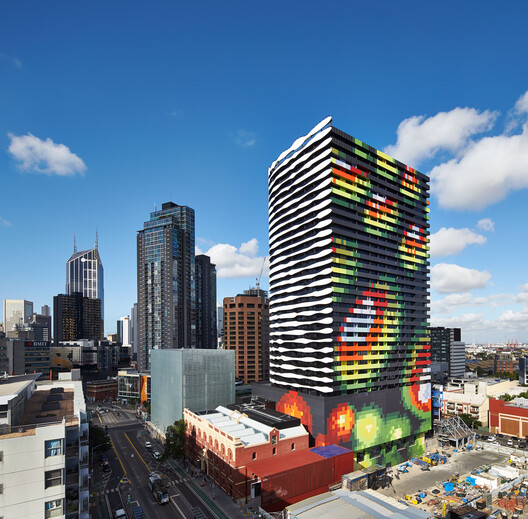
In Melbourne, for example, the Swanston Square Apartment Tower transforms material precision into public art. Its colorful façade, composed of more than a thousand unique glass-fiber-reinforced polymer (GFRP) panels, forms a vast pixelated portrait visible across the city. Beyond its striking visual effect, the modular system reduces weight, simplifies installation, and resists corrosion in the urban climate, showing how composites can unite industrial efficiency with symbolic expression.
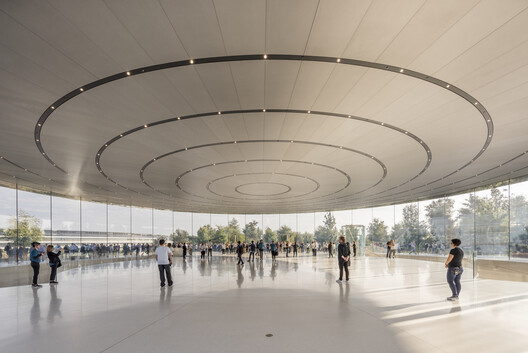
At the Steve Jobs Theater, designed by Foster + Partners within the Apple Park campus in Cupertino, this integration of material and technology reaches another level. Its circular roof (a carbon-fiber canopy weighing about 80 tons and spanning over 40 meters) rests on a continuous ring of structural glass, with no columns or visible connections. The lightness and rigidity of the composite allowed for extreme transparency and the elimination of conventional supports. The result is a fluid and precise spatial experience, where technology dissolves into materiality, embodying Apple's characteristic elegance and technical rigor.

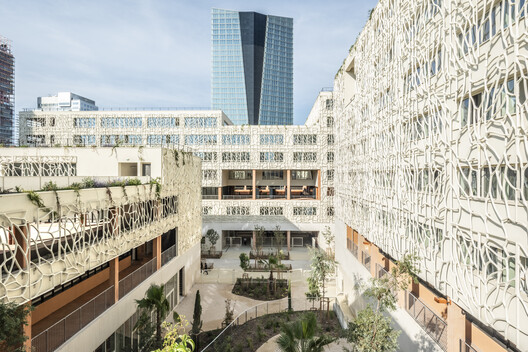
At the Cité Scolaire Internationale Jacques Chirac in Marseille, lightweight composite panels produced through a closed-mold process with polyester resin (RTM) enable large spans with minimal structure, maximizing natural light and maintaining thermal comfort while creating a dynamic and organic-shape façade pattern. In Miami, the One Thousand Museum by Zaha Hadid Architects takes these principles to the urban scale. Its fluid exoskeleton was shaped using composite molds that enabled high-performance concrete to achieve extraordinary precision. Here, composites act not as visible elements, but as invisible facilitators, transforming formal complexity into constructive feasibility.

Pavilions and Urban Infrastructure
Temporary structures and landmark buildings also often serve as laboratories for material experimentation. Due to their lightness, strength, and moldability, composites make it possible to create sculptural, dynamic forms that would be unfeasible with conventional materials. In pavilions and symbolic works, these systems provide formal freedom, modularity, and rapid assembly, paving the way for a new generation of expressive and technologically advanced architectures. Beyond their aesthetic potential, composites have also proven valuable in public infrastructure, where durability, modularity, and low maintenance are key.
At the United Arab Emirates Pavilion for Expo 2020, designed by Santiago Calatrava, 27 carbon-fiber wings open and close like a falcon's feathers. The system combines lightness and movement, with each element weighing only a fraction of its steel equivalent. The project illustrates how composites can translate cultural identity into architectural kinetics, merging structural performance with formal poetry.
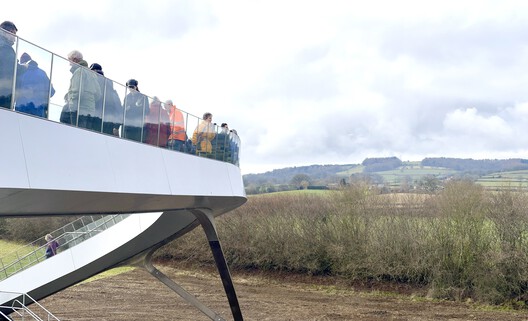
The Network Rail Flow Footbridge in the United Kingdom offers a glimpse into the future of public works. Modular fiber-reinforced polymer (FRP) components are prefabricated off-site, transported, and rapidly assembled with minimal disruption. Unlike traditional steel bridges, composite structures resist corrosion, require no periodic painting, and offer reduced life-cycle costs. Their lightness also allows for more slender supports and designs that integrate seamlessly into the urban landscape.
Research and Experimental Architecture
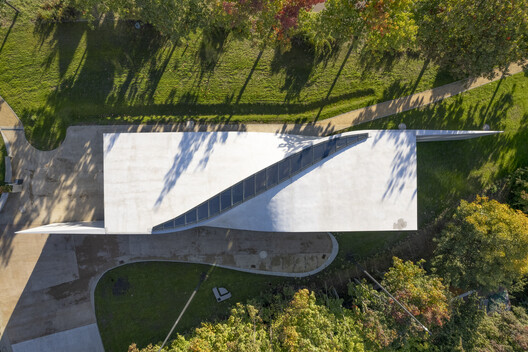
Some of the most radical composite innovations emerge from research environments, where architecture meets material science. The Carbonhaus at the Technical University of Dresden stands as a milestone in this field. Developed from studies of carbon-fiber-reinforced textile concrete, it replaces traditional steel reinforcement with carbon fibers. The result is a structure four times lighter and five times more durable than conventional concrete, without any risk of corrosion. Its thin shells and sweeping cantilevers point to a future in which form is freed from material weight.
The Caerostris Wall-e prototype explores the possibilities of pultruded glass-fiber-reinforced polymer (GFRP). Developed as a modular vertical panel system, it uses glass-fiber composite profiles produced through pultrusion, which is a continuous process that gives components high strength and dimensional stability while keeping them lightweight and slender.
Looking Ahead: JEC World and the Future of Composites
Events such as JEC World are essential to understanding the next chapter of composite architecture and other fields. Held annually in Paris, the world's largest composites fair brings together experts from more than 100 countries and functions as a global innovation hub where material science meets design culture. For architects, it offers direct access to emerging advances in the field, with demonstrations of thermoplastic forming, large-format additive manufacturing, and multi-material hybrid systems revealing how these technologies can shape the built environment and expand what building components can do and how they can be produced and assembled.

As construction industry evolves, JEC World has become a forecasting platform that identifies trends and showcases scalable applications. It opens pathways for collaboration and helps translate cutting-edge research into architectural practice, highlighting the cultural and spatial possibilities composites unlock from high-performance façades to modular infrastructure and regenerative systems. In this context, composites represent much more than substitutes for steel, glass, or concrete: they introduce a new design paradigm in which digital logic, material performance, and fabrication innovation converge. As sustainability demands and formal ambitions continue to evolve, such events will play an increasingly decisive role in expanding the horizon of composite architecture and shaping more efficient, expressive, and durable buildings.
Discover the latest innovations, projects, and sustainable materials at JEC World 2026, the leading global event dedicated to the composites industry.


