

The practice of combining materials to achieve better performance has accompanied humanity since the earliest constructions. One of the first known examples emerged over five thousand years ago, when civilizations in Mesopotamia and Egypt mixed mud and straw to mold sun-dried adobe bricks. Light and fibrous, straw prevented cracking and increased strength, while mud acted as a binder and protection. This simple yet ingenious invention can be considered the first composite in history, illustrating the ancestral intuition that distinct materials, when combined, can become something stronger and better.
The so-called modern era of composites began to take shape in the twentieth century, driven by advances in chemistry and materials engineering. In 1905, Belgian chemist Leo Baekeland created the first synthetic composite, Bakelite, by combining plastic with wood flour or asbestos fibers. Heat-resistant and electrically insulating, the material quickly found applications in household items, electrical components, toys, and records. Three decades later, in 1936, DuPont developed fiberglass, formed by bonding glass filaments within a plastic matrix, a lightweight, strong, and versatile material capable of replacing wood and metal. During World War II, fiberglass became essential for producing boats, airplanes, and fuselages, and by the 1950s it was widely adopted in the automotive industry and, gradually, in construction. This trajectory marked the beginning of composite materials on an industrial scale, paving the way for the vast field of innovation that now reaches architecture.
At their core, composites are materials made by combining two or more distinct components that remain separate at the microscopic level but work together to create a new material with superior performance. A matrix (usually a polymer resin) acts as the binding and protective element, while the reinforcement (often glass, carbon, aramid, or even natural fibers) provides strength and stiffness. This synergy results in materials that are stronger, lighter, and more durable than conventional ones. In architecture and construction, composites open new possibilities for design. Their lightness and strength allow larger spans with less material, while their malleability enables continuous, curved surfaces that merge structure and cladding. Unlike steel or concrete, composites can be tailored to specific mechanical, thermal, or acoustic properties, an innovation that allows architects to design from performance rather than just from form.
Composites also offer practical benefits that directly impact construction efficiency. Their lightweight nature significantly reduces loads on foundations and simplifies handling and transport, leading to faster on-site assembly and lower installation costs. Prefabricated composite components can be installed with minimal equipment, shortening construction schedules and minimizing disruption in dense urban areas. Once in place, their corrosion and fatigue resistance translate into lower maintenance requirements and longer service life, especially in harsh environments such as coastal or industrial zones.
Types and Applications in Construction
The main groups used in construction include FRP (Fiber-Reinforced Polymer), which combines synthetic fibers with polymer resins; GFRP (Glass Fiber Reinforced Polymer), made with glass fibers; CFRP (Carbon Fiber Reinforced Polymer), based on carbon fibers; and bio-composites, which use natural fibers and bio-based resins.
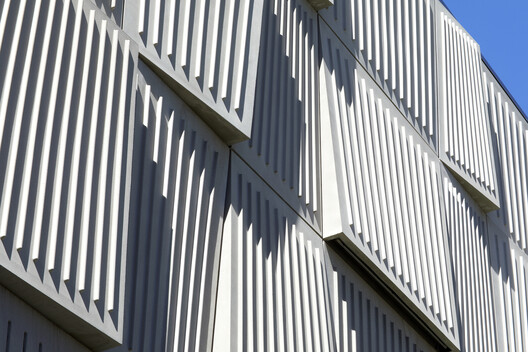
Each category offers specific advantages depending on the fiber and matrix employed. GFRP, made of glass fibers embedded in resin, combines high mechanical strength, low weight, and excellent durability, as well as resistance to humidity and corrosion. It is easily molded, relatively inexpensive, and widely used in ventilated façades, translucent roofs, skylights, modular panels, and decorative elements, offering both design freedom and structural lightness. CFRP, in turn, delivers superior stiffness, dimensional stability, and fatigue resistance compared to GFRP, with even lower density. It is ideal for bridges, pedestrian walkways, structural shells, elevated crossings, and concrete reinforcements, especially when weight reduction is critical without compromising performance. Beyond its strength, CFRP exhibits linear elastic behavior and excellent resistance to aggressive environments, making it widely employed in structural strengthening and retrofit systems, extending the lifespan of bridges and historic buildings with minimal visual impact.
Bio-composites are also emerging as a next-generation alternative, combining technical performance with low environmental impact. They use natural fibers, such as flax, hemp, jute, cellulose, or bamboo, and bio-based resins, of plant or recycled origin. Although they have lower strength compared to synthetic composites, these materials offer a high strength-to-weight ratio, thermal and acoustic insulation, partial biodegradability, and a natural aesthetic, making them ideal for interior cladding, acoustic panels, urban furniture, and parametric surfaces. Their production also requires less energy and can contribute to circular construction cycles, bringing technological innovation closer to ecological principles.
Manufacturing Processes and Performance
Composites are made possible by advanced manufacturing techniques that provide rigorous control over form and performance. Processes such as resin transfer molding (RTM), pultrusion, filament winding, and vacuum infusion allow for the production of components with complex geometries, optimized thickness, and precise fiber distribution, maximizing strength while minimizing weight. Pultrusion, for example, is ideal for linear profiles such as beams, columns, and structural panels, while filament winding is widely used for tubes, tanks, and cylindrical shells. Vacuum infusion makes it possible to mold large, seamless surfaces like canopies and architectural panels with excellent finish and minimal porosity.
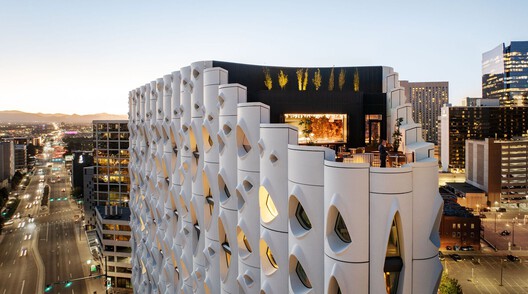
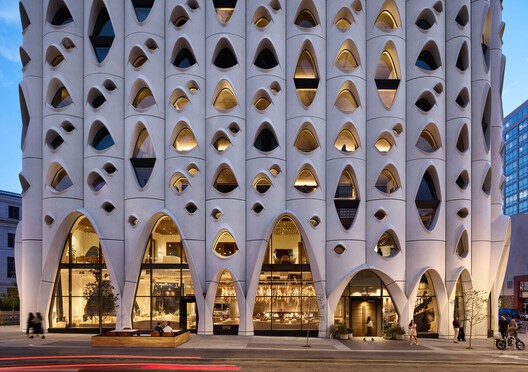
Unlike traditional construction, these techniques are additive, precise, and low-waste, allowing the creation of customized components at industrial scale and the integration of multiple functions into a single element. When combined with digital modeling, structural simulation, and robotic fabrication, these technologies bring concept and construction closer than ever before, enabling forms, textures, and structural solutions that would be impossible in steel, concrete, or wood.

A Global Network of Innovation
Behind this material evolution lies a dynamic global ecosystem, and JEC plays a central role in connecting its key players. Through digital platforms, publications, and international events, it promotes collaboration between researchers, manufacturers, and architects, accelerating innovation worldwide. The organization's flagship event, JEC World, held annually in Paris, is the largest international gathering the entire value chain of composites materials. The event showcases projects, technologies, and research shaping the future of industries such as aerospace, energy, mobility, and, increasingly, architecture and construction. For architects and designers, JEC World offers a unique opportunity to discover real-world applications of composites and connect with the professionals, engineers, and scientists shaping the future of material innovation.
The evolution from mud, stone, and steel to composites shows that every generation redefines its materials to meet new challenges. Today, composites embody that same spirit of innovation merging science, sustainability, and design freedom to once again expand the possibilities of architecture and respond to the complex challenges of our time through technology. Beyond new aesthetic and structural possibilities, these materials enable smarter, faster, and more efficient ways to build, where performance, precision, and sustainability work together from concept to construction.
Discover the latest innovations, projects, and sustainable materials at JEC World 2026, the leading global event dedicated to the composites industry.


