Hokkaido-born Sou Fujimoto’s breakout masterpiece, the playful and cloud-like 2013 Serpentine Pavilion says a lot about who Fujimoto is and how he thinks about architecture. But even more so do the 100-plus sometimes painstakingly refined, sometimes roughly executed exploratory models that dot the minimalist gallery space of Japan House Los Angeles. This, his retrospective show, Futures of the Future, neatly reflects on Fujimoto’s career, which began when he opened his own Tokyo-and-Paris-based firm in 2000.
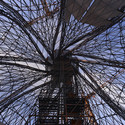
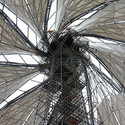
Now nearing completion just outside Santiago, Hariri Pontarini Architects' Bahá'í Temple of South America is currently one of the most significant religious construction projects in the world. In this article, originally published by Metropolis Magazine as "Sacred Structure," Guy Horton relates how - despite being in progress for almost a decade already - the design has changed remarkably little from the initial design sketch, using the latest technology to create a spiritual and emotional space.
For the last few years, in the Andean foothills just outside Santiago, Chile, a mysterious orb-like structure has been slowly rising under construction cranes. The new Bahá’i Temple of South America will be the first of its kind on the continent when it opens in 2016. It has been a historic journey for the Bahá’i faith in this part of the world—Bahá’i first arrived in Chile in 1919—and a patient journey for the architects, engineers, and builders who have brought the temple to life through a decade-long process of innovation.
Among the vast coverage of 3D printing in the media, the technology is frequently cited as the 'future' of production, focusing on its ability to bring new things into existence quickly and cheaply. But does 3D printing have to be all about the future? As this article originally printed by Metropolis Magazine as "3D Printing Saves a Frank Lloyd Wright Treasure" attests, 3D printing also has something to offer to the past; specifically, to a deteriorating Frank Lloyd Wright building whose 'textile block' was simply too complex to restore through any other modern techniques. Read on after the break to find out how this high-tech rescue mission is being achieved.
Did you know a 51-mile river runs through the city of Los Angeles? It might not be immediately recognizable as a river, but it's there. In a drastic attempt to prevent flooding in the early 1900s, the Army Corps of Engineers essentially turned the entire river into a giant drainage channel by encasing it in concrete. This article, originally posted on Metropolis Magazine, investigates landscape architect Mia Lehrer's vision to remedy the situation by transforming the desolate space into a public greenway, and a celebrated feature of Los Angeles.
From the offices of Los Angeles–based landscape architect Mia Lehrer, located near the western edge of Koreatown, you might not even know that Los Angeles has a river. It’s not visible from here — instead we can see other things L.A. is known for: the Hollywood sign, traffic, billboards, a dense urban grid that runs forever. In fact, unless you are right up against it, you may not see the river at all. In its current form, it sits as the abandoned, Brutalist evidence of the city’s past battles with seasonal flooding, an expedient way to move water quickly to the sea. To many, it’s more like an urban-design crime scene of missed opportunities and missteps, begging to be corrected. If Lehrer has her way, it will be corrected so that Los Angeles, the city with the huge drainage channel, becomes Los Angeles, river city.
Last year, I wrote about doing away with the title “intern,” saying the word “should be banished from the profession.” The post, titled, No More Interns, caused quite a flurry of responses, some quite angry, in fact. Some respondents defended the title, saying a title is just a title; others launched attacks against it, saying it connotes someone unskilled or untrained.
For the record, I still think we should get rid of it — not simply because it is demeaning and diminishing to individuals who have gone through the rigorous educational stages of the profession, but because it makes the profession look antiquated. Think about where you find “intern” used today and what it generally implies: volunteer, unpaid/low-paid, student, temporary, trainee, to name a few. Imagine how clients from progressive business cultures view it. Also, from the standpoint of business, doesn’t it make sense that people would pay more for architecture not done by “interns”? I would pay more for “associates.”
First off, I would like to thank Patrik Schumacher for taking to Facebook on March 17 at 9:45pm to let off steam -- thus starting a meaningful discussion on the role of the architect in society and culture. We could deconstruct it line by line, but I don’t think that will yield much in the way of enlightenment. What I take from it is that architecture creates form and should be free to do so without being restricted by ethical or moral imperatives to be social or political. But, as Benjamin Bratton remarked in reply to Schumacher, “To set the political to one side and at the same time make grandiose claims for how architectural form can in fact ‘remake civilization’, is a self-defeating program.”
Perceptions on the role of architecture in society can easily fall along class, race, and national lines. Coming from a place of privilege, it is easy to assume an apolitical, form-making agenda for the profession. The argument that architecture has nothing to do with the social domain, or the “content” as Schumacher calls it, is an argument for political conservatism, a hands-off, sink or swim argument for social Darwinism, that limits the range and impact of high architecture. Why can’t the best and most challenging forms of architecture penetrate through all social strata? Why shouldn’t it serve the poor? And why shouldn’t this be one criteria among others for judging the value of architecture?
Qatar says the World Cup projects are “on track,” but the International Trade Union Confederation (ITUC), which has been investigating worker deaths in the Gulf Emirate for the last two years, vehemently disagrees. To date there have been 1200 worker deaths associated with the on-going World Cup projects. A scathing report, issued by the ITUC on March 16, claims that unless significant improvements are made to working conditions on World Cup-related sites at least 4000 more migrant construction workers could lose their lives. This would mean that those construction sites are “on track” to kill 600 workers per year, or at least 12 per week until the ribbons are cut and the fireworks are set off.
At a FIFA executive committee meeting held in Zurich on March 20, FIFA president Sepp Blatter stated, “We have some responsibility but we cannot interfere in the rights of workers." Likewise, local FIFA organizing committee in Qatar says workers are not their responsibility. Zaha Hadid said the same.
However, given the increasing chorus of headlines along the lines of “The Qatar World Cup is a Total Disaster” they may have to say something stronger on the issue at some point — or have the image of their architecture tarnished. Of course we all know that what they mean is that legally it is not their responsibility. But does that mean they should be sitting back, not even attempting to influence change?
Get all the facts on the situation of the Qatar construction workers, after the break…
Zappos is one of the biggest companies to function as a ‘holocracy’ (without a fixed staff hierarchy). Their Las Vegas headquarters utilizes communal furniture to increase team-based collaboration (according to Business Insider, ‘desks are linked but can be easily disconnected or moved, the walls are movable as well. So if a team needs to work a different way, or a new product team is formed, the space can be changed, and changed again until it works’). Image Courtesy of Zappos, via OfficeSnapshots.com
What can architecture learn from Zappos? Yes, we’ve all heard about vegan cafés, yoga rooms, playing commando games indoors, and wearing Crocs in the office, but - more importantly - Zappos is transforming office culture in a meaningful, far-reaching way: it’s put an end to staff hierarchy.
According to The Washington Post, Zappos is the largest company to have adopted the Holocracy principle, the brainchild of software entrepreneur-turned-management-guru Brian Roberston. Guru would be the right word because, at first glance, and maybe second or third glance, Holocracy does come off as somewhat of a cult, albeit a business management cult. It creeps me out just a little bit, but having pushed through their website, I feel a little better now, not in the least like I’ve been L. Ron Hubbarded.
In a Holocracy, authority and responsibility are distributed across an organization in a way that is more goal-centered. As they say, “Everyone becomes a leader of their roles and a follower of others.” Still not making any sense? Old hierarchies that rely on “leaders” at the top, “followers” at the bottom, and “managers” in the middle are done away with completely. So, no more “bosses.” No more “staff.” No more “junior designer” or “senior designer.”
Zaha Hadid Architects' design for al-Wakrah stadium, the main stadium for the 2022 Qatar World Cup. Image Courtesy of ZHA
Zaha Hadid’s unfortunate comments in response to worker deaths on construction sites for the 2022 World Cup has made Qatar the eye of a storm that has been raging globally for decades. But it’s not just about Qatar. This has been an issue for as long as there have been construction sites and for as long as poor people have swarmed to them for a chance at a better life.
Construction booms and migrant construction workers have always been two sides of the same equation, both dependent on the other, and, by the twisted logic of the global economy, both are the reason for the other’s existence. No migrant labor pool = no global city = no fantastic architecture, or something to this effect.
The migrant workers are the silent collaborators in global architecture, the invisible, faceless, “untouchables” who make the cost-effective construction of these buildings possible.
Whenever I see sensational exposes on the supposedly sublime spatial intensity of Hong Kong’s Kowloon Walled City (demolished in 1994), they strike me as nothing more than colonial fantasies that have little to do with the reality of living in the midst of one of the world’s cruelest slums. You see the Walled City pop up constantly like it’s still a valid or even interesting subject. This informal settlement has been diagramed, photographed, and written about for decades from an aesthetic point of view, rendering its victimized and oppressed inhabitants all but invisible. Not to say that this wasn’t home to a lot of people and that no “fond memories” were formed there, but still, like all slums, it was a tough place to live, fraught with contradictions in the haze of hope for a better life.
The Folk Art Museum is most certainly doomed; it may have been doomed from its first appearance. Designed and built to endure, it will soon dissipate in a fog of demolition and fading memory, its lifespan ultimately briefer than a McDonald’s franchise. Looks aren’t everything, I guess.
This raises a lot of questions about permanence, memory, and the spatial character of cities. If The Folk were not in New York, would its status as a landmark building still hold? A particularly New York type of building, more front and slot, it’s a building that is about the street as much as it is about an interior world beyond that street. And losing it will mean West 53rd will be wrought more mega in scale and commercial in vision.
Photograph of the Division of Classification and Cataloging, 1937. Image Courtesy of Wikimedia Commons, the National Archives and Records Administration
You see it all the time. You walk into a firm and there, in the often open hangar-like space, you see a sea of people at their computers with headphones on, attempting to maintain their own sense of space in the face of pervasive distractions and the constant white noise of the studio environment. While it can be inspiring to see and hear everything that is going on in a creative office, and while it is healthy to engage co-workers, there are times when people need to “tune out”. But the space of headphones can not equate the true space of being alone and quiet.
Things at Architecture for Humanity were shaken up with the departure of co-foundersCameron Sinclair and Kate Stohr. Resiliency became the new sustainability. China suddenly became defined less for its adventurous architecture and urbanism and more for its darker, smoggier flipside. My hometown, Los Angeles got a few more bike lanes, some big plans for its concrete river, plus a new Bloomberg-esque mayor with attendant sustainability tsar. There were people complaining about architecture and telling us why they left the profession. Kanye got attacked for daring to tell us why he likes architecture, and then architecture loved talking about Kanye for weeks on end until we just wanted architecture to shut up about Kanye. Poor Kanye. There are so many things we could say were key in 2013. It’s been a great year. And there were also a lot of fantastic buildings.
Architectural street gang and provocateurs, On the Road, named (I would like to think anyway) for Jack Kerouac’s novel of same name, and let’s just say that is the origin (since I happen to like that book), and the decentralized dérives of this Los Angeles crew remind me of Jack’s edit-as-you-go-or-do-not-edit-as-it-may-be writing style, if he even had a “style” (which is questionable), are at it again, or were just last month for their program, “West of LaBrea / 20131117 / 10-4pm” in which these rebellious, anti-establishment “architects” (some may not be licensed and therefore cannot actually go by the official title according to legal precedents in this here United States of America but you all know what I mean wink wink) once again find themselves out in the streets bombing the architectural establishment, which by the way is critical for the history of Los Angeles architecture, and by doing so have once again reminded us that architecture can be about play and a healthy dose of transgression, though no laws were broken during the making of #OtR3, as it is being called, that I can tell....
And secrets they must be because Kemp’s little company, Digital Physical, has kept under the radar, housed away in some nondescript loft space in Los Angeles. What Mr. Kemp and his bearded acolytes have developed is something so simple, so obvious, and yet utterly revolutionary. It’s one of those inventions that all architects are soon going to realize they need - and clients will soon start to expect.
Robert Miles Kemp is going to be one of 2014’s Innovators of the Year. Mark my words. If I worked for Autodesk, I’d be calling him up right about now - or at the very least trying to steal his secrets.
The “it” is Spacemaker VR, architecture’s first virtual reality system made for designers. Yes, you have to wear a VR headset, but you won’t care if you look like a dork because you (and your big clients) will be blown away by the fact that you’re looking, flying around a 3D model of a future-space - all while being firmly in the present.
We all know what architecture critic Banksy thinks about 1 World Trade Center. He infamously called it a “shyscraper” in an op-ed piece the New York Times declined to publish. But that hasn’t stopped the article from circulating and pissing New Yorker’s off. In true Banksy form you can find it on his website, mocked up to appear like a front page headline.
In it, he writes, “It reminds you of a really tall kid at a party, awkwardly shifting his shoulders trying not to stand out from the crowd. It’s the first time I’ve ever seen a shy skyscraper.” Of course, this didn’t stop the Council on Tall Buildings and Urban Habitat (CTBUH) from recently celebrating it as the tallest building in this here United States of America. Yippee ki-yay!
But- who cares? New York has many other things going on urbanistically and architecturally that render tallness less significant than it used to be, if not outright pointless. Infrastructural interventions of the more horizontal sort, a la the High Line for example, seem far more significant. In the face of real urban complexity and uneven development, grasping for tallness is a simplistic go-to, while the real problems remain down on the street, unrelated to air rights, view corridors, sunlight access angles, and blocked horizons.
And yet cities of the world continue to privilege tall towers as icons of economic and political might.
Christine Outram’s rant “Why I Left the Architecture Profession” is an honest and seemingly spontaneous attempt at staking out a position against an “outdated” profession. It’s explosive in its assertion that “you,” meaning all you architects, are out of touch. “You” don’t listen to your clients. “You” are obsessed with form-making. “You” are a soulless machine, designing by code templates and cut and paste, with no regard for humanity. Her essay hits like a splatter bomb, throwing shrapnel in all directions. It’s a drone strike that has killed innocents. It’s clumsy and reckless.
It begs to be deconstructed. It demands a counterattack. And, judging from the lengthy comment thread, this is what it has reaped. Be that as it may, the issues are obvious. Telling architects they are “outdated” or that they don’t listen seems like a calculated attempt to get the attention of architects and to get them to somehow prove themselves, to make them mad in ways equal to her own anger.
On October 23rd, the Walt Disney concert hall, the project that almost never was, will celebrate its ten-year anniversary. Throughout these ten years it has had all manner of transformative power attributed to it. But has it really transformed LA? What would the city have been like if it had never been built? Would it be fundamentally different?
The answer? No.The city wouldn’t even be that different in the immediate vicinity of Grand Avenue.



.jpg?1542548128)



.jpg?1542548128)