Andrew Kroll
AD Classics: Berlin Philharmonic / Hans Scharoun

© Courtesy of Wikimedia Commons

Hans Scharoun is a well known German architect best known for his design of the Philharmonic concert hall in , .  Completed in 1963, Scharoun’s organic and futuristic aesthetic interpretation for the concert was a replacement for the previous Philharmonic that was destroyed in WWII.  Scharoun’s design was fairly straightforward that focused on placing music at the center of his design, both conceptually and physically. From the center, the music would be amplified and filtered throughout the auditorium.

More on the Berlin Philharmonic after the break.

AD Classics: Kunsthaus Bregenz / Peter Zumthor

© Courtesy of Wikimedia Commons

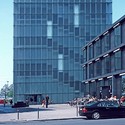
A year after the completion of Therme Vals [1996], renowned minimalist architect, completed the design of Kunsthaus Bregenz [1997].  The Kunsthaus museum in Bregenz, is always in a constant state of flux always changing its exhibition spaces to accommodate international contemporary art.  Zumthor’s minimalist design adapts its spaces to the art that is showcased in its exhibits creating a coexisting and redefining relationship between art and architecture.

The Kunsthaus Bregenz has two main principles to their permanent collection: archives of art architecture and a collection of Contemporary art, which complements the changing exhibition spaces.  The museum strives to be the intersection of art and architecture that opens itself to culture and international influence.

More on the Kunsthaus Bregenz after the break.

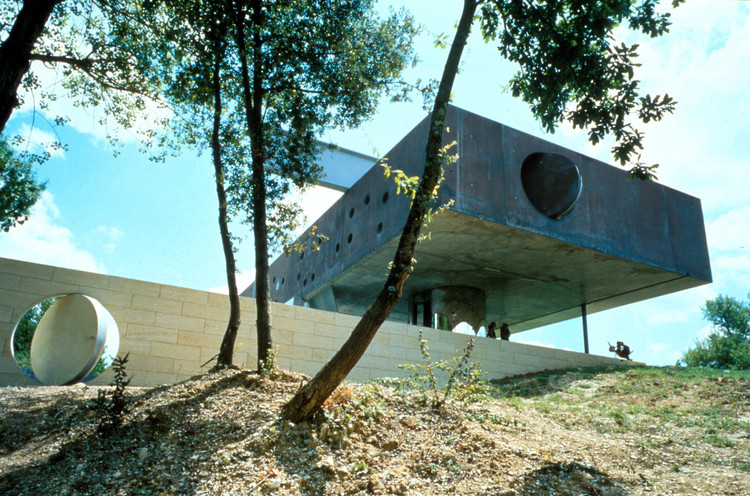
AD Classics: Maison Bordeaux / OMA

© Hans Werlemann, courtesy

With the ability to make even the simplest and straightforward programs spatially dynamic and in a constant state of redefinition, Rem Koolhaas and his firm OMA have redefined the term that “a house is a machine for living” in their design of Maison .  Completed in 1998, Maison sits on a small cape-like hill overlooking the city of .

The house was designed for a couple and their family, but before Koolhaas and OMA were commissioned for the project in 1994 the husband of the family was in a life threatening car accident that left him paralyzed from the waist down.  Two years after his accident, the couple approached Koolhaas to design them a new home outside of Bordeaux.  Despite having been paralyzed, the man did not want t straightforward house rather he wanted a complex design, stating: “Contrary to what you would expect. I want a complex house because the house will define my world.”

More on the Bordeaux House after the break.

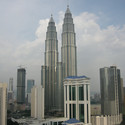
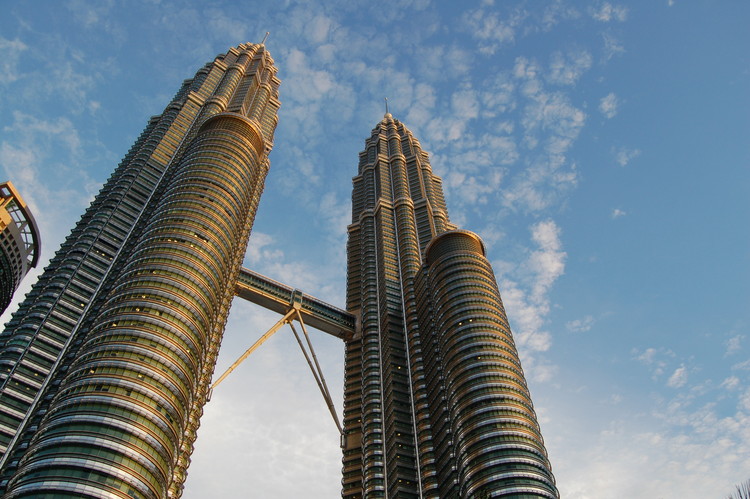
AD Classics: Petronas Towers / Cesar Pelli

Courtesy of Wikimedia Commons

Once considered the tallest building[s] in the world from 1998 to 2004, the Petronas Towers designed by Cesar Pelli stand as a cultural and architectural icon in Kuala Lumpur, .  Completed in 1998, the Petronas Towers are a reflection and homage to the dominant Islamic culture of .

More on the Petronas Towers after the break.

AD Classics: Lovell House / Richard Neutra

Courtesy of Wikimedia Commons

The 20th Century was one of the most inspiring and progressive centuries for the discipline of architecture; was one such contributor that has left his mark on modern architecture with his advancement of residential design.  Prior to the Kaufmann House, Neutra design the Lovell House for Philip Lovell and his family in Los Angeles, between 1927-1929.  The Lovell House was the turning point in Neutra’s career, putting him on the architectural radar.

More on the Lovell House after the break.

AD Classics: Kaufmann House / Richard Neutra

© Thom Watson

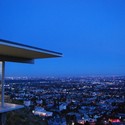
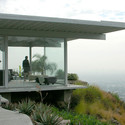
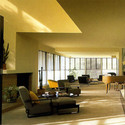
One of the most important architects of the 20th Century, yet often overlooked, has been on the forefront of modern residential architecture.  After moving to the United States from Vienna, Austria in 1923, Neutra worked with Frank Lloyd Wright and Rudolf Schindler until 1930 when he started his own practice.  One of Neutra’s several iconic projects is the Kaufmann House in Palm Springs, .  Completed between 1946-1947, the Kaufmann House was a vacation home for Edgar J. Kaufmann Sr. and his family to escape the harsh winters of the northeast.

More on the Kaufmann House after the break.

AD Classics: Igualada Cemetery / Enric Miralles & Carme Pinos

© Andrew Kroll
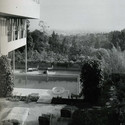
As part of a competition to replace an older cemetery, Enric Miralles and Carme Pinos envisioned a new type of cemetery that began to consider those that were laid to rest, as well as the families that still remained.  After 10 years of construction, the Igualada Cemetery, outside of Barcelona, Catalonia, , was completed in 1994 as a place of reflection and memories.

The Igualada Cemetery is a project that challenges the traditional notions of what makes a cemetery.  Miralles and Pinos conceptualized the poetic ideas of a cemetery for the visitors to begin to understand and accept the cycle of life as a link between the past, present, and future.  It’s understood by the architects to be a “city of the dead” where the dead and the living are brought closer together in spirit.  As much as the Igualada Cemetery is a place for those to be laid to rest, it is a place for those to come and reflect in the solitude and serenity of the Catalonian .

More on the Igualada Cemetery after the break.

AD Classics: Kunsthal / OMA

© Flickr User: Kleiobird

Arguably one of the most spatially innovative architects in the world, Rem Koolhaas, and his firm OMA, designed a cultural staple in the city of .  Completed in 1992, the Kunsthal, in the Museumpark neighborhood of , is more of a cultural center that it is a museum.  Dubbed as a collection-less museum, the Kunsthal is a compilation of several galleries and halls that allow for maximum flexibility and accommodate a multitude of exhibitions and activities that can coexist singularly or collectively.

More on the Kunsthal after the break.

AD Classics: Parc de la Villette / Bernard Tschumi

© Cyrus Penarroyo

As part of an international competition, 1982-83, to revitalize the abandoned and undeveloped land from the French national wholesale meat market and slaughterhouse in Paris, , Bernard Tschumi was chosen from over 470 entries including that of OMA/Rem Koolhaas, Zaha Hadid, and Jean Nouvel.  Unlike other entries in the competition, Tschumi did not design the park in a traditional mindset where landscape and nature are the predominant forces behind the design [i.e. Central Park].  Rather he envisioned Parc de la Villette as a place of culture where natural and artificial [man-made] are forced together into a state of constant reconfiguration and discovery.

More on Parc de la Villette after the break.

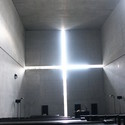
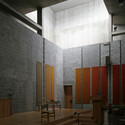
AD Classics: Church of the Light / Tadao Ando

© Naoya Fujii

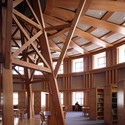
In the small town of Ibaraki, 25km outside of Osaka, , stands one of ’s signature architectural works, the Church of the Light.  The Church of the Light embraces Ando’s philosophical framework between nature and architecture through the way in which light can define and create new spatial perceptions equally, if not more so, as that of his concrete structures.  Completed in 1989, the Church of the Light was a renovation to an existing Christian compound in Ibaraki.  The new church was the first phase to a complete redesign of the site – later completed in 1999 – under Ando’s design aesthetic.

More on the Church of the Light after the break.

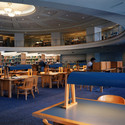
AD Classics: Denver Central Library / Michael Graves & Associates

©

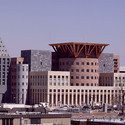
Michael Graves, one of the most respected and original minds of post-modern architecture, was commissioned in 1990 to renovate and design an extension to the Denver Central Library.  Known for his surreal and “entertainment” architecture; Graves’ implemented traditional post-modern motifs of abstracted classical forms, natural materials, and colors commonly found in past centuries.

Sitting adjacent to Daniel Libeskind’s Denver Art Museum, the Denver Central Library stands as the 8th largest library in the United States, as well as the largest library between Chicago and , attracting over a million visitors each year.

AD Classics: Jewish Museum, Berlin / Daniel Libeskind

© Mal Booth

In 1987, the government organized an anonymous competition for an expansion to the original Jewish Museum in that opened in 1933.  The program wished to bring a Jewish presence back to after WWII.  In 1988, Daniel Libeskind was chosen as the winner among several other internationally renowned architects; his design was the only project that implemented a radical, formal design as a conceptually expressive tool to represent the Jewish lifestyle before, during, and after the Holocaust.

The original Jewish Museum in Berlin was established in 1933, but it wasn’t open very long before it was closed during Nazi rule in 1938.  Unfortunately, the museum remained vacant until 1975 when a Jewish cultural group vowed to reopen the museum attempting to bring a Jewish presence back to Berlin.  It wouldn’t be until 2001 when Libeskind’s addition to the Jewish Museum finally opened (completed in 1999) that the museum would finally establish a Jewish presence embedded culturally and socially in Berlin.

AD Classics: Lloyd’s of London Building / Richard Rogers

© Andrew Kroll

After the completion of Centre Pompidou in 1977 with Renzo Piano, was commissioned to design a new building to replace the original Lloyd’s insurance building in .  It would be the second expansion in the history of the company’s headquarters due to the overcrowded conditions of hundreds of people working with international insurance cases.  Completed in1986, the Lloyd’s building brought a high-tech architectural aesthetic to the medieval financial district of that was previous implemented in the design of the Centre Pompidou in Paris.

Since 1928, the site has been home to the Lloyd’s of London; one of the largest insurance firms in the world dating back to the 17th Century.   After it originated in the 17th Century, the Lloyd’s of London has grown from an insurance company dealing from within the United Kingdom to working on a global scale, taking on staff and clientele at an unprecedented rate, which has required several expansions; the largest and most prominent being Roger’s.

AD Classics: Le Grande Louvre / I.M. Pei

© Reji K. A

In 1981, the newly elected French president, Francois Mitterrand, launched a campaign to renovate cultural institutions throughout France.  One of the most advantageous of those projects was the renovation and reorganization of the Louvre.  In 1983 after touring Europe and the United States, President Mitterrand commissioned the Chinese American architect, I.M. Pei.  It was the first time that a foreign architect was enlisted to work on the Louvre museum.

Completed in 1989, ’s renovation redesigned Cour Napoleon, the main court of the Louvre, in order to alleviate the congestion from the thousands of daily visitors.  A new grand entrance provided a convenient, central lobby space separate from the galleries, which provided focal point for the cyclical process of one’s experience through the museum.   In addition to providing a new entrance to the Louvre, Pei’s design featured a new underground system of galleries, storage, and preservation laboratories, as well as a connection between the wings of the museum.  The addition and relocation of the supporting spaces of the museum allowed for the Louvre to expand its collection and place more work on exhibit.

AD Classics: Corbusierhaus / Le Corbusier

© Thomas Lewandovski

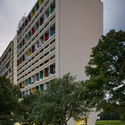
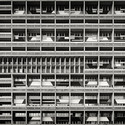
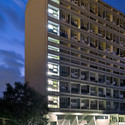
After World War II, post-war Europe was suffering from a lack of housing with many displaced people from the extensive bombing raids.  In response to the housing crisis in Europe, Le Corbusier began delving into designing large scale, communal residences for the victims of World War II. One of the most notable projects in this series was the Unite d’ Habitation in Marseilles, . This project had inspired a continued implementation of the design type across Europe. The fourth building in the series is the Corbusierhaus in Berlin, . Completed in 1959, it was designed as a symbol for the modernization of after the war and the Cold War.

AD Classics: Marina City / Bertrand Goldberg

© Flickr User: TRAFFIK [US
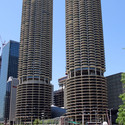
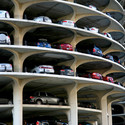
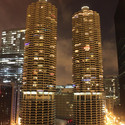
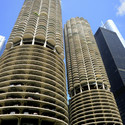
Along the eastern branch of the River lies one of the most formally interesting skyscrapers in all of , Marina City by .  Completed in 1964, Marina City, at the time, was the tallest residential projects in the world and still remains one of the densest inhabited developments.  Unlike any project before it, Marina City was an experiment of allocating diverse programs into a “city within a city.”  Although, it is not as widely recognized as the Sears Tower or the John Hancock Building, Marina City’s distinctive “corn-cob” shape has a strong presence among modern architecture, as well as Chicago’s skyline.
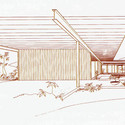
AD Classics: First Unitarian Church of Rochester / Louis Kahn

© Ed Brodzinsky

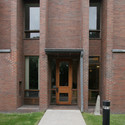
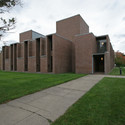
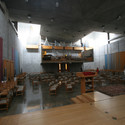
was known for his infusion of culture and creating a sense of place within modern architecture.  Although it may not be as well known as some of his other projects around the world, the First Unitarian Church in , New York is one of Kahn’s most impressive works.  Completed slightly after the Salk Institute in 1967, it replaced their previous church that was designed by Richard Upjohn, founder of the AIA, which was demolished during urban redevelopment in .  The First Unitarian Church combines modern design aesthetic with traditional Unitarian values that promotes community and unites everyone at the heart of the building, the sanctuary.

AD Classics: Unite d’ Habitation / Le Corbusier

© Wojtek Gurak

After World War II, the need for housing was at an unprecedented high.  The Unite d’ Habitation in Marseille, was the first large scale project for the famed architect, .  In 1947, Europe was still feeling the effects of the Second World War, when Le Corbusier was commissioned to design a multi-family residential housing project for the people of Marseille that were dislocated after the bombings on France.  Completed in 1952, the Unite d’ Habitation was the first of a new housing project series for Le Corbusier that focused on communal living for all the inhabitants to shop, play, live, and come together in a “vertical garden city.”

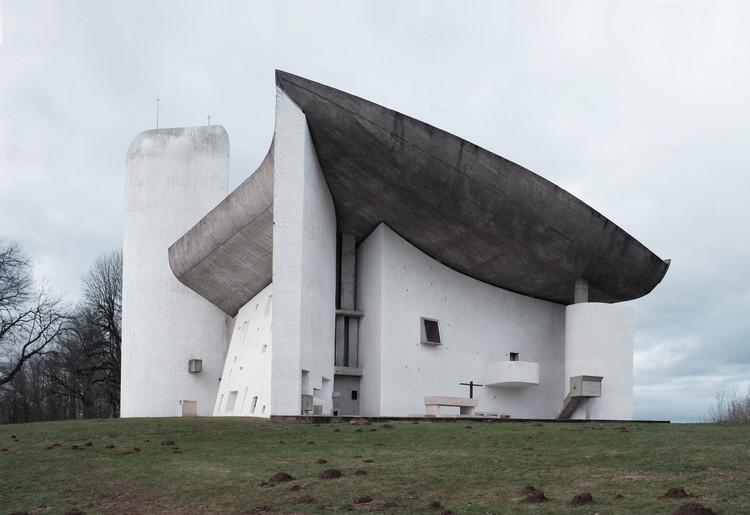
AD Classics: Ronchamp / Le Corbusier

© Cara Hyde-Basso

In the commune of Ronchamp, slightly south of east of Paris, sits one of ’s most unusual projects of his career, Notre Dame du Ronchamp, or more commonly referred to as Ronchamp.  In 1950, Le Corbusier was commissioned to design a new Catholic church to replace the previous church that had been destroyed during World War II.

The site of Ronchamp has long been a religious site of pilgrimage that was deeply rooted in Catholic tradition, but after World War II the church wanted a pure space void of extravagant detail and ornate religious figures unlike its predecessors.  Ronchamp is deceptively modern such that it does not appear as a part of Corbusier’s aesthetic or even that of the ; rather it sits in the site as a sculptural object.  The inability to categorize Ronchamp has made it one of the most important religious buildings of the 20th Century, as well as Corbusier’s career.

AD Classics: Villa Savoye / Le Corbusier

© Flavio Bragaia

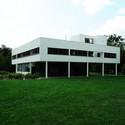
Situated in Poissy, a small commune outside of , is one of the most significant contributions to modern architecture in the 20th century, Villa Savoye by Le Corbusier.  Completed in 1929, Villa Savoye is a modern take on a French country house that celebrates and reacts to the new machine age.  The house single handedly transformed Le Corbusier’s career as well as the principles of the ; becoming one of the most important architectural precedents in the history.  Villa Savoye’s detachment from its physical context lends its design to be contextually integrated into the mechanistic/industrial context of the early 20th century, conceptually defining the house as a mechanized entity.

AD Classics: Indian Institute of Management / Louis Kahn

© Dave Morris

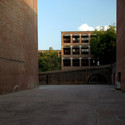
While was designing the National Assembly Building in Bangladesh in 1962, he was approached by an admiring Indian architect, Balkrishna Doshi, to design the 60 acre campus for the Indian Institute of Management in Ahmedabad, India.  Much like his project in Bangladesh, he was faced with a culture enamored in tradition, as well as an arid desert climate.  For Kahn, the design of the institute was more than just efficient spatial planning of the classrooms; he began to question the design of the infrastructure where the classroom was just the first phase of learning for the students.