Los Angeles is often portrayed as the example of the car-friendly city. The traditional image of the town is an endless pattern of single family dwellings, interconnected by traffic-clogged freeways, where transit is undeveloped and the air is choked with smog.
However, Los Angeles is changing. The city’s Transport Authority has planned in the last years a series of measures aiming to improve quality of life through improving transit and walking and providing alternative to car commuting.
The last measure of this series is Measure R, approved in November 2008, whose aims are:
Measure R is a perfect occasion to rethink the image of the city, getting rid of its stereotypes, and in this direction goes the competition “A New Infrastructure“, organized by SCIFI (Southern California Institute for Future Initiatives) and The Architect’s Newspaper, whose results have been published on March 21, 2009.
Here are the results.
Más is regional high-speed rail for Los Angeles with a landscape to match. It diversifies the communities in the built environment, making travel less necessary, easier and more predictable, and bypassing roadway congestion through a new raised infrastructure. A partnership between the public and private sectors creates varied opportunities for organic development.
Travel times improve over time with the addition of new trains. Más also links local and inter-regional commuting; providing frequent service that will sync up with the California High Speed Rail network. San Diego via más is less than an hour away, including transfer times; San Francisco is less than three hours away.

Recognizing the vital role that mobility, water, and sewage will play in Los Angeles’ future, the city must begin to invest in a core armature of new bundled infrastructures which will allow the city to survive the impending reality of peak water and peak oil.

The city must reorganize along the matrices of transportation, water and sewer networks, and grow infrastructural tentacles out into the world to ship and receive.

The scheme proposes eroding a portion of the freeway and supplanting it with a new object, mode, and form for adoration— Mag Luv.

The high speed magnetic levitation peripheral train appropriates freeway, right of way and “dream space” to become the mega structure of the Los Angeles transit system. The loop circumnavigates the city providing 12 hubs of activity, transportation, and power production.

The physical separations between places of work and play have become outdated and burdensome. Meanwhile the divide between commercial, residential, agricultural, and manufacturing zones have become so exaggerated that the infrastructures needed to connect and sustain them crumble in lack of upkeep and congestion.

In conjunction with newer, faster transit systems, this plan proposes a simple development strategy that collapses the distances between all the elements needed to support our lifestyles by suggesting that workplaces, as well as production of food and goods, be within walking distance.

In a car, the passenger can go from any given point to another in one continuous trip. To achieve this level of mobility in tandem with an increase in roadway capacity, we introduce a mass transit system based upon a Modular Transit Vehicle (MTV for short).
This modular system would allow passengers to (1) board from a wide range of street stops, (2) travel along the freeway, and (3) take the freeway exit closest to the destination drop passengers off there, all in one ride.

This team believes that Los Angeles need not invest in a “new” public transportation system but transform its existing transportation system of freeways into “trainways”.


By taking over “freeways” with rail tracks, a comprehensive expansion of the LA Metro will respond to the projects that are indicated in Measure R and will commence at a much lower cost due to taking advantage of the rights of ways established by the freeway.


A combination of rail, light-rail, smart cars, bike share, and different bus systems will provide easy connection in and between cities. Multiple vehicle types provide users with choices among combinations of cost, comfort, and functionality.

A commuter might choose to ride the train to work, pick up a smart car to attend a meeting, go to the gym, pick up groceries before going back home.

In creating a dense commercial and residential environment to support and foster the inevitable expansion of the transit system, the scheme also investigates alternative development strategies that are adaptable to the ever changing conditions of our urban culture.


This scheme created green tech districts along the Westside expansion corridor stretching from downtown to Santa Monica.

The plan likened itself to a living organism, including a Skeletal System composed of new green districts between stations; a respiratory system that included a 2.5 mile green park along the length of the transit system; and tendons, which were linkages to the community, like freeway bridges, human-scaled densities, walkability plans, urban parks, and agricultural zones.


In 2000, LA Metro gambled that it could increase both ridership and transit efficiency by making a bus a little more like a subway: The Metro Rapid. Mixed-modal goes even further to suggest that any bus has the potential to go “local,” “rapid” or “express” at coordinated points along its route to flexibly serve transit demand.
A bus may go “express” by entering grade-separated express lanes shared with planned or existing rail modes, with the help of new friction-less electric power-transfer technologies and hybrid rail/road drive surfaces.

The Mixed-modal project offers a vision of what the Expo line might look like if it operated as the “trunk” of a regional transit tree with “branches” extending up and down existing Metro Rapid lines.

If we are to develop along a freeway we need to keep in mind that the surrounding residential neighborhoods need to access the train in a way that encourages a shift away from car dependency.


This entry proposes a string of micro-scale infill developments along a bus line that feeds into the Eastside Transit Corridor.

Positioned along newly developed commercial corridors, stops have waiting rooms that store bikes, serve as markets, and create a center of community.


This scheme proposes a a reconsideration of the existing freeway corridor as a multi-function transit corridor. The existing freeway would be retrofitted with a new structure above that over a series of stages adds layers of public and environmental friendly transit options.
As this second tier becomes more populated, greenscaping is added, converting the freeway corridor into a vibrant public space.

Los Angeles’ current subway network relies too much on a centralized spoke network approach. A more effective subway system should also include cross-linkages. This subway design project looks to develop a new cross-link between the existing red line (which connect Hollywood and Downtown) and the future purple Westside Extension line.


The proposed connecting line would add three new stops: the first at Santa Monica Blvd. and Highland Ave, the second at Santa Monica and Fairfax and the third at La Cienega. The connecting point to the red line would be at Hollywood and Highland, and the connecting point to the future purple line would be located at the Beverly Center.

This project takes advantage of LA’s polycentric character, developing a grid of multimodal transit systems, articulated on different levels within the existing city. On the scale of the city, the plan proposes a Free Car Transport System, on the model of free bike systems largely developed in Europe today. Electric cars will be available for hire throughout the city.

Other proposals include Smooth Jumps over Motorways: stations that combine the urban proposal of green park links between the two sides of the freeways by building a station over them, and containing contain carparks, commerce, Free Car and Free Bike stations.

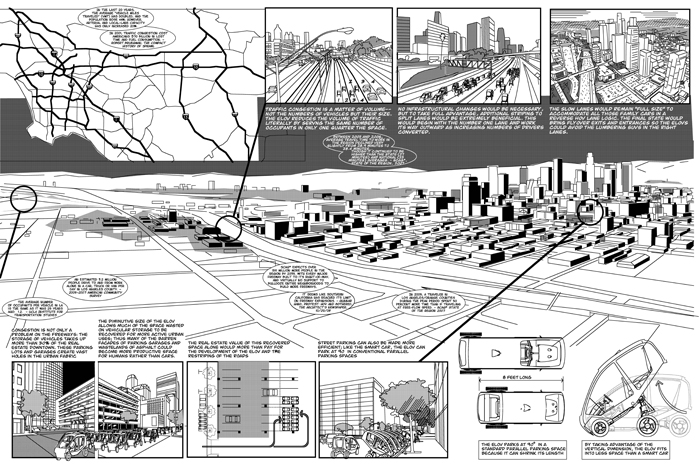
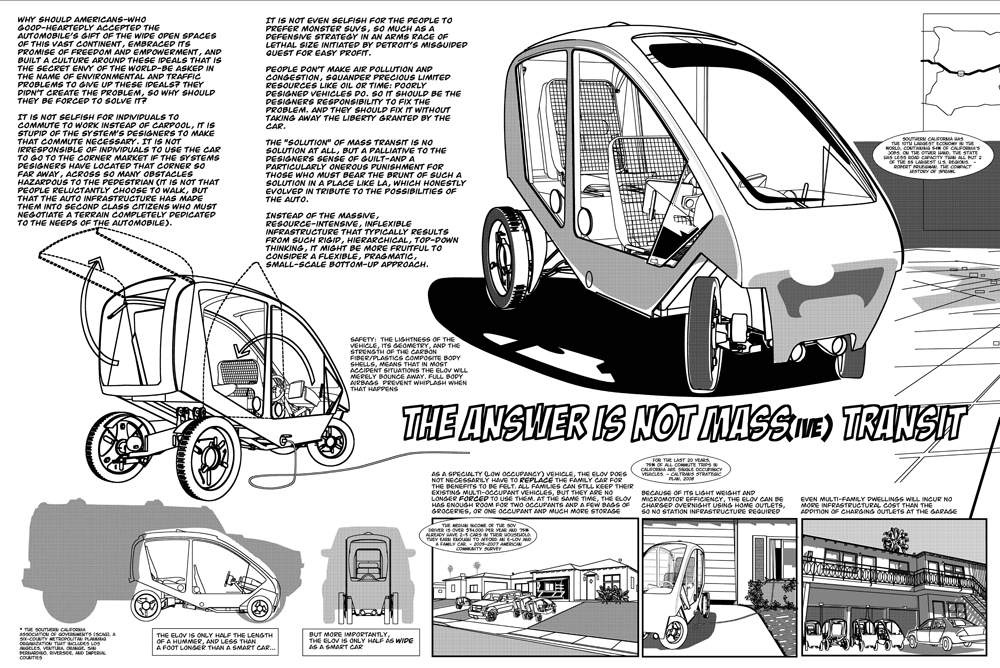
Instead of the massive, resource-intensive, and inflexible infrastructure that results from top-down approaches to planning, this proposal argues, why not consider a flexible, pragmatic, small-scale, bottom-up approach?
Introducing the Elov, a small, pod-like vehicle that fits into less space than a smart car and reduces the volume of traffic by serving the same number of occupants in only one quarter of the space. Because of its light weight and micromotor efficiency, the Elov can be charged overnight using home outlets, further reducing the required infrastructure.